**The Secret Beneath Ray’s Fishing Boat**
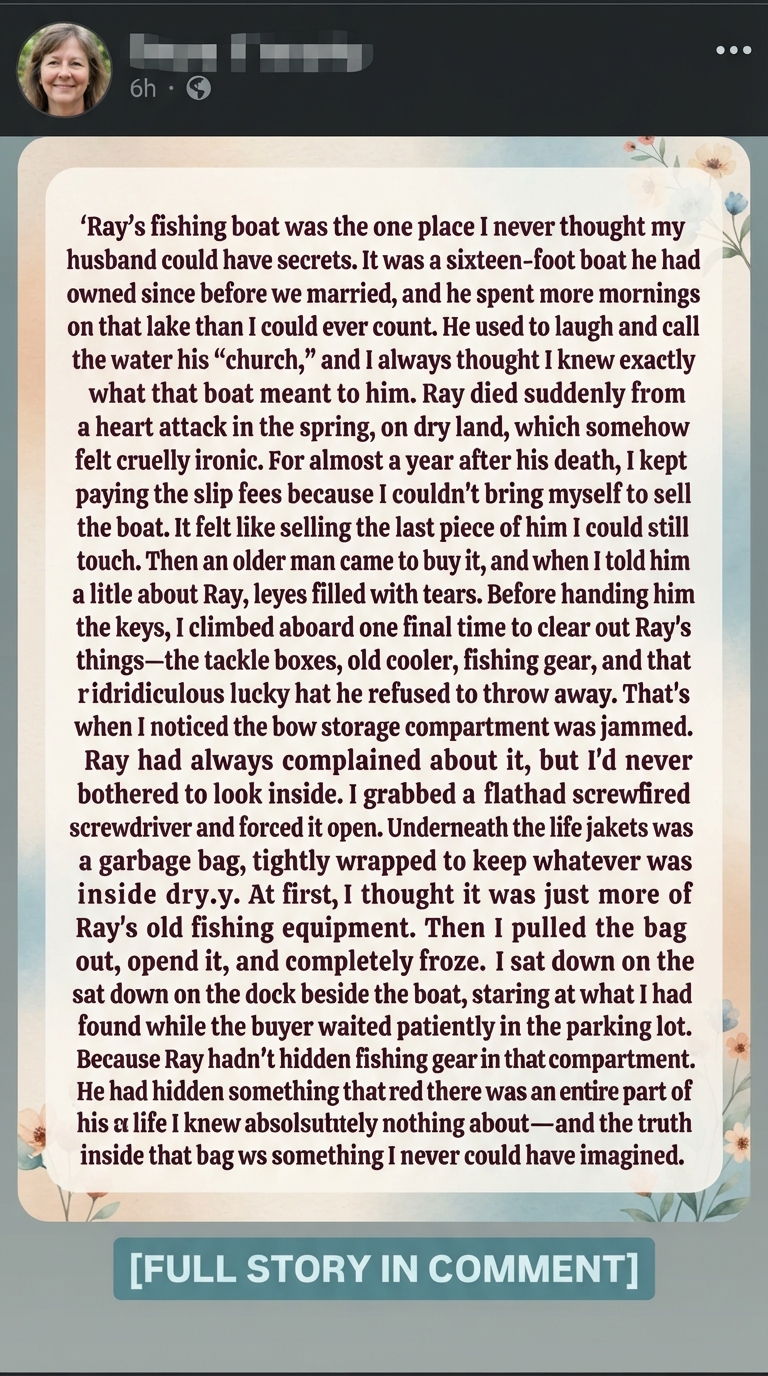
Ray’s fishing boat was the one place I never thought my husband could have secrets.
It was a sixteen-foot boat he had owned since before we married, and he spent more mornings on that lake than I could ever count. He used to laugh and call the water his “church,” and I always thought I knew exactly what that boat meant to him.
Ray died suddenly from a heart attack in the spring, on dry land, which somehow felt cruelly ironic.
For almost a year after his death, I kept paying the slip fees because I couldn’t bring myself to sell the boat. It felt like selling the last piece of him I could still touch.
Then an older man came to buy it.
When I told him a little about Ray, his eyes filled with tears.
Before handing him the keys, I climbed aboard one final time to clear out Ray’s things—the tackle boxes, old cooler, fishing gear, and that ridiculous lucky hat he refused to throw away.
That’s when I noticed the bow storage compartment was jammed.
Ray had always complained about it, but I’d never bothered to look inside.
I grabbed a flathead screwdriver and forced it open.
Underneath the life jackets was a garbage bag, tightly wrapped to keep whatever was inside dry.
At first, I thought it was just more of Ray’s old fishing equipment.
Then I pulled the bag out, opened it, and completely froze.
I sat down on the dock beside the boat, staring at what I had found while the buyer waited patiently in the parking lot.
Because Ray hadn’t hidden fishing gear in that compartment.
He had hidden photographs.
Dozens of them.
Old photographs, some faded nearly white around the edges.
There were pictures of Ray standing beside a small wooden house.
Pictures of a little girl.
Pictures of a woman I had never seen before.
And then I found one that made my hands start shaking.
Ray was holding the little girl in his arms.
Written on the back in his handwriting were four words:
**“My daughter, Emily. 2003.”**
I couldn’t breathe.
I turned the photograph over again.
Then back.
Then over again.
As if the words might somehow change.
Emily.
My husband had a daughter.
A daughter I had never heard of.
We had been married for twenty-nine years.
Twenty-nine years.
I thought about every birthday, every Christmas, every anniversary. Every time Ray had complained that we were spending too much money. Every time he had insisted we take a particular route when we traveled near the lake.
And suddenly, memories that had once seemed insignificant began rearranging themselves in my mind.
The unexplained trips.
The envelopes of cash he sometimes kept in his desk.
The phone calls he would take outside.
The way he always became strangely quiet whenever anyone asked him about his family before me.
I had always assumed he simply didn’t like talking about the past.
Now I wondered what else he had been hiding.
I emptied the bag onto the dock.
There were letters.
Bank statements.
A hospital bracelet.
A child’s drawing.
And a small silver bracelet engraved with the name **Emily**.
I opened the first letter.
It was dated seventeen years earlier.
*Ray,*
*I know you said you need more time. But Emily is asking about you again. She keeps drawing pictures of a man fishing on a lake. She says that’s where her daddy lives.*
I stopped reading.
My vision blurred.
There were at least twenty letters from the same woman.
Her name was Claire.
The letters told a story that was nothing like the one I had spent my entire marriage believing.
Ray hadn’t abandoned Claire and Emily.
He had been sending money.
Paying medical bills.
Buying school supplies.
Sending birthday presents.
But he had never told them where he lived.
And he had never brought them into our life.
I found a bank statement showing regular transfers to an account under Claire’s name.
Then another.
Then another.
For almost twenty years.
My first reaction was anger.
Not sadness.
Not understanding.
Anger.
I wanted to scream at him.
I wanted to throw every photograph into the lake.
How could he lie to me for twenty-nine years?
How could he have an entire family somewhere else while coming home every night and kissing me goodnight?
I was so consumed by rage that I almost missed the folded piece of paper at the bottom of the bag.
It was different from the others.
It wasn’t a letter from Claire.
It was Ray’s handwriting.
The date was only six months before his death.
I unfolded it.
There were only a few sentences.
*If you’re reading this, then I never found the courage to tell you myself.*
*Emily is my daughter.*
*But the secret is not what you think.*
I read that sentence three times.
Then I continued.
*I met Claire before I met you. We were young. She was pregnant when we separated. I wanted to marry her, but her father threatened to destroy both of our families if I stayed. I made a terrible choice. I walked away.*
*Years later, I found her again.*
*By then, you and I were married.*
*Emily knew I was her father, but Claire asked me never to reveal myself publicly because Emily was being raised by another man who had become her real father.*
My heart sank.
I kept reading.
*I never wanted to steal the place of the man who raised her.*
*So I became the man behind the curtain.*
*I paid what I could. I helped when she needed me. I watched from a distance.*
*And every time she called me “Mr. Ray,” I pretended it didn’t break my heart.*
I had to stop.
The lake was perfectly still.
I could hear birds in the trees behind me.
For almost a year, I had thought I was grieving the man I knew.
Now I wasn’t sure who I was grieving at all.
The buyer finally walked over.
“Ma’am?”
I quickly folded the letter.
“I need a little more time.”
He looked at my face and nodded.
“Take all the time you need.”
He walked back toward his truck.
I stayed there for another hour.
Then I drove home with the bag sitting on the passenger seat.
That night, I didn’t sleep.
I searched through Ray’s office.
His desk.
His closet.
Old filing cabinets.
I found nothing.
Then I remembered something.
Ray had always kept a small black notebook in the boat.
He called it his “fishing log.”
I found it beneath a stack of old magazines in our garage.
Inside were dates, weather conditions, fishing spots and notes about the lake.
But toward the back, the entries changed.
They weren’t about fishing.
They were about Emily.
*Emily’s first day of college.*
*Emily got the scholarship.*
*Emily’s graduation.*
*Emily’s mother is sick.*
*Emily got married.*
Then, near the end:
*Emily had a baby girl today.*
I stared at the page.
Ray had written the baby’s name.
**Sophie.**
My husband’s granddaughter.
A child I had never known existed.
I spent the next morning trying to find Claire.
It took hours.
Eventually, I found an obituary from three years earlier.
Claire had died from cancer.
The obituary listed one daughter.
Emily.
There was an address.
I drove there.
I nearly turned around twice.
What was I going to say?
Hello, I’m the wife of the father you never got to have?
I sat in my car for twenty minutes before finally knocking.
A woman opened the door.
She was probably in her early thirties.
Dark hair.
Green eyes.
And when she looked at me, I saw Ray.
Not just a resemblance.
Ray’s expression.
His smile.
His eyes.
She stared at me.
“Can I help you?”
My throat tightened.
“My name is Linda.”
She looked confused.
“I was married to a man named Ray.”
Her face changed instantly.
She opened the door wider.
“You’re Linda?”
I nodded.
She whispered, “He told me about you.”
I almost collapsed.
“You knew?”
She looked toward the hallway.
“Not at first. I found out when I was eighteen.”
“Why didn’t you ever contact me?”
She looked down.
“Because Dad begged me not to.”
Dad.
She called him Dad.
I felt something crack inside me.
“He said you didn’t know about me,” she continued.
“I didn’t.”
She studied my face.
“I thought he was protecting you.”
“From what?”
She hesitated.
“From knowing what kind of man he thought he was.”
She led me into the kitchen.
On the wall were photographs.
Emily as a child.
Emily graduating.
Emily getting married.
And in the corner was a photograph of Ray standing beside a young Emily.
I stared at it.
“You kept it.”
“Of course.”
She sat across from me.
“He came to every important moment.”
“Without me knowing.”
She nodded.
Then she said something I will never forget.
“He wasn’t ashamed of you.”
I looked at her.
“He talked about you all the time.”
That hurt more than anything.
“He said you were the best thing that ever happened to him.”
“Then why didn’t he tell me?”
Emily’s eyes filled with tears.
“Because he was afraid you would hate him.”
I laughed bitterly.
“He was right.”
She nodded.
“I know.”
We sat in silence.
Then Emily reached into a drawer.
She pulled out a small envelope.
“He gave me this six months before he died.”
My heart stopped.
“You knew he was sick?”
“No. He told me he wasn’t expecting to live much longer.”
“He had a heart condition?”
She shook her head.
“He said he just had a feeling.”
She handed me the envelope.
My name was written across the front.
**Linda.**
I opened it with trembling hands.
Inside was a letter.
*Linda,*
*If you are reading this, then I’m gone, and I’m sorry.*
*I’m sorry for the secret.*
*I’m sorry for every time I chose silence.*
*But I need you to know something.*
*I never loved anyone the way I loved you.*
*Emily was my daughter, but you were my life.*
*I didn’t keep Emily from you because I loved her more.*
*I kept her separate because I was terrified that the truth would destroy the only family I had left.*
*Maybe that was selfish.*
*Maybe I should have trusted you.*
*Maybe I should have told you twenty years ago.*
*I will regret that until the day I die.*
*But there is one thing I don’t regret.*
*Every dollar I sent.*
*Every birthday I remembered.*
*Every night I drove to that lake and sat alone because it was the only place where I could be honest with myself.*
*The lake wasn’t my church because of the fishing.*
*It was where I prayed for forgiveness.*
I couldn’t read anymore.
I pressed the letter against my chest and cried.
Not the quiet tears I had cried since his funeral.
These were the kind that came from somewhere deeper.
The kind that hurt.
Emily reached across the table and took my hand.
“I hated him for keeping you away from us,” she whispered.
I looked at her.
“And now?”
She smiled sadly.
“Now I think he was just a scared man who made one terrible decision and spent the rest of his life trying to make it right.”
I stayed at Emily’s house until sunset.
Before I left, she gave me one more thing.
A photograph.
It showed Ray standing on his fishing boat.
He was laughing.
Behind him, on the dock, stood a teenage girl.
Emily.
The photograph had been taken almost twenty years ago.
On the back, Ray had written:
**“The happiest day I was never allowed to talk about.”**
I brought the photograph home.
For the first time since Ray died, I went back to the lake.
The boat was gone.
The buyer had taken it the following week.
I stood at the empty slip and listened to the water.
I finally understood why Ray had loved that place so much.
It wasn’t just where he went fishing.
It was where he carried the parts of himself he was too afraid to bring home.
I wish I could say I forgave him immediately.
I didn’t.
Forgiveness isn’t a switch.
It came slowly.
In pieces.
Some days I was angry.
Other days I missed him so badly that I would have given anything to hear his voice.
But eventually, I stopped asking myself why he had kept the secret.
I started asking myself what he had done with the years he had left.
And the answer was complicated.
He had made a terrible mistake.
But he had spent decades trying to protect two families from the consequences of it.
Maybe that didn’t excuse the lie.
But it helped me understand the man behind it.
A few months later, Emily invited me to her daughter’s birthday.
Sophie was turning five.
When I arrived, Emily handed me a small gift.
“From Grandpa,” she said.
Inside was a tiny wooden fishing lure.
Ray had apparently bought it years before.
I started crying.
Emily hugged me.
“Mom would have liked you,” she whispered.
I hugged her back.
“I think I would have liked her too.”
That evening, Sophie sat beside me and asked about the man in the photographs.
“Was Grandpa a good fisherman?”
I smiled through my tears.
“He thought he was.”
She laughed.
“Was he?”
I looked at the little girl.
Then at Emily.
Then at the photograph of Ray hanging on the wall.
“He was a good man,” I said.
“He just wasn’t always brave enough to be honest.”
Sophie thought about that.
Then she nodded like she understood something far beyond her years.
Before I left, Emily gave me a key.
“What is this?”
“The boat key.”
I stared at it.
“The boat is gone,” she said. “But Dad made a copy before he died.”
I turned the key over in my hand.
On the back, engraved in tiny letters, were the words:
**“For Linda, when she’s ready.”**
I never learned what he meant by that.
Maybe he wanted me to keep it.
Maybe he thought someday I’d understand.
Maybe it was simply his final attempt to leave me something from the place where he had hidden his deepest secret.
Whatever it was, I keep that key in my jewelry box.
Not because I want to hold on to the lie.
But because I want to remember the truth.
People are rarely only one thing.
Ray was a loving husband.
A secretive father.
A flawed man.
A generous stranger.
A frightened coward.
And, somehow, all of those things could be true at the same time.
I still visit the lake every spring.
I sit on the dock where I first opened that garbage bag.
Sometimes I bring flowers.
Sometimes I bring nothing.
I just sit there and listen to the water.
And whenever the sun begins to disappear behind the trees, I think about Ray.
I think about the life he showed me.
And the life he hid.
Then I remind myself of something I’ve learned since he died:
**The hardest secrets aren’t always the ones that destroy a marriage.**
**Sometimes they’re the ones people carry because they’re too afraid that the truth will destroy everyone they love.**
I don’t know if Ray ever found forgiveness.
But after all these years, I think I finally found mine.
And when I leave the lake, I always whisper the same thing:
“Go rest, Ray. Your church is quiet now.”
Then I walk home carrying the little boat key in my pocket.
