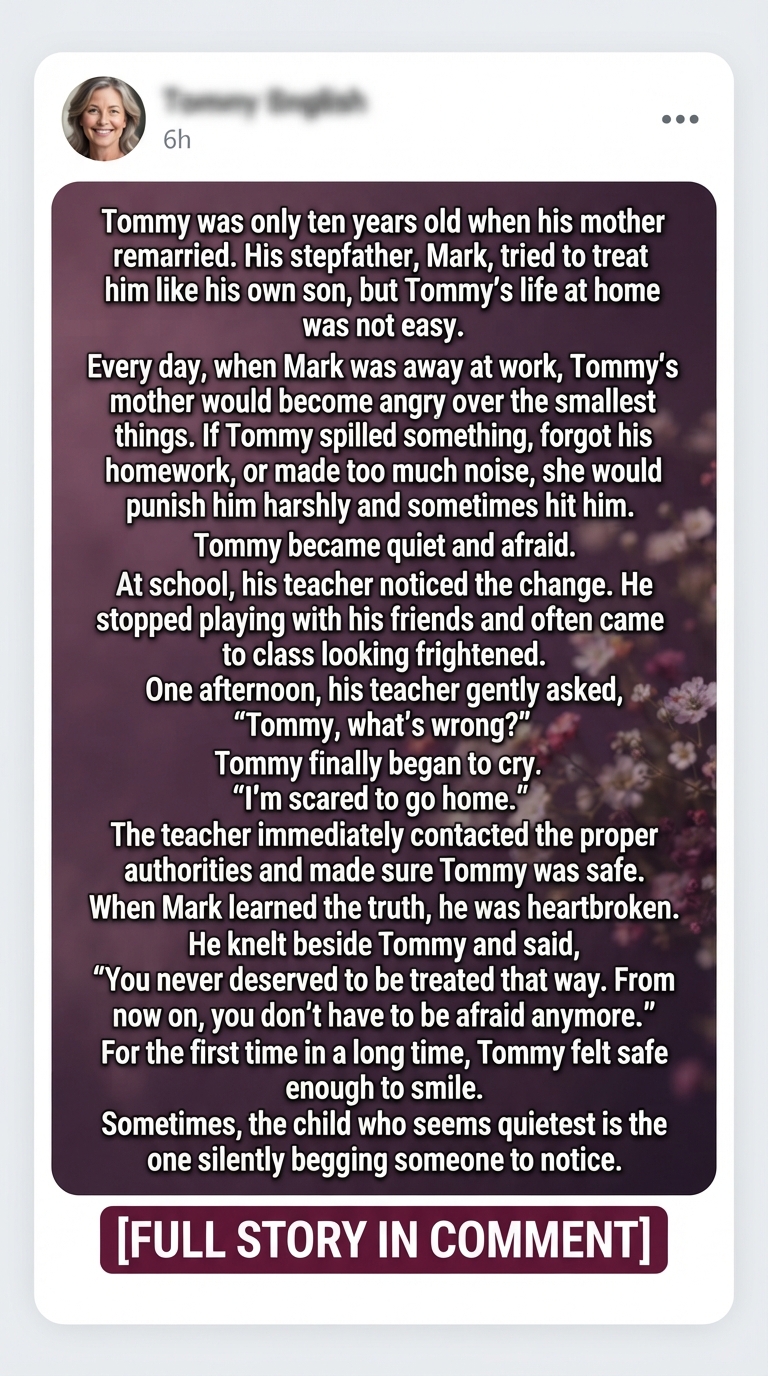
Tommy was only ten years old when his father remarried.
His biological mother had passed away when he was very young, so when his father married Sarah, Tommy hoped he would finally have someone who would care for him like a mother.
At first, Sarah was kind.
She bought Tommy new clothes, helped him with his homework, and told everyone that she loved him.
Tommy believed her.
But after a few months, everything changed.
Sarah became angry over the smallest things.
If Tommy left a toy on the floor, she would scream at him.
If he spilled a glass of water, she would punish him.
If he came home a few minutes late from school, she would accuse him of being disrespectful.
Sometimes, when his father was at work, Sarah would hit him.
Tommy never told his father.
Whenever his father came home, Sarah acted like everything was normal.
“He was naughty today,” she would say.
Tommy would lower his head and stay quiet.
His father believed her.
As the months passed, Tommy became more frightened.
He stopped asking for new toys.
He stopped talking at dinner.
He even started apologizing for things that weren’t his fault.
One evening, Tommy accidentally dropped a plate while helping in the kitchen.
The plate shattered on the floor.
Sarah became furious.
“You can’t do anything right!”
Tommy immediately began crying.
“I’m sorry. I’ll clean it up.”
But Sarah grabbed his arm roughly.
“Stop crying!”
Tommy tried to pull away.
At that moment, the front door opened.
His father had come home earlier than expected.
Sarah immediately stepped back.
“What happened?” Tommy’s father asked.
“Nothing,” Sarah replied quickly. “He dropped a plate and started acting dramatic.”
Tommy looked at his father.
For a moment, he wanted to tell him everything.
But he was afraid.
He simply whispered,
“I’m okay.”
His father believed him.
That night, Tommy went to his bedroom and cried quietly under his blanket.
The next morning, his teacher noticed that Tommy was unusually quiet.
Normally, he was a cheerful child who loved drawing and playing with his classmates.
But now he rarely smiled.
He often sat alone.
His teacher, Mrs. Anderson, gently asked,
“Tommy, are you feeling okay?”
Tommy nodded.
“Yes.”
“Are you sure?”
He nodded again.
But his eyes filled with tears.
Mrs. Anderson didn’t pressure him.
She simply said,
“You can talk to me whenever you’re ready. You won’t be in trouble.”
Those words stayed in Tommy’s mind all day.
A few days later, Tommy accidentally dropped his pencil case.
A classmate reached down to help him.
Tommy suddenly flinched and covered his head with his arms.
Mrs. Anderson saw it.
She immediately understood that something was wrong.
After class, she asked Tommy to stay for a few minutes.
She closed the door and sat beside him.
“You don’t have to be afraid of me.”
Tommy looked at the floor.
Then he whispered,
“Please don’t call my mom.”
Mrs. Anderson’s heart sank.
“Why?”
Tommy began crying.
“She gets angry all the time.”
He finally told her everything.
He explained how Sarah would yell at him, punish him, and hurt him whenever his father was away.
Mrs. Anderson listened carefully.
She told Tommy that what was happening was not his fault.
“You didn’t do anything to deserve being hurt.”
Tommy wiped his tears.
“But she’s my mom.”
Mrs. Anderson gently replied,
“Being a parent means protecting a child, not hurting one.”
The school followed the appropriate child-protection procedures and contacted the proper authorities.
Tommy was interviewed by professionals who helped make sure he was safe.
Eventually, his father learned the truth.
He was devastated.
He remembered every time Tommy had said, “I’m okay.”
Every time Tommy had avoided eye contact.
Every time he had suddenly become silent when Sarah entered the room.
His father realized he had mistaken Tommy’s fear for obedience.
When he finally sat down with his son, he was crying.
“Tommy, I’m so sorry.”
Tommy looked at him.
“I tried to tell you.”
His father lowered his head.
“I know. I should have listened.”
Tommy began crying too.
His father hugged him gently.
[8/15/2026 9:46 AM] ម្ហូប ពិសេស: “You are not responsible for what happened. None of it was your fault.”
The family situation was then handled through the appropriate authorities and courts, with Tommy’s safety placed first.
Tommy eventually moved to a safe environment where he could receive support and begin healing.
For the first few weeks, he still woke up frightened during the night.
He apologized whenever he made a small mistake.
He was afraid adults would become angry with him.
But slowly, things changed.
His counselor taught him that he didn’t have to live in fear.
His teacher encouraged him to draw again.
And his father worked hard to rebuild the trust he had lost.
One afternoon, Tommy came home from school carrying a drawing.
It showed a small house surrounded by trees.
His father looked at it and smiled.
“What’s this?”
Tommy pointed at the picture.
“It’s my new home.”
His father looked carefully.
There was something different about the drawing.
There were no dark clouds.
There were no tears.
There was a bright sun above the house.
His father hugged him.
“I like it.”
Tommy smiled.
“Me too.”
For the first time in a long time, Tommy wasn’t afraid to smile.
He finally understood that his childhood wasn’t supposed to be filled with fear and silence.
And his father learned a painful lesson he would never forget:
Sometimes a child doesn’t say, “I’m being hurt.”
Sometimes they simply become quiet, stop smiling, and keep saying, “I’m okay.”
That is why adults must learn to notice the silence.
