The Jars They Thought Were Worthless
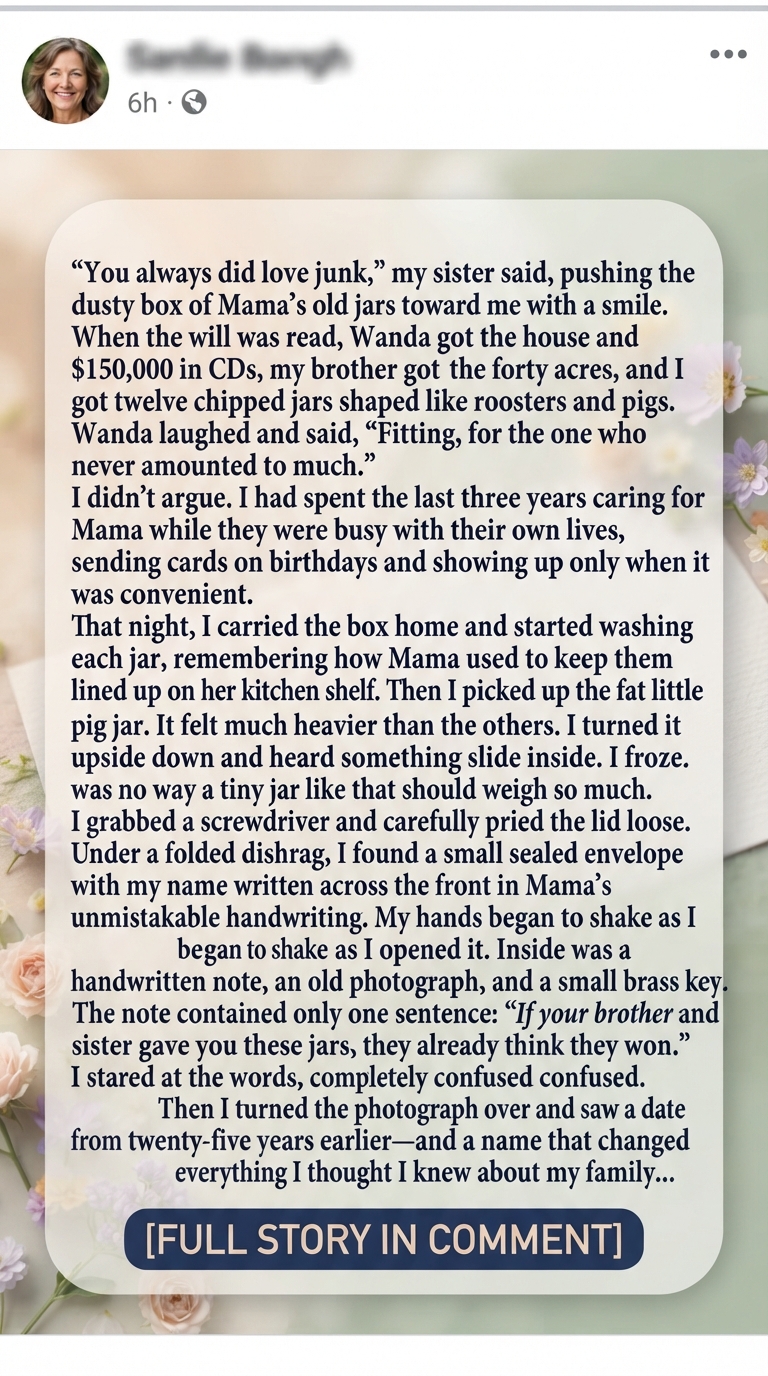
“You always did love junk,” my sister said, pushing the dusty box of Mama’s old jars toward me with a smile.
When the will was read, Wanda got the house and $150,000 in CDs, my brother got the forty acres, and I got twelve chipped jars shaped like roosters and pigs.
Wanda laughed and said, “Fitting, for the one who never amounted to much.”
I didn’t argue.
I had spent the last three years caring for Mama while they were busy with their own lives, sending cards on birthdays and showing up only when it was convenient.
That night, I carried the box home and started washing each jar, remembering how Mama used to keep them lined up on her kitchen shelf.
Then I picked up the fat little pig jar.
It felt much heavier than the others.
I turned it upside down and heard something slide inside.
I froze.
There was no way a tiny jar like that should weigh so much.
I grabbed a screwdriver and carefully pried the lid loose.
Under a folded dishrag, I found a small sealed envelope with my name written across the front in Mama’s unmistakable handwriting.
My hands began to shake as I opened it.
Inside was a handwritten note, an old photograph, and a small brass key.
The note contained only one sentence:
**“If your brother and sister gave you these jars, they already think they won.”**
I stared at the words, completely confused.
Then I turned the photograph over.
There was a date from twenty-five years earlier.
And beneath it was a name that changed everything I thought I knew about my family.
**Evelyn Carter.**
My mother’s maiden name.
I looked at the photograph again.
It showed Mama standing beside a younger man I had never seen before.
The man was holding a little boy.
The little boy was me.
My heart stopped.
I had been told my entire life that my father had abandoned us when I was two years old.
Mama rarely spoke about him.
Whenever I asked, she would simply say, “Some people leave because staying would hurt you more.”
But the man in that photograph wasn’t a stranger.
He was my father.
And he was standing in front of a building I recognized immediately.
The old Carter Mill.
The same mill that had been closed for decades.
I turned the photograph over again.
Written underneath the date were five words:
**“The key opens what remains.”**
I stared at the brass key in my palm.
For years, Wanda and my brother had told me I was the least important person in the family.
The one who didn’t go to college.
The one who stayed home.
The one who took care of Mama.
The one who never “amounted to much.”
But suddenly, I wondered if there had been another reason Mama had always treated me differently.
Maybe she had been protecting me.
The next morning, I drove to the old mill.
The building looked exactly as I remembered it from childhood, although I hadn’t been there in more than twenty years.
The windows were broken.
Vines covered the walls.
A rusted sign hung crookedly above the entrance.
I walked around the back and found a small metal door almost hidden beneath the weeds.
There was a brass lock.
My hands trembled as I inserted the key.
It turned.
Inside was a narrow storage room.
There were no boxes of money.
No jewelry.
No secret treasure.
At first, I thought I had come all that way for nothing.
Then I noticed a wooden filing cabinet.
One drawer was locked.
The brass key fit that lock too.
Inside were documents.
Dozens of them.
Property records.
Bank statements.
Old contracts.
And finally, a letter addressed to Mama.
I unfolded it carefully.
It was from my father.
He explained everything.
The Carter family had owned the mill and nearly two hundred acres surrounding it.
When the mill began failing, my grandfather wanted to sell.
But my father believed the land was worth saving.
He had secretly negotiated with a development company that wanted to buy the property for a huge amount of money.
Then my father disappeared.
Not because he abandoned us.
Because someone in the family had threatened him.
The letter said he had discovered that his own brother had been stealing from the company and forging documents.
My father had planned to expose him.
But before he could, he was attacked and forced to leave town.
He had spent years trying to return.
But Mama had refused.
Not because she hated him.
Because she believed someone was still watching us.
At the bottom of the letter was something that made my knees weak.
A bank account number.
And the words:
**“The land was placed in your name the day you were born.”**
I sat down on the dusty floor.
The forty acres my brother had received from Mama’s will weren’t the entire property.
They were only part of it.
And according to the documents, the remaining land—including the old mill—belonged to me.
But why had Mama allowed Wanda and my brother to believe they had received everything?
I found the answer in another envelope.
This one was dated three years earlier.
It was written shortly after Mama became ill.
She had known she was dying.
She had also known that Wanda and my brother had been pressuring her to change her will.
Mama wrote:
**“They believe money is the only thing worth inheriting. Let them have what they can see.”**
I began to cry.
She continued:
**“The jars are not worthless. They are the first lesson I ever gave you. You always looked for value where other people didn’t. That is why I knew you would find this.”**
I covered my mouth.
Mama had known.
She had known exactly what would happen.
She had known Wanda would laugh.
She had known my brother would take the land.
And she had known I would wash those old jars instead of throwing them away.
The twelve jars weren’t random.
They were clues.
I went home and examined every single one.
Inside each jar was something hidden.
A key.
A document.
A photograph.
A receipt.
A bank number.
A piece of the truth.
By the end of the night, I had discovered that Mama had quietly built a small investment company decades earlier using money she had inherited from her parents.
She had bought pieces of farmland.
She had invested in local businesses.
She had purchased mineral rights beneath part of the Carter property.
And over the years, the value had grown far beyond anything my siblings could imagine.
The old mill property alone was worth millions because a major company had recently begun looking for land in that exact area.
Mama had known.
She had been negotiating privately before she died.
But she hadn’t wanted to give that money to people who only showed up when there was something to inherit.
She wanted to give me something more important.
A chance to understand my own worth.
Three weeks after the funeral, Wanda came to my house.
She was furious.
“You’ve been hiding something,” she said.
I looked at her calmly.
“What makes you think that?”
She slammed a folder onto my kitchen table.
“The developer contacted us. They said the old mill property isn’t ours.”
I said nothing.
My brother walked in behind her.
“You knew,” he said.
“No,” I replied. “Mama knew.”
Wanda’s face changed.
“What did she leave you?”
I looked at the box of jars sitting on the counter.
“She left me the truth.”
My brother laughed bitterly.
“You always were Mama’s favorite.”
For the first time in my life, I didn’t feel guilty hearing those words.
“I wasn’t her favorite,” I said quietly. “I was the one who stayed.”
The room went silent.
I told them about the documents.
About my father’s letter.
About the property.
About the investments.
And finally, I told them the part they least expected.
The land was mine.
Legally.
Completely.
There was nothing they could do about it.
Wanda started crying.
She said Mama had promised her the house.
She said she deserved more.
My brother argued that he had worked hard for the forty acres.
I listened.
Then I remembered something.
For three years, while Mama was sick, Wanda had visited only twice.
My brother had come once.
I had been there every morning.
Every night.
Every doctor’s appointment.
Every sleepless night.
Every meal.
Every bath.
Every moment when Mama forgot where she was and needed someone to hold her hand.
I didn’t do those things because I expected an inheritance.
I did them because she was my mother.
So I told them something Mama had taught me long ago.
“Being family isn’t about what you get when someone dies.”
“It’s about what you’re willing to give while they’re alive.”
Neither of them answered.
Months passed.
The developer eventually purchased the old mill property from me for an amount large enough to change my life.
But I didn’t buy a mansion.
I didn’t buy an expensive car.
I didn’t spend my days proving Wanda wrong.
Instead, I restored Mama’s old house.
Then I turned part of the property into a small community center and scholarship fund.
I used some of the money to help children whose parents couldn’t afford college.
I also restored the old kitchen exactly the way Mama had kept it.
And on the shelf, I placed all twelve jars.
Even the chipped ones.
Especially the chipped ones.
One afternoon, I found myself standing in front of the little pig jar again.
I smiled.
Inside it, I had placed Mama’s photograph and her original note.
Not because I needed to hide them.
But because I wanted to remember the lesson.
People had looked at those jars and seen junk.
Wanda had seen something embarrassing.
My brother had seen something worthless.
I had seen memories.
Mama had seen a key to the future.
And sometimes, that’s the difference between losing everything and discovering that you were never poor at all.
A year after Mama died, I received a letter from a man in another state.
He introduced himself as my father’s cousin.
He had found my name through the old property records.
He told me my father had died several years earlier.
He had never stopped looking for a way back to us.
The letter contained one final photograph.
It showed my father standing outside a small house, holding a little boy who looked exactly like me.
On the back were six words:
**“He talked about you every day.”**
I cried for a long time.
Not because I had lost him.
But because I finally understood that he had never truly chosen to leave me.
Mama had protected me in the only way she knew how.
Maybe she had made mistakes.
Maybe she had kept too many secrets.
But in the end, she had left me something far greater than money.
She had left me the truth.
And she had taught me something I would never forget:
Never let someone convince you that your life has no value simply because they can’t see what you’ve built.
Wanda thought she had won when she handed me those twelve chipped jars.
She was right about one thing.
I did love them.
But she was wrong about why.
I didn’t love those jars because they were valuable.
I loved them because they carried the last secret my mother had trusted me to find.
And every time I looked at them, I remembered the woman who had spent her final years quietly watching, waiting, and believing that one day I would finally understand.
The day I did, I stopped wondering why Mama had left me “junk.”
Because the greatest inheritance she gave me had never been inside the jars.
It had been inside me all along.
