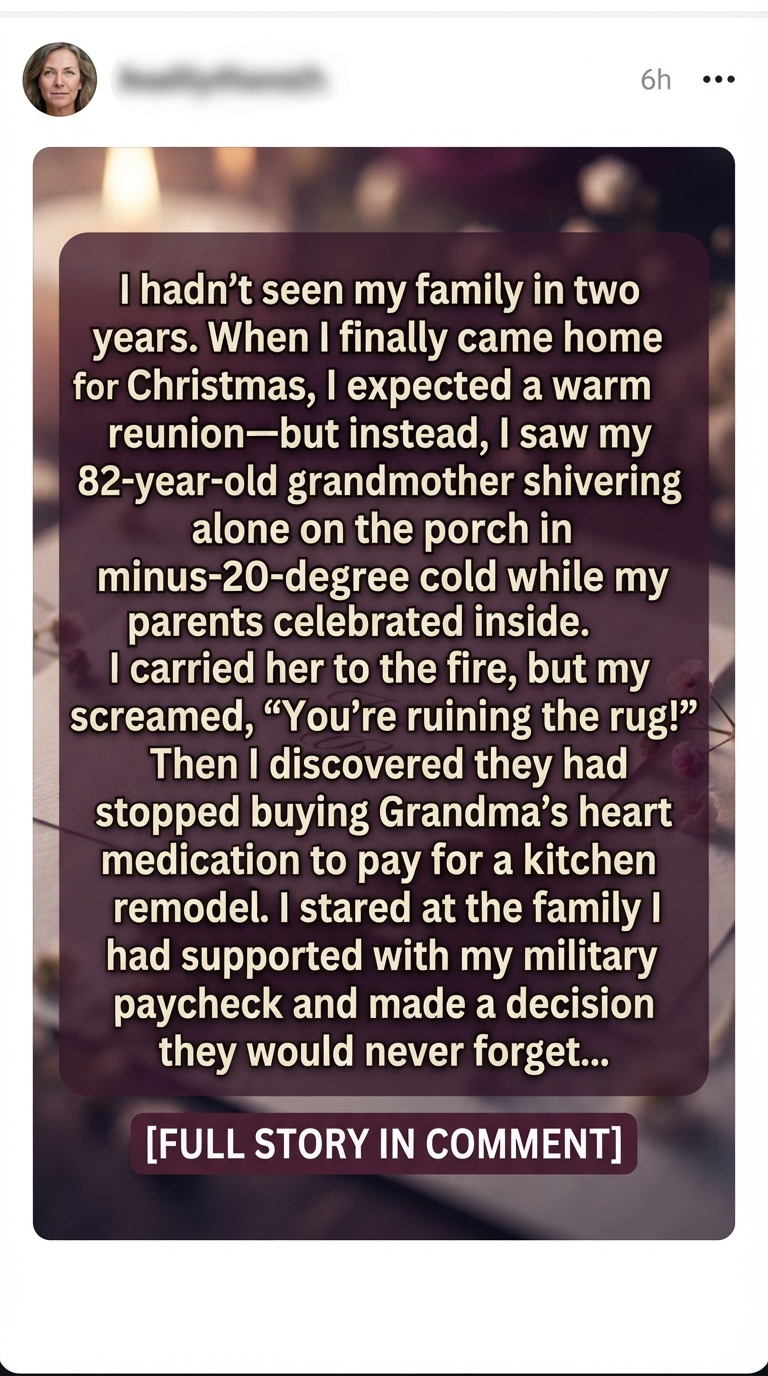
The Christmas I Chose Grandma
I hadn’t seen my family in two years.
Two years of missed birthdays, unanswered calls, and Christmases spent thousands of miles away because I was serving in the military. I told myself the distance was temporary. I believed that when I finally came home, everything would feel the way it used to.
Warm.
Safe.
Like family.
So when my leave was approved just before Christmas, I packed my bags without hesitation.
I even bought presents for everyone.
For my father, a new watch.
For my mother, an expensive perfume she had mentioned months earlier.
For my younger brother, a pair of headphones he had been wanting.
And for Grandma, I bought a soft blue blanket because she was always cold.
I also brought something else.
Money.
For years, I had quietly sent part of every military paycheck home. I paid for my parents’ bills when their roof leaked. I helped with my brother’s college expenses. When my father needed surgery, I covered the medical costs they couldn’t afford.
I never complained.
They were my family.
That was what I believed.
I arrived home late on Christmas Eve.
The temperature was brutally cold—minus twenty degrees, with the wind cutting through my uniform like a knife.
The house looked beautiful from the road.
Warm yellow lights covered the windows. A giant Christmas tree stood in the living room. I could see my family moving around inside, laughing.
I smiled.
I imagined Grandma opening the door.
I imagined my mother hugging me.
I imagined my father saying, “Welcome home, son.”
But when I walked toward the house, something felt wrong.
I heard laughter coming from inside.
Music was playing.
Someone was opening gifts.
Then I saw her.
Grandma.
She was sitting alone on the front porch.
She was wearing a thin sweater, an old coat, and slippers.
Her hands were trembling violently.
Her white hair was covered with tiny pieces of snow.
For a moment, I couldn’t move.
“Grandma?”
She looked up.
Her eyes widened.
Then she whispered my name.
I ran to her.
“What are you doing out here?”
She tried to smile.
“They said I was making the living room too cold.”
My heart dropped.
I touched her hands.
They were freezing.
“How long have you been outside?”
She looked toward the door.
“I don’t know.”
I didn’t ask again.
I lifted her into my arms.
She was so light that it frightened me.
I carried her inside.
The moment I stepped onto the expensive white rug in the living room, my mother screamed.
“Watch the rug!”
I stared at her.
She pointed at Grandma.
“You’re dripping snow everywhere!”
I couldn’t believe what I was hearing.
“Mom, she’s freezing.”
“I know,” she snapped. “But you could have taken her around the back.”
My father stood near the Christmas tree holding a glass of wine.
He looked uncomfortable.
But he said nothing.
I carried Grandma toward the fireplace.
My mother immediately stepped in front of me.
“Don’t put her there. That’s where the decorations are.”
I stared at her.
Then I looked at Grandma.
Her lips were turning pale.
I moved the decorations myself.
I wrapped Grandma in the blue blanket I’d bought her and sat beside her.
For several minutes, nobody spoke.
Then I noticed something on the side table.
A small plastic prescription bottle.
Grandma’s name was on it.
I picked it up.
The bottle was nearly empty.
I looked at the date.
It had been refilled weeks ago.
“Grandma,” I asked quietly, “are you taking your heart medicine?”
She looked down.
My mother suddenly said, “Don’t start.”
I turned toward her.
“What?”
“She doesn’t need it every day.”
I looked back at the bottle.
“Her doctor prescribed it every day.”
My father sighed.
“Things have been tight.”
I stared at him.
“Tight?”
My mother crossed her arms.
“We had to make some choices.”
“What choices?”
Nobody answered.
Then I noticed the kitchen.
The old kitchen was gone.
In its place was a massive new renovation.
Marble countertops.
New cabinets.
Expensive appliances.
A huge island with gold-colored fixtures.
It must have cost a fortune.
I slowly looked back at my parents.
“How much did the kitchen cost?”
My father looked away.
My mother said nothing.
I felt something inside me break.
Then Grandma whispered, “They said there wasn’t enough money for my medicine.”
Silence.
I looked at my parents.
“How much is her medication?”
My mother shrugged.
“I don’t know.”
“How much?”
My father finally answered.
“About three hundred dollars.”
I laughed once.
Not because it was funny.
Because I couldn’t believe it.
Three hundred dollars.
I had sent them thousands.
Over the years, I’d transferred money for bills, repairs, tuition, emergencies, vacations, and anything else they asked for.
And they couldn’t find three hundred dollars for Grandma’s heart medication?
I looked at the new kitchen again.
“How much did this renovation cost?”
My father didn’t answer.
My mother finally said, “Forty-eight thousand.”
Forty-eight thousand dollars.
And Grandma’s medication was three hundred.
I felt my hands shaking.
I remembered every month I had skipped buying things for myself so I could send money home.
Every deployment.
Every night I had slept somewhere uncomfortable while worrying about whether my family was okay.
I had believed I was helping them build a better life.
I never imagined they were using my sacrifices to build a life that didn’t include Grandma.
I stood up.
“Get Grandma her medicine.”
My mother rolled her eyes.
“We’ll handle it tomorrow.”
“No.”
I looked directly at her.
“Tonight.”
My father frowned.
“It’s Christmas Eve.”
“Exactly.”
I pulled out my phone.
“I’ll call the pharmacy.”
My mother grabbed my arm.
“You are embarrassing us.”
I looked at her hand.
Then at her face.
“No, Mom.”
I gently removed her hand.
“You embarrassed yourself.”
The room went silent.
I called the pharmacy and arranged for Grandma’s prescription to be filled.
Then I called the doctor.
While I was making those calls, Grandma began crying.
“I’m sorry,” she whispered.
I knelt beside her.
“You have nothing to apologize for.”
She touched my face.
“I didn’t want to be a burden.”
“You are not a burden.”
I looked around the room.
“You’re the reason this family exists.”
My father finally spoke.
“You don’t understand everything.”
I turned toward him.
“Then explain it.”
He couldn’t.
My mother started crying.
But her tears didn’t move me.
Not anymore.
I went upstairs to the bedroom where I had stayed as a teenager.
On the dresser was an envelope.
Inside were copies of bank statements from the accounts I had been sending money to.
I had kept them for years without really looking.
That night, I did.
And I discovered something worse.
My parents hadn’t simply been using my money for necessities.
They had been spending it on vacations, expensive furniture, restaurant bills, and the kitchen renovation.
Some of the transfers were labeled as “medical expenses.”
But they weren’t.
I sat on the edge of my old bed and stared at the numbers.
Then I made a decision.
The next morning, I called my bank.
I stopped every automatic transfer.
Every single one.
Then I called the lawyer who had helped me with my military benefits.
I asked him one question.
“What can I legally do to protect Grandma?”
That question changed everything.
I learned that Grandma had been financially dependent on my parents for years.
They controlled her pension.
They controlled her bank account.
They controlled her medical appointments.
And they had been deciding what bills to pay.
Including her medication.
I didn’t yell.
I didn’t threaten them.
I simply acted.
Within weeks, Grandma moved into a small assisted-living apartment near my military base.
I paid for it myself.
She had a warm room, regular meals, nurses nearby, and most importantly, control over her own money and medical care.
I also hired an attorney to make sure nobody could take advantage of her again.
My parents were furious.
My mother called me almost every day.
“After everything we’ve done for you…”
I finally interrupted her.
“Everything you’ve done for me?”
She went silent.
I continued.
“I was the one sending money.”
“We’re your parents!”
“And Grandma was your mother.”
Silence.
That was the last conversation we had for months.
My father eventually called.
His voice was different.
He sounded tired.
He admitted they had become obsessed with appearances.
They wanted the perfect kitchen.
The perfect house.
The perfect Christmas.
They were so focused on looking successful that they forgot the person who had given them everything.
He apologized.
But I wasn’t ready to forgive them.
Not yet.
A year later, I returned for Christmas.
This time, I didn’t go to my parents’ house first.
I went to Grandma’s apartment.
She opened the door wearing the blue blanket I’d given her the year before.
She smiled.
“You came home.”
I hugged her tightly.
“Of course I did.”
She laughed.
“You’ve grown thinner.”
“You’ve grown stronger.”
She shook her head.
“I’m eighty-three.”
“And still bossy.”
She laughed so loudly that the nurse outside smiled.
Later that evening, I took her to dinner.
She ordered dessert first.
I pretended to be shocked.
“Grandma, dinner comes before dessert.”
She pointed her fork at me.
“I’m eighty-three. I make the rules.”
For the first time in years, I felt at peace.
My parents eventually became part of my life again.
But things were different.
There were boundaries now.
I still loved them.
But love no longer meant blindly supporting people who refused to take responsibility for their choices.
And I never again confused financial support with unconditional permission to hurt someone.
Years later, Grandma passed away peacefully in her sleep.
She was surrounded by people who loved her.
At her funeral, my mother stood beside me.
She held my hand.
“I’m sorry,” she whispered.
I looked at her.
For a long moment, I didn’t know what to say.
Then I squeezed her hand.
“I know.”
It wasn’t forgiveness for everything.
But it was a beginning.
After the funeral, I went home and found the blue blanket folded neatly on my chair.
Grandma had left it for me.
Attached to it was a small handwritten note.
It said:
“Never let anyone convince you that kindness is weakness. The world needs people who still choose to care.”
I cried when I read it.
Because that Christmas, I thought I had come home to save my family.
I was wrong.
I had come home to discover who my family really was.
And the hardest decision I ever made wasn’t walking away from the people who hurt Grandma.
It was finally understanding that sometimes loving your family means refusing to finance their cruelty.
Grandma didn’t need a bigger kitchen.
She needed someone willing to carry her inside from the cold.
And that Christmas, I finally understood what coming home truly meant.
