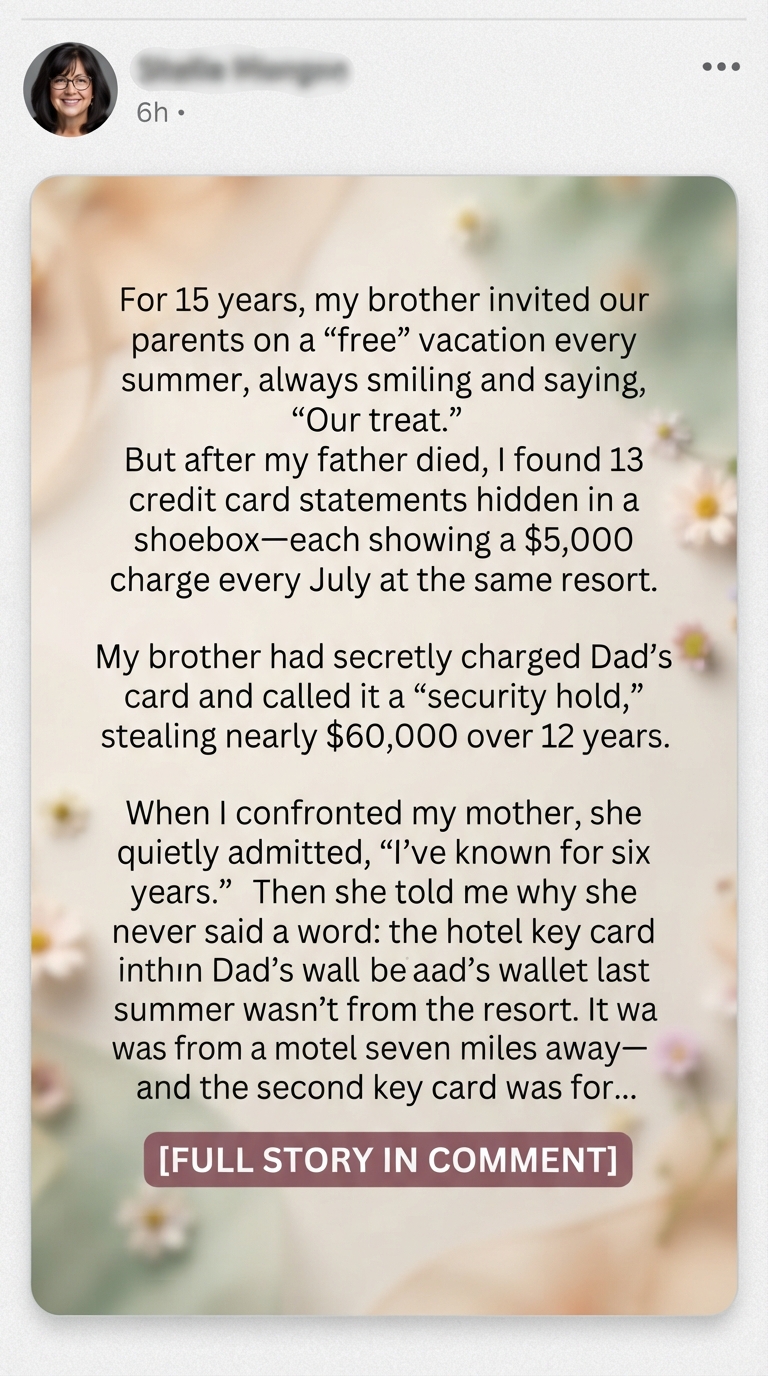
The Second Key Card
For fifteen years, my brother invited our parents on a “free” vacation every summer.
Every July, he would show up at their house with a smile, two plane tickets, and the same cheerful words:
“Pack your bags. Our treat.”
My parents always believed they were lucky.
My father would brag about his son to everyone.
“Your brother takes good care of us,” he would say.
My mother would smile and tell her friends that family was the greatest blessing in the world.
And I believed it too.
My brother had always been the successful one.
He owned a growing construction company, drove expensive cars, and lived in a beautiful house.
I was the quieter sibling.
I worked an ordinary job, lived modestly, and rarely asked anyone for anything.
So when my brother began taking our parents on annual vacations, I thought it was generous.
Sometimes I even thanked him.
“You’re a good son,” I told him once.
He smiled.
“They’re our parents.”
I didn’t know how much that sentence was hiding.
My father died unexpectedly in the spring.
He was seventy-eight.
One day he was complaining about his garden.
The next morning, my mother called me crying.
The funeral passed in a blur.
Afterward, I stayed with my mother for several weeks to help her organize Dad’s belongings.
We went through his clothes.
His old watches.
His military photographs.
His fishing equipment.
And finally, the financial papers.
Dad had always been organized.
Every receipt had a place.
Every bill was filed.
Every bank statement was neatly stacked.
That’s when I found the shoebox.
It was hidden beneath several old folders in the back of his closet.
At first, I thought it contained photographs.
Instead, I found credit card statements.
Thirteen of them.
I sat on the floor and began sorting through them.
The first statement was from twelve years earlier.
There was a charge for $5,000.
The description was for the same luxury resort my brother took our parents to every summer.
I stared at it.
Then I looked at the next statement.
Another $5,000.
Same month.
Same resort.
Same amount.
I checked another.
And another.
Every July.
$5,000.
For years.
I grabbed a calculator.
Nearly $60,000.
My stomach tightened.
I called my brother.
He answered casually.
“What’s up?”
“Did you charge Dad’s credit card for $5,000 every summer?”
There was a long silence.
Then he laughed.
“What are you talking about?”
“I found the statements.”
Another silence.
Then he said, “Those were security holds.”
“Security holds?”
“Yeah. The resort required a large authorization for the rooms and expenses. It gets handled later.”
I looked at the statements.
“Then why is every charge exactly $5,000?”
“Because that’s their standard authorization.”
“Then why did Dad pay the money?”
“He didn’t.”
I froze.
“What?”
My brother sighed.
“Look, you’re making something out of nothing.”
I asked him to explain.
He changed the subject.
Then he hung up.
I called the resort.
I explained that I was handling my father’s estate and needed to verify several charges.
The employee looked up the records.
After a few minutes, she said something that made my blood run cold.
“There were no $5,000 security holds.”
I closed my eyes.
“Are you sure?”
“Yes.”
She explained that the resort had charged my father’s card for only the actual room and incidental expenses.
The $5,000 charges were not from them.
They were fraudulent.
My brother had been lying.
I went downstairs and found my mother sitting at the kitchen table.
I put the statements in front of her.
“Mom.”
She looked at them.
Then she looked at me.
She didn’t ask what I had found.
She simply whispered,
“I know.”
My heart stopped.
“You know?”
She nodded.
“How long?”
Her eyes filled with tears.
“Six years.”
I couldn’t speak.
“You’ve known for six years that he was stealing from Dad?”
“He wasn’t stealing from me.”
“He was stealing from Dad.”
She looked down.
“I know.”
“Why didn’t you tell me?”
She didn’t answer.
“Mom, why?”
She finally looked at me.
“Because your father knew too.”
I felt dizzy.
“What?”
She reached into the drawer and pulled out an old envelope.
Inside was a photograph.
It showed Dad standing outside a motel.
Seven miles from the resort.
I recognized the place immediately.
It was cheap.
Old.
Nothing like the luxury resort my brother advertised.
“When was this taken?” I asked.
“Last summer.”
My father had died only months later.
I stared at the photograph.
“Why was Dad at that motel?”
My mother shook her head.
“I don’t know.”
Then she said something that made everything even stranger.
“Your father never went to the resort last summer.”
I looked at her.
“What are you saying?”
“He went to the motel.”
“Alone?”
She hesitated.
“No.”
I waited.
She took a breath.
“Your brother wasn’t taking him on vacation.”
The room suddenly felt too small.
“What was he doing?”
My mother reached for another envelope.
Inside were photocopies of hotel records.
There were room numbers.
Dates.
Names.
And payment records.
My brother had been booking two rooms every summer.
One at the luxury resort.
One at the motel seven miles away.
The resort room was for appearances.
The motel room was where my brother actually stayed.
But that wasn’t the worst part.
My mother pulled out one final piece of paper.
It was a handwritten note from Dad.
I recognized his handwriting immediately.
It said:
**“If anything happens to me, don’t trust what he tells you about the vacations.”**
My hands began shaking.
“What does this mean?”
My mother started crying.
“I didn’t want to believe it.”
“Believe what?”
She looked at me.
“Your father discovered where the money was going.”
I stared at her.
“He confronted your brother six years ago.”
“And?”
“He threatened to expose him.”
My brother had begged Dad not to ruin his business.
He claimed the money was temporary.
He said he had debts.
He promised to repay everything.
Dad believed him.
Or at least he wanted to.
But after that conversation, something changed.
Dad stopped talking about the vacations.
He started keeping notes.
He photographed receipts.
He copied statements.
He even began tracking my brother’s movements.
Then, last summer, Dad discovered something that terrified him.
My brother wasn’t just stealing money.
He had been using Dad’s identity to open accounts.
Credit cards.
Loans.
Travel accounts.
Even a storage unit.
I looked at my mother.
“Why didn’t you report him?”
She whispered,
“Because your father asked me not to.”
“Why?”
“Because he was afraid.”
I couldn’t believe it.
“My father was afraid of my brother?”
She nodded.
“He said your brother knew things about him.”
“What things?”
My mother shook her head.
“I don’t know.”
Then I remembered the key card.
Dad’s wallet had been returned to us after his death.
I had gone through it earlier that week.
There were two hotel key cards inside.
One had the resort’s logo.
The other had no obvious name.
I had assumed they were both from the resort.
I pulled Dad’s wallet from the drawer.
The key cards were still there.
I placed them on the table.
My mother stared at them.
Her face went pale.
“That one,” she whispered.
“What about it?”
“That is the motel.”
I looked at the card.
Then at her.
“You said Dad went there with someone.”
She nodded.
I picked up the second key card.
“Who was the other room for?”
My mother closed her eyes.
“I don’t know.”
“Mom.”
She began crying.
“I found out the morning after your father died.”
“What did you find?”
She reached into her purse and pulled out a folded piece of paper.
It was a motel receipt.
Room 214.
Two occupants.
One name was my father’s.
The second name was my brother’s.
I stared at it.
My brother had been in the motel room with Dad.
Seven miles away from the resort.
The same week he claimed he was giving our parents a luxury vacation.
But why?
Then I noticed the date.
It was the same date as the final $5,000 credit card charge.
I felt sick.
I called my brother again.
He didn’t answer.
I sent him one message.
**“I know about Room 214.”**
He called within thirty seconds.
“Where did you get that?”
His voice wasn’t angry.
It was terrified.
I asked him one question.
“What happened in that motel?”
He didn’t answer.
Then he whispered,
“Dad found out.”
“Found out what?”
“You don’t understand.”
“Then explain it.”
Silence.
Finally, he said,
“Those charges weren’t for vacations.”
“I know.”
“They were payments.”
“For what?”
He started crying.
I had never heard my brother cry before.
Not even when our grandfather died.
“I owed someone money.”
“Who?”
He wouldn’t say.
Then he told me the truth.
Years earlier, he had made a terrible investment.
He lost nearly everything.
He borrowed money to cover it.
Then he borrowed more money to pay the first debt.
Eventually, he was drowning.
He began using Dad’s credit card.
At first, he told himself he’d repay it.
Then the lies became easier.
He invented the vacations.
He created fake security holds.
He used the money to pay his debts.
But Dad eventually discovered everything.
And Dad didn’t just threaten to expose him.
He demanded that my brother repay every dollar.
My brother agreed.
But he didn’t have the money.
So Dad made one final demand.
He wanted my brother to sign over part of his company.
My brother refused.
That’s when the two of them met at the motel.
They argued.
They yelled.
Dad told him,
“You’re going to tell your mother and your sister everything.”
My brother panicked.
But before he could explain what happened next, I heard him say:
“Dad wasn’t supposed to die.”
I froze.
“What do you mean?”
“I didn’t kill him.”
“I didn’t say you did.”
He went silent.
That silence told me everything.
I contacted the police.
Investigators reviewed the financial records, the motel records, and Dad’s notes.
They discovered that Dad had been planning to meet with an attorney the week after his final trip.
He had intended to expose my brother’s fraud.
But there was no evidence my brother had caused Dad’s death.
The medical examiner confirmed that Dad died from a natural cardiac event.
My brother wasn’t charged with murder.
But he was charged with financial crimes.
The investigation uncovered years of fraud.
Nearly $60,000 from Dad’s credit card was only the beginning.
There were additional debts, forged signatures, and accounts my brother had opened using family information.
He eventually admitted everything.
My mother was devastated.
But she also admitted something else.
She had stayed silent because she was afraid the family would fall apart.
Ironically, her silence was what allowed the damage to continue.
My brother lost his business.
He sold his house.
He repaid as much as he could to Dad’s estate.
But the money wasn’t what mattered anymore.
The truth was.
A year after Dad died, my mother and I visited his grave.
She placed flowers beside his name.
Then she whispered,
“I should have told you.”
I put my arm around her.
“Yes.”
She looked at me.
“Are you angry?”
I thought about it.
“Yes.”
“But I still love you.”
She nodded through her tears.
“I love you too.”
We stood there quietly.
Before leaving, I placed the old motel key card on Dad’s grave.
Not because it held any magical secret.
Not because it could change the past.
But because it represented the truth that had been hidden for too long.
For fifteen years, my brother had told everyone that those vacations were a gift.
They weren’t.
They were built on lies.
And the most painful part wasn’t losing the money.
It was realizing that my father had spent his final years knowing the person he trusted most was taking advantage of him.
I still think about that second key card.
The one from the motel seven miles away.
It didn’t unlock a hotel room anymore.
It unlocked the truth.
And sometimes the smallest piece of evidence can destroy the biggest family lie.
