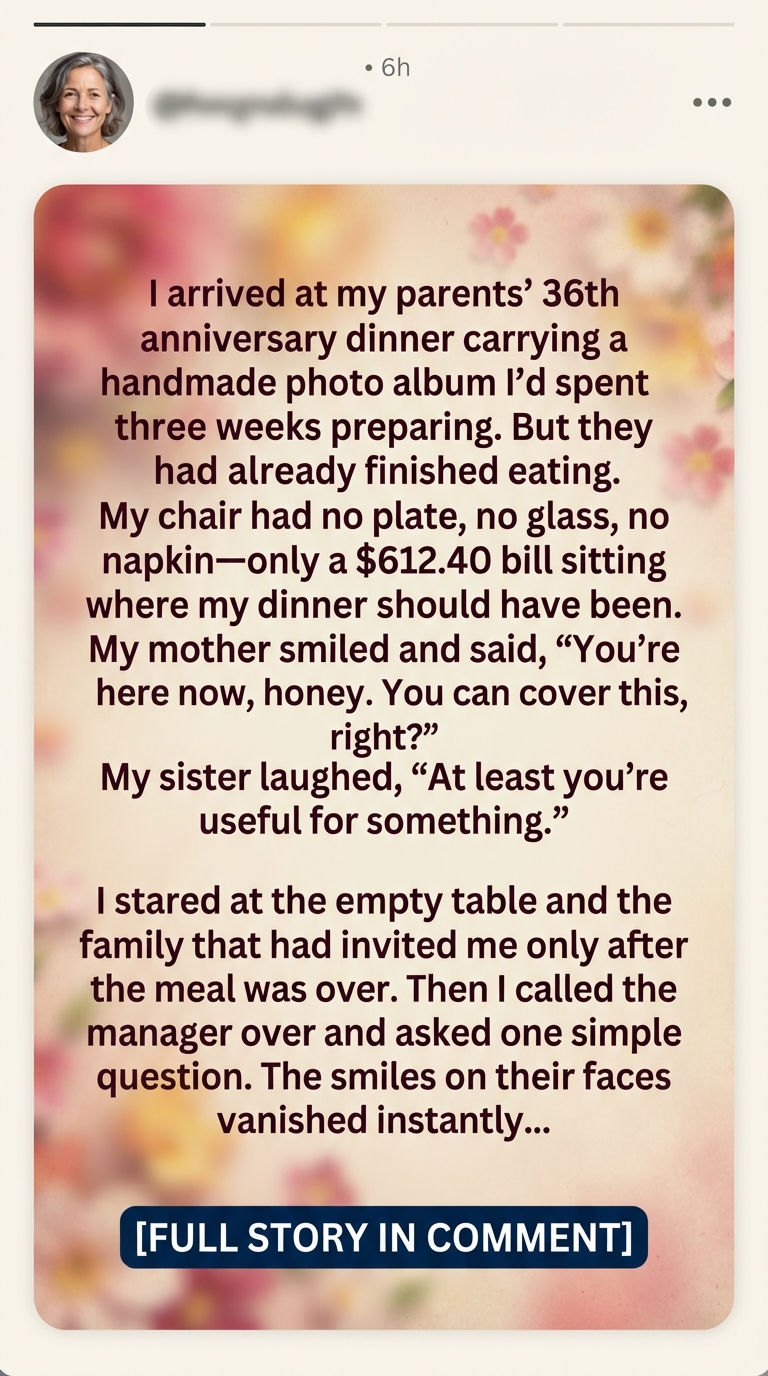
I arrived at my parents’ 36th anniversary dinner carrying a handmade photo album I’d spent three weeks preparing. I had stayed up late for nights, carefully printing old photographs,
writing memories beneath each one, and arranging everything in chronological order. There were pictures of my parents when they were young, their wedding day,
my sister and me as children, family vacations, birthdays, Christmas mornings, and one photograph of the four of us standing together in front of our first family home.
I had even found an old photograph of my parents dancing in their kitchen. I thought they would love it. I thought the evening would be special.
Instead, when I walked into the restaurant, the hostess looked at me strangely. “Are you with the Thompson party?” “Yes.” She glanced toward the dining room. “They’ve already finished dinner.”
I smiled awkwardly. “They’re still there?” She nodded. I walked toward the table. My parents were sitting with my sister and her husband.
Empty plates were stacked in front of them. Half-empty wine glasses sat on the table. Dessert plates had already been cleared. Everyone looked relaxed. Everyone except me.
I looked for my chair. There was only one problem. There wasn’t one. The place where I had supposedly been invited to sit was empty. No plate. No glass. No silverware. No napkin. Nothing. Except a folded restaurant bill.
I picked it up. $612.40. For a moment, I thought it was a joke. Then my mother looked up. She smiled. “You’re here now, honey.” I smiled back, confused.
“You already ate?” My sister laughed. “Obviously.” My mother pointed at the bill. “Can you take care of this?” I stared at her. “The whole bill?” She shrugged. “It’s your father’s anniversary.
You don’t want him worrying about money tonight, do you?” My sister laughed again. “At least you’re useful for something.” I looked around the table. My father didn’t laugh.
He just stared at his empty dessert plate. I placed the photo album on the table. “I made this for you.” My mother glanced at it. “Oh. That’s nice.” She didn’t touch it. I felt something inside me sink.
For three weeks, I had prepared that album. I had spent hours finding photographs my parents hadn’t seen in decades. I had called relatives for copies. I had written personal messages beneath the pictures.
I thought I was bringing them a piece of our family history. Instead, they had apparently invited me only after the meal was finished. And now they wanted me to pay for it. I looked at the bill again. $612.40.
I reached for my wallet. Then stopped. I looked at my mother. “Can I ask you something?” She smiled. “Of course.” “Why did you invite me after dinner?” Her smile faded slightly. “We didn’t.” My sister laughed.
“We figured you’d show up eventually.” I looked at her. “What?” My sister shrugged. “Mom mentioned the dinner weeks ago. You didn’t confirm.” I looked at my mother. She nodded.
“We weren’t sure you were coming.” I pulled out my phone. I opened the family group chat. There it was. Three weeks earlier, my mother had written: “Dinner at 7:00 Saturday.
Everyone is invited.” I had replied immediately: “I’ll be there. I wouldn’t miss your anniversary.” My father had responded with a heart emoji. My sister had said: “Great!” I showed them the message. Nobody spoke.
Then my sister said, “Well, you didn’t answer again.” “I didn’t need to. I already said yes.” My mother waved her hand. “It’s not a big deal.” I stared at the empty place setting. “No.
Apparently it isn’t.” My father finally spoke. “Maybe we should just let this go.” I looked at him. “Dad, did you know they were going to leave my place empty?” He looked uncomfortable.
“No.” “Did you know they were going to ask me to pay the bill?” His silence answered me. I looked around the table. Something felt different now. I wasn’t angry about missing dinner.
I was angry because this wasn’t an accident. It was a pattern. For years, my family had treated me like the person who would always cover the gap. Need money? Call me. Need help with a bill? Call me.
Need someone to drive across town? Call me. Need someone to organize Mom’s birthday? Call me. Need someone to pay for Dad’s dental work? Call me. I had done it because I loved them.
But somewhere along the way, helping had become an expectation. And now they had turned my own parents’ anniversary into another opportunity to use me. I slowly pushed the bill back across the table.
My mother frowned. “What are you doing?” “I want to speak with the manager.” My sister laughed. “Seriously?” I nodded. “Yes.” A few minutes later, the restaurant manager approached.
He was a middle-aged man with a tablet in his hand. “Is everything all right?” I looked at him. “I have a question about this bill.” He looked at it. “Sure.” “Was a dinner reservation made for five people?”
He checked the system. “Yes.” “Was the reservation paid in advance?” He shook his head. “No.” “Were all five guests seated at the beginning of the reservation?” He paused. Then looked at the table. “No.” I nodded.
“Who was the reservation under?” He checked the screen. “Mrs. Thompson.” My mother shifted in her chair. I continued. “And did she tell you that I was expected to arrive later?” The manager looked at my mother.
“Yes.” The table went silent. I turned toward the manager. “Did she also tell you that I would be paying the bill?” The manager’s expression changed. He looked at my mother again. “Yes.” My sister’s smile disappeared.
My father stared at the table. I took a slow breath. Then I asked the simple question that changed everything. “Can you show me the original reservation notes?” The manager hesitated.
My mother immediately said, “That isn’t necessary.” I looked at her. “Why not?” The manager glanced between us. “I can show the reservation notes to the person who made the reservation.” My mother said nothing.
He turned the tablet toward her. She looked at it. Then her face went completely white. I leaned forward. “What does it say?” The manager looked uncomfortable. “It says that the fifth guest was added specifically because
Mrs. Thompson said she would be covering the bill.” My sister’s eyes widened. My father looked at my mother. “You told them that?” My mother didn’t answer. The manager continued.
“There is also a note here saying, ‘Don’t bring her food. She will arrive after dinner and pay.’” Nobody moved. The restaurant suddenly felt completely silent. I looked at my mother.
She couldn’t meet my eyes. My sister whispered, “Mom…” My father slowly pushed his chair back. “You planned this?” My mother started crying. “I didn’t mean it like that.” I looked at the album sitting on the table.
“Then what did you mean?” She wiped her eyes. “We thought you’d understand.” “Understand what?” “That you should contribute.” I almost laughed. “Contribute?” My father looked at her.
“She spent three weeks making that album.” My mother looked at it. For the first time, she seemed to notice the work that had gone into it. I opened the album. The first page showed my parents on their wedding day.
Beneath the photograph, I had written: “Thirty-six years of choosing each other.” My father touched the page. His eyes filled with tears. My mother looked away. I turned another page.
There were pictures of them holding my sister and me as babies. Another page showed their first house. Another showed the four of us at the beach. I had written something beneath every photograph.
Memories. Stories. Things I remembered that they had forgotten. I looked at my mother. “I didn’t bring you money tonight. I brought you memories.” She started crying harder. My sister looked down.
I closed the album. Then I stood. “I’ll pay for my parents’ anniversary dinner.” My mother looked relieved. But I continued. “Not this bill.” She frowned. “What does that mean?” “I’ll pay for what my parents actually ordered.”
The manager nodded. I looked at him. “And please remove anything my sister and her husband ordered after the reservation.” My sister’s head snapped up. “What?” “You heard me.” “You’re seriously going to make us pay?”
I smiled sadly. “You’re useful too.” Her face turned red. My father almost smiled. The manager separated the bill. My parents’ portion was reasonable. My sister and her husband’s portion was nearly $300.
They had ordered expensive wine, steaks, appetizers, and desserts. My mother had assumed I would cover all of it. I paid my parents’ portion. My sister reluctantly paid hers. Then I picked up my album.
My father stood. “Wait.” I turned. He walked toward me. “I want the album.” I handed it to him. He held it against his chest. “Thank you.” My mother stood too. “I want to apologize.” I looked at her. She continued.
“I thought because you’ve always helped us, you wouldn’t mind.” “That was the problem.” She nodded. “I know.” My sister remained seated. She didn’t apologize. She simply stared at me. I walked toward the door.
Then my father called my name. I turned. “Will you come home for Christmas?” I looked at him. Then at my mother. Then at my sister. “I don’t know.” My father nodded. “I understand.” I left. That night, I drove home alone.
I put the empty passenger seat beside me and thought about all the years I’d spent trying to earn a place at that family table. Then I realized something. I shouldn’t have to earn it. I should have been wanted there.
Three days later, my father called. He said he had looked through the entire album. He told me he cried. He said the pictures reminded him of something he had forgotten.
“We were happier when we didn’t measure everything in money,” he said. I didn’t know what to say. Then he added, “I should have defended you at dinner.” That meant more to me than he knew. A week later,
my mother called. She apologized again. This time, she didn’t make excuses. She admitted that my sister had complained for months that I was “getting more attention” from Dad because I was always helping him.
They had planned the dinner without telling me the time had changed. They intentionally waited until everyone finished eating. Then they planned to hand me the bill. They wanted to embarrass me.
My mother said she was sorry. I told her I needed time. And I did. Months passed. I didn’t stop loving my family. But I stopped paying for everything. I stopped saying yes automatically.
I stopped confusing being needed with being loved. Eventually, my mother invited me to dinner again. This time, she asked, “What time will you arrive?” I smiled. “Six-thirty.” She laughed.
“We’ll save you a seat.” When I arrived, there was a plate waiting for me. A glass. A napkin. Silverware. And a handwritten card on my chair. It said: “We’re glad you’re here.” I sat down.
My mother looked at me. My father smiled. My sister was quiet. Then my mother pushed the album toward me. “We looked at it again.” I smiled. “Did you like it?” My father nodded. “We loved it.” I looked around the table.
For the first time in a long time, I didn’t feel like the family wallet. I felt like a son. And that was worth far more than $612.40. Sometimes the most expensive bill isn’t the one printed on a restaurant receipt.
It’s the emotional price of realizing the people you love have stopped treating you like family. And sometimes the strongest thing you can do isn’t walk away. It’s put the bill back on the table and finally say:
“I love you—but I will never again pay for being included.”
