The House Rules
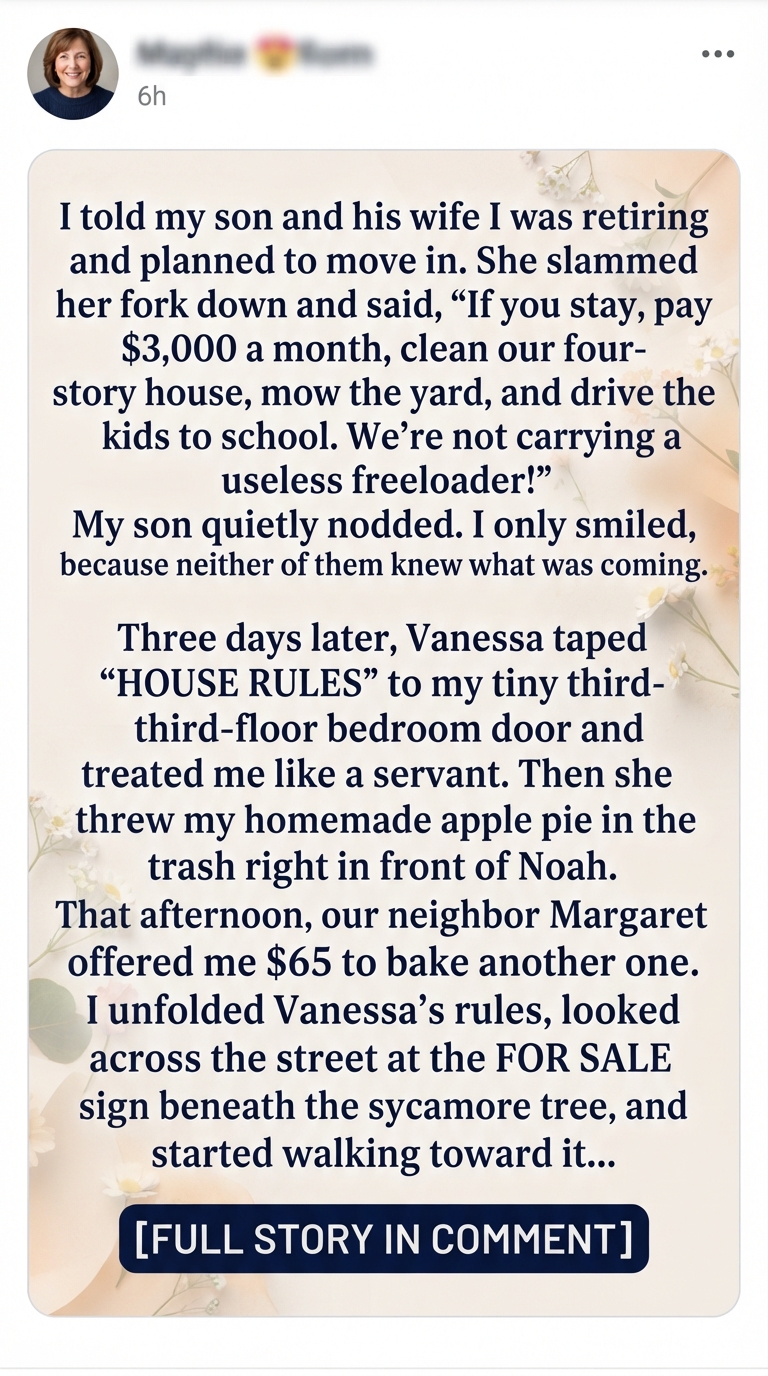
I told my son and his wife that I was retiring and planned to move in with them. I thought it was good news. I had spent most of my life working, saving, and putting my family first.
Now that I was finally ready to retire, I imagined spending more time with my grandchildren, helping around the house, and enjoying a quieter life. Instead, my daughter-in-law, Vanessa,
slammed her fork against the dinner plate. “If you stay, you pay $3,000 a month,” she said. I stared at her. She continued. “You’ll clean this four-story house, mow the yard,
and drive the kids to school. We’re not carrying a useless freeloader.” My son, Noah, quietly nodded. That hurt more than Vanessa’s words. I looked at my son. He wouldn’t meet my eyes. I could have argued.
I could have reminded him how many times I had helped him. How I had paid for his first car. How I had covered his college tuition when his scholarships fell through.
How I had watched Noah and his sister struggle through their childhood after their mother died. But I didn’t. I simply smiled. “All right,” I said. Vanessa smiled triumphantly.
She thought she had won. Neither of them knew what was coming. Three days later, Vanessa taped a sheet of paper to my tiny third-floor bedroom door. At the top, in huge red letters, were two words: HOUSE RULES.
I stood there reading them. 1. Wake up by 5:30 a.m. 2. Clean all bathrooms. 3. Vacuum all four floors. 4. Wash everyone’s laundry. 5. Prepare breakfast. 6. Prepare dinner. 7. Drive the children to school. 8.
Mow the lawn every Saturday. 9. No guests. 10. Do not use the living room after 8 p.m. 11. Do not touch the thermostat. 12. Keep personal belongings inside your room. 13. $3,000 rent due on the first of every month.
At the bottom, Vanessa had written: “This is not a free hotel.” I read the list twice. Then I folded it carefully. I put it inside my pocket. That morning, I woke at 5:30. I cleaned the bathrooms.
I vacuumed the floors. I made breakfast. I drove the children to school. I mowed the lawn. I cooked dinner. And I said nothing. For the first few days, Vanessa was delighted.
She told her friends that having me there was “a blessing.” But what she really meant was that she had found someone willing to do everything she didn’t want to do. Noah barely spoke to me.
He left for work before breakfast and came home after dinner. Whenever Vanessa gave me another task, he simply nodded. I tried not to take it personally. He was my son. I loved him.
But I was beginning to wonder whether he remembered that I was his father. Then came the apple pie. It was Saturday afternoon. I had baked it from scratch. Grandma’s recipe. My grandchildren loved it.
Noah’s little boy was sitting at the kitchen counter waiting for it to cool. I cut him a small slice. His eyes lit up. “This is the best pie ever!” I smiled. “Your great-grandmother taught me.” Vanessa walked into the kitchen.
She looked at the pie. “What’s that?” “Apple pie.” “I can see that.” “I made it for the kids.” She picked up the plate. Then she walked to the trash can. Before I could react,
she dropped the entire pie inside. Noah Jr.’s smile disappeared. “Mom!” Vanessa shrugged. “We don’t need all this junk in the house.” I stared at the trash. Then at her. “You could have told me.” She crossed her arms.
“This is my kitchen.” Noah Jr. looked at me. “Grandpa, I’m sorry.” I smiled at him. “It’s okay.” But it wasn’t. That afternoon, I sat alone on the front steps. Across the street stood an old house beneath
a giant sycamore tree. A FOR SALE sign stood in the yard. I had noticed it when I first moved in. It was a beautiful little house. Three bedrooms. Two bathrooms. A small kitchen.
A porch. A backyard. Nothing extravagant. But it looked peaceful. As I stared at it, our neighbor Margaret walked over. She was an elderly woman who had lived across the street for decades. “You all right?” she asked.
I smiled. “I’m fine.” She looked toward the kitchen window. Then back at me. “You don’t look fine.” I laughed quietly. “I suppose I’m not.” She sat beside me.
“I smelled your apple pie earlier.” I smiled. “Vanessa threw it away.” Margaret’s eyebrows rose. “Why?” “Apparently it was junk.” Margaret shook her head. “That’s a shame.” Then she smiled.
“Would you bake me one?” I laughed. “Of course.” “How much?” I waved my hand. “Nothing.” She pulled out her wallet. “Sixty-five dollars.” I stared at her. “What?” “I’ll pay you $65.” “For a pie?” “Your pie is better
than anything from the bakery.” I laughed. “I can’t take your money.” She shook her head. “You can if you want.” I finally accepted. “Deal.” I went upstairs. I took out Vanessa’s HOUSE RULES sheet. I looked at it again.
Then I looked out the window. Across the street, the FOR SALE sign stood beneath the sycamore tree. I folded the rules. Put them in my pocket. And started walking toward the house. The realtor was standing outside.
She smiled. “Are you interested?” I nodded. “Yes.” She handed me a brochure. “It’s been on the market for a while.” “Why?” “Most people think it’s too small.” I smiled.
“It’s perfect.” She looked surprised. “You want to see it?” “Yes.” We walked inside. The house was old, but charming. The kitchen had wooden cabinets. The living room had large windows.
The backyard was surrounded by a low fence. And there was a small room upstairs that would be perfect for my grandchildren. I stood in the kitchen. For the first time since moving in with Noah,
I could breathe. “How much?” I asked. She gave me the price. It was less than half of what I had expected. I smiled. “I’ll take it.” The realtor blinked. “Are you serious?” “Yes.” She looked at me.
“Do you need to discuss it with your family?” I shook my head. “No.” That afternoon, I signed the paperwork. I paid cash for the house. No mortgage. No debt. No one else’s permission. The realtor stared at me.
“You were prepared.” I smiled. “I’ve been prepared for a long time.” What Vanessa didn’t know was that my retirement wasn’t simply about stopping work. For thirty-five years, I had worked as a financial advisor.
I had managed money for wealthy families. I had saved aggressively. I had invested carefully. And after my wife died, I created a retirement fund that I never touched. I owned enough to live comfortably
for the rest of my life. The $3,000 rent Vanessa demanded was meaningless to me. But what she didn’t understand was that I wasn’t paying it because I couldn’t afford my own place. I was paying attention.
That evening, I came home. Vanessa handed me another list. “Tomorrow, clean the garage.” I nodded. “Sure.” Noah looked at me. “Dad, everything okay?” I smiled. “Everything is fine.” Three days later,
my new house closed. I quietly moved my important belongings. My photographs. My wife’s jewelry box. My books. My father’s old watch. And the recipe book my mother had given me. I left the rest.
Then I waited. The next morning, Vanessa came downstairs. “Where’s breakfast?” “I won’t be making it anymore.” She frowned. “What?” “I’ve decided to move.” Noah froze. “What?” I handed him an envelope.
He opened it. Inside was a copy of the house deed. His eyes widened. “Dad…” “I bought the house across the street.” Vanessa stared at me. “You did what?” I smiled. “I bought it.” She ran to the window.
The FOR SALE sign was gone. My new house stood across the street. Vanessa’s face turned pale. “But… how?” I looked at her. “You asked me for $3,000 a month to live here.” She nodded.
“I figured that was fair.” “I agree.” She looked confused. “So?” “So I decided to spend that money on my own home instead.” Noah lowered his head. “Dad, why didn’t you tell me?” I looked at him. “Because I wanted to see
whether you wanted your father or a servant.” He looked devastated. “I love you.” “I know.” “Then why did you let Vanessa treat you like this?” I looked at my son. “You were standing beside her.” He started crying.
“I didn’t know what to do.” “That was the problem.” Vanessa suddenly interrupted. “This is ridiculous! You agreed to the rules!” I looked at her. “Yes.” “And you agreed to the rent!” “Yes.”
“So why are you acting like we did something wrong?” I looked at her. “Because you forgot something.” “What?” “I was never desperate.” She went silent. “I stayed because I wanted to believe my son
still wanted me around.” Noah wiped his eyes. “I do.” I looked at him. “Then prove it.” I picked up my suitcase. Before I left, I handed Vanessa the HOUSE RULES sheet. She stared at it. “What is this?” “Your rules.”
She looked confused. I smiled. “I thought you might need them.” She opened the paper. On the back, I had written one sentence: “Rule #14: Never mistake someone’s kindness for dependence.” Then I walked across the street.
My new home felt strangely quiet. But it was peaceful. That evening, there was a knock on my door. It was Margaret. She was holding a pie plate. “Your $65 order.” I laughed. “You actually paid me?” She smiled.
“Best pie I’ve had in years.” Then she looked around my new kitchen. “So this is why you were smiling.” I nodded. “I think so.” A week later, Noah came over. Alone. He stood on my porch.
“I brought something.” He handed me a box. Inside were old family photographs. “I found these in the attic.” I looked through them. There was one photograph of me holding him when he was a baby. He stood beside me.
“I’ve been a terrible son.” I shook my head. “You made a terrible choice.” He nodded. “I want to fix it.” I looked at him. “You can start by coming inside.” He smiled. We sat in the kitchen. We talked for three hours.
He told me Vanessa had apologized. She had admitted that she had become obsessed with money and appearances. She had also realized how much work I had done for the family. But I didn’t immediately move back. I didn’t need to.
I had my own home now. And slowly, things changed. Noah began bringing the kids over every weekend. We baked pies. We played board games. We watched football. The children loved having Grandpa’s house across the street.
Even Vanessa eventually came over. The first time she entered my kitchen, she looked embarrassed. “I owe you an apology.” I nodded. “Yes, you do.” She took a breath. “I treated you horribly.” “Yes.” “I thought you were going
to become a burden.” I smiled sadly. “I was never a burden.” “I know.” She looked around. “You built a beautiful life here.” I nodded. “I built it before you knew I could.” She looked down. “I hope someday you can forgive me.”
“I already have.” She looked surprised. “But forgiveness doesn’t mean I move back.” She nodded. “I understand.” And she did. Years later, the two houses became the center of our family. My grandchildren would run between them.
Margaret would come over every Saturday for apple pie. Noah would mow my lawn sometimes. Not because I paid him. Not because he had to. Because he wanted to. And every Christmas, we gathered around my kitchen table.
One year, my grandson asked me, “Grandpa, why did you buy this house?” I looked across the room at Noah. Then at Vanessa. Then at the little boy who was now old enough to understand the answer. “Because sometimes,” I said,
“you have to choose a home where you’re loved instead of a house where you’re merely tolerated.” He thought about that. Then he hugged me. And I realized something. Retirement hadn’t been the end of my life.
It had been the beginning of the part where I finally stopped asking other people for permission to be happy. I had spent decades taking care of everyone else. But the day Vanessa threw my apple pie into the trash,
I finally understood something simple: My family didn’t need me to be their servant. And I didn’t need them to survive. I only needed the courage to walk across the street. And sometimes, the best revenge isn’t making
someone regret hurting you. It’s building a peaceful life they can no longer control.
