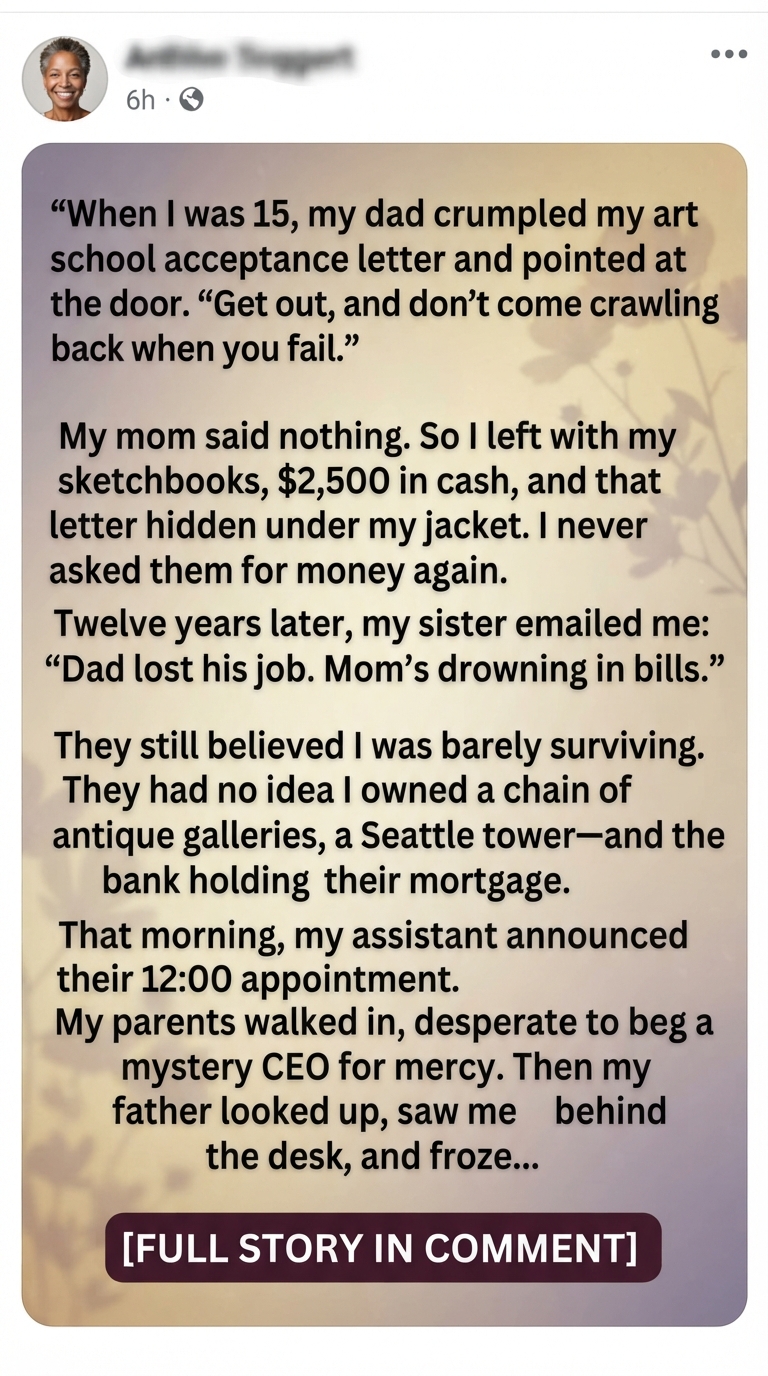
The Girl They Thought Had Failed
When I was fifteen, my dad crumpled my art school acceptance letter and pointed at the door.
“Get out, and don’t come crawling back when you fail.”
My mother sat at the kitchen table.
She said nothing.
Not one word.
I remember looking at her, waiting for her to defend me.
She didn’t.
So I picked up my sketchbooks.
I took the $2,500 I had saved from babysitting, selling paintings, and doing small design jobs around town.
Then I folded the acceptance letter as carefully as I could and hid it under my jacket.
I walked out.
I didn’t slam the door.
I didn’t scream.
I didn’t beg.
I simply walked down the driveway with a backpack over my shoulder and tears burning my eyes.
That was the last time I lived under my parents’ roof.
For the next twelve years, I never asked them for money.
I never asked them for help.
I never called when things got difficult.
And believe me, there were plenty of difficult days.
My first apartment was a tiny studio above a laundromat.
The pipes rattled at night.
The heater barely worked.
I slept on a mattress that had already belonged to two other people.
I worked mornings at a coffee shop and spent afternoons taking classes.
At night, I painted.
Sometimes I sold a piece for $80.
Sometimes $200.
Once, I sold a painting for $700, and I thought I’d become rich.
I wasn’t.
But I was free.
I enrolled in art school.
I worked harder than anyone around me.
I learned restoration.
Then antiques.
Then auction management.
Then property investment.
My professors told me I had a strange eye for old things.
I could walk into a dusty storage room and immediately see what other people ignored.
An ugly cabinet might contain rare wood.
A cracked painting might be worth thousands.
A forgotten vase might belong to a century most people had never studied.
I started buying small pieces.
Restoring them.
Selling them.
Then buying more.
After graduation, I opened my first antique gallery.
It was tiny.
The sign was handmade.
The roof leaked.
The front window had a crack running through it.
But I loved that little store.
I named it after the acceptance letter my father had destroyed.
**North Star Antiques.**
Because that letter had been the one thing that pointed me toward the life I wanted.
Within two years, I opened a second gallery.
Then a third.
Then a fourth.
By the time I was twenty-three, I had employees.
By twenty-five, collectors were flying in to see pieces we had acquired.
By twenty-seven, I had galleries in several cities.
And then I bought my first building.
It wasn’t supposed to be a major investment.
It was an old office tower in Seattle that most investors considered too expensive to renovate.
I saw something different.
I saw possibility.
I bought it.
Renovated it.
Turned the lower floors into galleries and cultural spaces.
The upper floors became offices and luxury apartments.
Within a few years, the tower became one of the most recognizable buildings in our portfolio.
I eventually became the CEO of the company I had built.
And I never told my parents.
Not because I wanted revenge.
Because they had made their decision.
They had told me to leave.
I respected it.
I simply built a life somewhere else.
My sister, Claire, was the only person in my family who occasionally contacted me.
Even she didn’t know the truth.
She thought I was doing okay.
Maybe selling paintings.
Maybe working in a small gallery.
Once, she asked me if I needed help paying rent.
I laughed and told her I was fine.
She didn’t know that by then I owned multiple properties.
She didn’t know that my company managed millions of dollars in assets.
She didn’t know I had a private office overlooking downtown Seattle.
And she certainly didn’t know that one of the financial institutions holding my parents’ mortgage had recently become part of a company I controlled.
Then, twelve years after I left home, Claire emailed me.
The subject line said:
**Please don’t be angry.**
I opened it.
“Dad lost his job.”
I stared at the screen.
Then I kept reading.
“Mom is drowning in bills. Their mortgage is behind. They’ve already received notices. Dad refuses to ask you for help because he thinks you failed and are probably still barely surviving yourself.”
I almost laughed.
Not because their situation was funny.
Because they still had no idea who I had become.
Claire continued.
“They’re meeting with someone from the bank tomorrow. They think there’s a chance the mortgage can be restructured. Please, if you can do anything…”
I stopped reading.
My assistant, Maya, knocked on my office door.
“Come in.”
She stepped inside with a tablet.
“You have a twelve o’clock appointment tomorrow.”
“Who?”
She checked the schedule.
“Edward and Evelyn Harper.”
My parents’ names.
I stared at her.
“Who arranged it?”
“The bank’s restructuring department. They’re requesting a meeting with the owner of the investment group because the mortgage has become complicated.”
I leaned back in my chair.
My parents were coming to my office.
They thought they were meeting a mystery CEO.
They didn’t know they were walking into the company their daughter owned.
I looked at the clock.
“Confirm the appointment.”
Maya nodded.
“Anything else?”
“Yes.”
I paused.
“Make sure the conference room is private.”
The next morning, I arrived early.
I wore a simple black suit.
Nothing flashy.
No expensive jewelry.
No attempt to impress anyone.
I sat behind the desk in the conference room and waited.
At 11:58, I heard voices in the hallway.
My assistant opened the door.
“Mr. and Mrs. Harper are here.”
I nodded.
“Send them in.”
The door opened.
My father walked in first.
He looked older.
Much older.
His hair was gray.
His shoulders had fallen.
He carried a folder filled with financial documents.
My mother followed behind him.
She looked exhausted.
She clutched her purse with both hands.
Neither looked at me.
They were too nervous.
My father sat down.
“Thank you for seeing us.”
I said nothing.
My mother sat beside him.
“We’re sorry to take up your time.”
I folded my hands.
“What can I do for you?”
My father opened the folder.
“Our mortgage has become difficult.”
“I see.”
“We’ve never missed a payment until recently.”
“Understood.”
“My job disappeared unexpectedly.”
“I know.”
He looked surprised.
“You know?”
I nodded.
“My office received the financial records.”
He swallowed.
“We’re asking for a restructuring.”
My mother leaned forward.
“We’re not asking for charity.”
I looked at her.
“I didn’t think you were.”
“We can pay,” she continued. “We just need time.”
I glanced at the documents.
“You owe approximately $418,000.”
My father nodded.
“Yes.”
“The property is worth approximately $1.2 million.”
“Yes.”
“So this isn’t really a problem with the property.”
He looked confused.
“No?”
“No.”
I closed the folder.
“The problem is that you no longer have enough income to support the loan.”
My father nodded.
“That is correct.”
I looked at him.
“Then why didn’t you sell the property?”
My mother answered.
“It’s our home.”
I nodded.
“I understand.”
There was a long silence.
Then my father looked up.
Really looked at me.
His eyes narrowed.
His face changed.
He stared at my face.
Then at my hands.
Then at the painting hanging behind me.
I watched recognition slowly spread across his expression.
His mouth opened.
No words came out.
My mother looked at him.
“What?”
He whispered,
“No.”
I smiled faintly.
“Hello, Dad.”
My father’s face went completely white.
My mother turned toward me.
She stared.
Her eyes widened.
“Is it…?”
I nodded.
“It’s me.”
My father stood so quickly that his chair nearly fell backward.
“Emma?”
I nodded.
For several seconds, nobody spoke.
My mother covered her mouth.
“You?”
I smiled.
“Yes.”
My father looked around the room.
Then at the company logo on the wall.
Then at me.
“You own this?”
“Yes.”
He slowly sat down.
“How?”
I almost laughed.
“That’s a long story.”
My mother stared at me.
“You’re the CEO?”
“Yes.”
“But Claire said…”
“I know what Claire said.”
My father looked down.
“We thought you were struggling.”
“I was.”
“When?”
“The first few years.”
He looked ashamed.
I continued.
“But I kept going.”
My mother started crying.
“I didn’t know.”
“No.”
She shook her head.
“We didn’t know.”
I looked at her.
“You didn’t ask.”
She flinched.
That sentence hung in the room.
My father looked at me.
“I thought you would come crawling back.”
I nodded.
“You told me to.”
He closed his eyes.
“I was angry.”
“I know.”
“I was wrong.”
I didn’t answer.
He continued.
“I thought art was going to ruin your life.”
“It almost did.”
He looked surprised.
I smiled.
“But not because of art.”
My mother wiped her eyes.
“Then why didn’t you tell us?”
I thought about it.
“Because every time I imagined coming home, I remembered the door.”
My father lowered his head.
“The door?”
“The night you told me to leave.”
He swallowed.
“I remember.”
“So I stayed away.”
My mother whispered,
“We should have looked for you.”
“Yes.”
“We should have helped you.”
“Yes.”
She began crying harder.
My father looked at the mortgage papers.
Then at me.
“Are you going to help us?”
There it was.
The question I had imagined for years.
I could have said no.
Part of me wanted to.
I had every reason.
But I remembered the girl I had been.
Fifteen years old.
Standing in the driveway.
Holding a crumpled acceptance letter.
She hadn’t wanted revenge.
She had wanted someone to believe in her.
So I took a breath.
“Yes.”
My father looked surprised.
“Why?”
“Because I don’t want you to lose your home.”
My mother cried.
“But there’s a condition.”
My father nodded.
“Anything.”
“You’re not getting a free house.”
“I understand.”
“You’re getting a fair restructuring.”
He nodded.
“And the interest will be reduced.”
My mother looked at me.
“Thank you.”
I continued.
“But you will also meet with a financial counselor.”
My father agreed.
“You will sell the unnecessary assets you’ve been holding.”
He nodded.
“And you will stop pretending you have to be ashamed of needing help.”
He looked at me.
That one hurt him.
But he nodded.
“I can do that.”
I stood.
The meeting was over.
My father remained seated.
“Emma?”
I looked at him.
“I am proud of you.”
Those words hit me harder than I expected.
I looked away.
For twelve years, I had told myself I didn’t need to hear them.
But some part of me had been waiting.
“Thank you,” I said quietly.
My mother stood.
She walked toward me.
For a moment, I thought she was going to hug me.
She stopped.
“Can I?”
I nodded.
She hugged me.
And I cried.
Not because everything was fixed.
It wasn’t.
Not because the past disappeared.
It didn’t.
But because for the first time, my mother was holding me like the daughter she had once been too afraid to defend.
My father watched us.
Then he stood.
“I owe you an apology.”
I looked at him.
“Yes.”
He smiled sadly.
“You’re still honest.”
“I learned that from you.”
He laughed.
It was the first time I’d heard him laugh in years.
Before they left, my father stopped at the door.
He looked at me.
“Do you still paint?”
I smiled.
“Every Sunday.”
“Can I see one?”
I hesitated.
Then nodded.
I opened a drawer and pulled out a small painting.
It was a painting of a girl standing outside a house.
She held a letter under her jacket.
Behind her was a dark doorway.
In front of her was a long road beneath a bright sky.
My father stared at it.
“What is this?”
“The night I left.”
He looked closely.
“And the road?”
“The life I built.”
He nodded slowly.
Then he smiled.
“You made it.”
I looked at him.
“No.”
I smiled.
“I built it.”
He understood.
A year later, my parents were financially stable again.
My father found another job.
My mother started selling homemade crafts online.
They didn’t become wealthy.
They didn’t need to.
They learned how to live within their means.
And slowly, our relationship changed.
Not overnight.
There were awkward conversations.
There were old wounds.
There were moments when I wanted to walk away.
But there were also Sunday dinners.
Birthday calls.
Christmas visits.
And eventually, something I never expected.
My father came to one of my galleries.
He stood in front of a painting I had purchased for the company.
He stared at it for several minutes.
Then he turned to me.
“You know what I realized?”
“What?”
“I was afraid your dream would make you poor.”
I smiled.
“And?”
He laughed.
“I was the one who was poor.”
I shook my head.
“No, Dad.”
He looked at me.
“You were poor in something more important.”
He waited.
“Belief.”
He nodded.
“I know.”
Then he hugged me.
And for the first time since I was fifteen, I didn’t feel like the girl who had been thrown out.
I felt like the woman who had walked away and built her own life.
I never needed to prove my worth to my father.
I only needed to stop letting his opinion determine it.
That crumpled acceptance letter had once represented rejection.
Years later, I had it framed.
It hangs in my office.
Not because it reminds me of what my father did.
It reminds me of what I did afterward.
I took that letter.
I took my sketchbooks.
I took $2,500.
And I took one terrified step into the unknown.
That step became a career.
The career became a company.
The company became a legacy.
And the girl my father thought would fail became the woman sitting behind the desk when he came asking for help.
I could have humiliated him.
Instead, I gave him a chance to learn what I had already learned.
Success isn’t about making the people who doubted you regret it.
It’s about becoming so secure in who you are that their doubt no longer has power over you.
My father once pointed at the door and said,
“Get out.”
Twelve years later, he walked through another door.
This time, he was the one asking me for help.
And I opened it.
Not because he deserved it.
Because I had finally become the kind of person I wanted to be.
The girl who left that night didn’t fail.
She just took a longer road than everyone expected.
And that road led her somewhere far better than she ever imagined.
