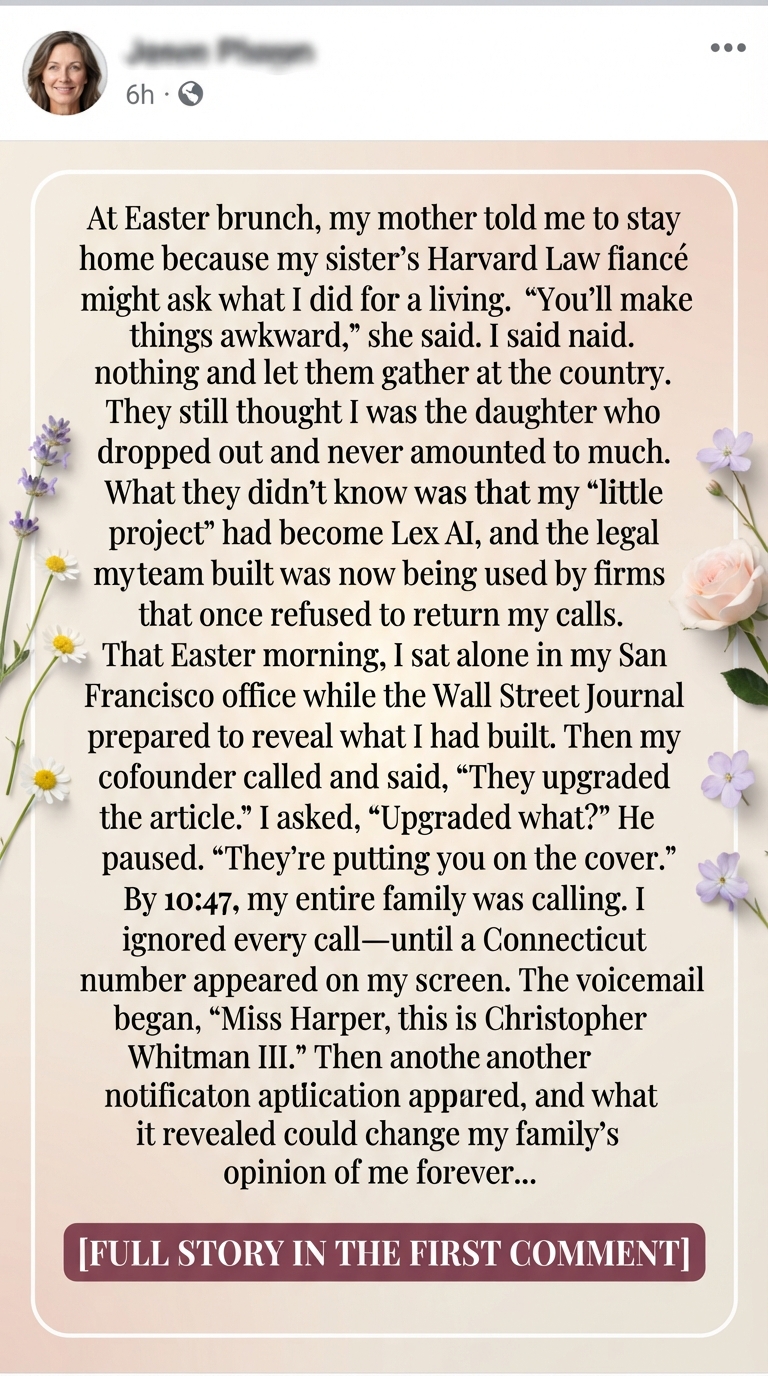
At Easter brunch, my mother told me to stay home because my sister’s Harvard Law fiancé might ask what I did for a living. “You’ll make things awkward,” she said. I said nothing.
I simply looked at her for a few seconds, picked up my coffee, and nodded. “Okay.” She smiled with relief. Then she walked away as if she had just solved a problem. My sister, Ashley,
was getting married in three months. Her fiancé, Christopher Whitman III, came from one of those families people recognized immediately. Old money. Old buildings. Old law firms.
His grandfather had been a federal judge. His father was a senior partner at one of Connecticut’s most prestigious firms. Christopher himself had graduated from Harvard Law
and was already being talked about as the next generation of the family practice. My mother adored him. My father admired him. And Ashley had spent the last year making sure everyone knew
she was marrying into something important. Then there was me. The daughter who had dropped out of college. The daughter who supposedly couldn’t stick with anything.
The daughter who had moved to San Francisco with two suitcases and a “little software project.” At least, that’s what my family believed. They didn’t know my little project had become a company.
They didn’t know that company was called Lex AI. They didn’t know our legal software was being used by major law firms. They didn’t know several firms that had once ignored
my emails were now competing to become enterprise clients. And they certainly didn’t know that on Easter morning, while they were preparing to sit down at a country-club brunch,
I was sitting in a private office overlooking San Francisco, waiting for the biggest article of my life to be published. My cofounder, Daniel, was pacing around the office. “Are you nervous?”
I looked out the window. “A little.” “You shouldn’t be.” “I know.” “You built this.” I smiled. “I know that too.” The truth was, I had spent ten years proving something I wasn’t sure I needed to prove anymore.
When I dropped out of college at twenty, my parents treated it like a family tragedy. My father told everyone I had thrown away my future. My mother cried for weeks.
Ashley told her friends I was “going through a phase.” I wasn’t. I had been building software. I had become fascinated by how much time lawyers spent searching through documents.
Contracts. Case files. Depositions. Regulations. Thousands of pages. Sometimes hundreds of thousands. I thought there had to be a better way. So I built one. At first, nobody cared.
I sent emails to law firms. No response. I called attorneys. Voicemails. I sent demonstrations. Rejections. One partner actually laughed when I told him my system could analyze a 500-page contract in minutes.
“Come back when you’ve finished school,” he said. I never forgot that sentence. Not because it hurt. Because it motivated me. I kept building. Eventually, one small firm agreed to test it.
Then another. Then a larger one. Then a national firm. Investors came. Employees came. The little project became Lex AI. And Lex AI became one of the fastest-growing legal technology companies in the country.
But I never told my family. Every time my mother called, she asked the same question. “Are you still doing that computer thing?” “Yes.” “Is it paying the bills?” “Yes.” She never asked for details.
So I never gave them. That Easter morning, Daniel walked into my office holding his phone. “I got an email from the Journal.” I looked up. “About the article?” He nodded.
The Wall Street Journal had been preparing a major feature about Lex AI for weeks. They wanted to tell the story of how an unknown startup had built software that was transforming legal research
and document review. The original article was supposed to appear in the business section. Daniel’s phone rang. He looked at the screen. Then at me. “It’s the editor.” “Answer it.” He did.
“Hello?” His expression changed. He listened. Then looked at me. “Really?” He put the call on speaker. The editor’s voice came through. “We’ve upgraded the article.” Daniel looked at me. I frowned.
“Upgraded what?” The editor laughed. “The placement.” Daniel’s eyes widened. “They’re putting you on the cover.” I didn’t say anything. For several seconds, I simply stared at him.
The cover. Me. The girl my family thought had failed. The girl my mother didn’t want sitting across from a Harvard Law graduate. I laughed quietly. Daniel smiled. “You okay?” “Yeah.”
I looked at my reflection in the window. “I’m fine.” The article went live at 10:47 a.m. By 10:50, my phone began vibrating. Mom. Dad. Ashley. Mom again. Ashley again. Dad. Then Ashley.
Then Mom. I turned the phone face down. Daniel looked at me. “You’re not answering?” “No.” “Why?” “Because I know what they’re calling about.” He smiled. “Fair.” I went back to work. At 11:03,
my phone vibrated again. This time, it wasn’t a family number. Connecticut. I answered. “Hello?” A man’s voice said, “Miss Harper, this is Christopher Whitman III.” I sat back. Christopher.
My sister’s fiancé. “Hello.” “I apologize for calling unexpectedly.” “That’s okay.” There was a pause. “I just read the article.” I smiled. “I figured.” “I had no idea.” “Neither did my family.” He laughed awkwardly.
“I suppose that’s why your mother wanted you to stay home.” I didn’t respond. Then he said, “There’s something else you should know.” My expression changed. “What?” He lowered his voice.
“I received a notification this morning from our firm’s legal technology department.” “Okay.” “They’re recommending Lex AI for a firm-wide contract.” I smiled. “That sounds familiar.”
“It’s your company.” “Yes.” There was silence. Then Christopher said something I wasn’t expecting. “My father personally asked me to contact you.” I frowned. “Why?” “He wants to discuss a partnership.” I looked at Daniel.
He was already staring at me. “Your father?” “Yes.” “Your father knows who I am?” “He knows exactly who you are.” I leaned back. “And he wants to meet you.” “Why?” Another pause. “Because twelve years ago,
he met your father.” My heart stopped. “What does my father have to do with this?” Christopher sighed. “That’s the part you don’t know.” I frowned. “What part?” “My father says your father once helped him.”
I didn’t understand. “How?” “He says your father invested in one of his earliest cases.” I couldn’t believe it. “My father wasn’t a lawyer.” “No.” Christopher’s voice became quieter.
“He was an investor.” I froze. My father had never told me that. Christopher continued. “Why are you telling me this?” “Because my father wants to return something.” “What?” “A debt.” Before I could ask another question,
he said, “And there’s one more thing.” “What?” “My father saw your article this morning.” “And?” “He said he recognized the name.” I frowned. “Recognized it?” “Yes.” Then Christopher said,
“He told me he has a file with your name on it.” My stomach tightened. “What kind of file?” “I don’t know.” “Did he say why?” Christopher hesitated. “He said your father asked him to keep it.” My heart began pounding.
“Keep what?” “I don’t know.” Then the call ended. I stared at my phone. Daniel walked toward me. “What happened?” I told him everything. He looked confused. “You think your dad knew the Whitmans?”
“I don’t know.” “Then ask him.” I looked at my phone. There were still fourteen missed calls from my family. I finally called my father. He answered immediately. “Why did you ignore us?” I skipped the question.
“Dad, do you know Christopher Whitman’s family?” Silence. Then, “Why?” “Because Christopher says you knew his grandfather.” Another silence. “Who told you that?” “Christopher.” My father’s breathing changed.
“What else did he say?” “That you asked his father to keep a file.” My father said nothing. “Dad?” Finally he said, “Where are you?” “San Francisco.” “Stay there.” “What?” “I need to come see you.” “Why?”
“Because there’s something I should have told you years ago.” My hands went cold. “What?” He whispered, “You didn’t fail when you dropped out.” I stared at the wall.
“What are you talking about?” “I knew what you were building.” I couldn’t speak. “You knew?” “Yes.” “How?” “Because I helped you get started.” I laughed in disbelief. “No, you didn’t.” “Yes, I did.” He paused.
“Do you remember the $25,000 you thought came from an anonymous investor?” My mouth fell open. That money had kept Lex AI alive during our first year. The investor had refused to reveal his identity.
I had always assumed it was a venture fund. “You?” “Yes.” I couldn’t believe it. “Why?” “Because I had finally realized I was wrong.” I sat down. “You never said anything.” “Because I didn’t want to interfere.”
“You told everyone I had ruined my life.” “I know.” “You told Mom I was wasting my future.” “I know.” I felt tears forming. “Why?” My father sighed. “Because I was embarrassed.” “Of me?” “Of myself.”
I didn’t understand. He continued. “I wanted you to follow the traditional path. College. Law school. Corporate job. I thought your dream was childish.” He paused. “Then I saw your first prototype.” I closed my eyes.
“And?” “I realized you were building something nobody else had thought of.” I couldn’t speak. “I was proud,” he said. “But you never told me.” “I was stubborn.” I laughed through my tears. “That sounds like you.”
He laughed softly. Then he said, “There’s another reason I stayed quiet.” “What?” “Your mother.” I frowned. “What about her?” “She didn’t want to know.” My heart sank. “She believed your failure reflected badly on our family.”
I closed my eyes. “That sounds like her.” My father continued. “That’s why I let you leave.” I whispered, “You let me?” “Yes.” “You told me I was a disappointment.” “I know.” “You told me not to come crawling back.”
“I know.” “And all along, you were secretly investing in me?” “Yes.” I didn’t know whether to laugh or cry. Then he said, “There’s something else.” “What?” “The Whitmans.” I waited.
“Christopher’s father asked me to keep your identity secret.” “Why?” “Because he wanted to see whether you would succeed without anyone rescuing you.” I stared at the floor. “And you agreed?” “Yes.”
“Why?” “Because I knew you would.” I started crying. Not because I was angry. Because suddenly the last twelve years looked different. I thought I had built everything alone. Maybe I had. But somewhere in the background,
my father had been quietly watching. He had never taken credit. Never called. Never asked for anything. He had simply believed in me from a distance. Then my mother called. I answered. “Hello?” Her voice was emotional.
“Why didn’t you tell us?” I almost laughed. “You never asked.” “We’re your family.” “You told me not to come home.” “I was angry.” “So was I.” Ashley got on the phone. “Emma, please.” I sighed. “What?”
“You’re really the CEO?” “Yes.” “Lex AI?” “Yes.” “The company in the newspaper?” “Yes.” She was silent. Then she whispered, “Why didn’t you tell me?” I smiled sadly. “You once told me I was embarrassing the family.”
“I was seventeen.” “So was I.” She started crying. “Can we fix this?” I looked out at San Francisco. “I don’t know.” She said nothing. Then my mother came back on the phone. “Christopher says his father wants to meet you.”
“I know.” “Are you going?” “Yes.” “Can we come?” I thought about it. Then said, “Yes.” Two weeks later, my parents and Ashley flew to San Francisco. I met them at the lobby of my company’s headquarters.
My mother stared at the building. “This is yours?” “Yes.” Ashley looked around. Employees were moving through the lobby. Lawyers. Engineers. Executives. People who knew my name. People who had built careers with me.
My father looked at me. He smiled. “You did well.” I smiled back. “I did.” Then Christopher arrived. He shook my father’s hand. Then he turned toward me. “Miss Harper.” I laughed. “Please call me Emma.” He smiled.
“Emma.” His father joined us. He was older, distinguished, and carrying a thin leather folder. He looked at me for a long moment. Then he handed it to me. “This belongs to you.” I opened it. Inside was a letter.
My father’s handwriting. But it wasn’t addressed to me. It was addressed to Christopher’s father. I read it. It said: “If my daughter succeeds, never tell her I helped. She needs to know the success is hers.
If she fails, never tell her I believed in her. She needs to learn to believe in herself.” My hands trembled. I looked at my father. “You wrote this?” He nodded. I closed the folder. For twelve years,
I had believed my family saw me as a failure. The truth was more complicated. My mother had been ashamed. My father had been afraid. And I had spent years building a life so strong that their opinions
eventually stopped defining me. I looked at Ashley. She was crying. “You know what the funny part is?” I said. She shook her head. “I spent twelve years trying to prove I wasn’t a failure.” My father looked at me.
“And now?” I smiled. “Now I don’t care whether anyone believes it.” Christopher laughed. His father smiled. And my mother quietly reached for my hand. I let her. Not because the past had disappeared. It hadn’t.
But because forgiveness didn’t mean pretending nothing happened. It meant deciding the past no longer controlled what happened next. That Easter morning, my mother had told me to stay home
because she was afraid I’d embarrass the family. By noon, the entire family knew my name. Not because I had announced my success. Not because I had bragged. Not because I had demanded an apology.
The world had simply discovered what I had been building all along. And the funniest part? The man they were afraid would judge me was the first person to recognize exactly what I had accomplished.
Christopher didn’t ask me what I did for a living. He already knew. He had read the article. He had seen the company. And he understood something my family had taken twelve years to learn. I hadn’t dropped out
because I had no future. I had dropped out because I had already found one. And while my family was sitting at a country club discussing whether I belonged at their table, I was sitting in my office
watching the world discover what I had built. I never needed to walk into that Easter brunch. The headline walked in for me. And when my father finally looked at me and said, “You did well,” I realized something.
Those were the words I had spent twelve years waiting to hear. But by then, I didn’t need them anymore. Because I had already said them to myself.
