The $80,000 They Thought I Owed Them
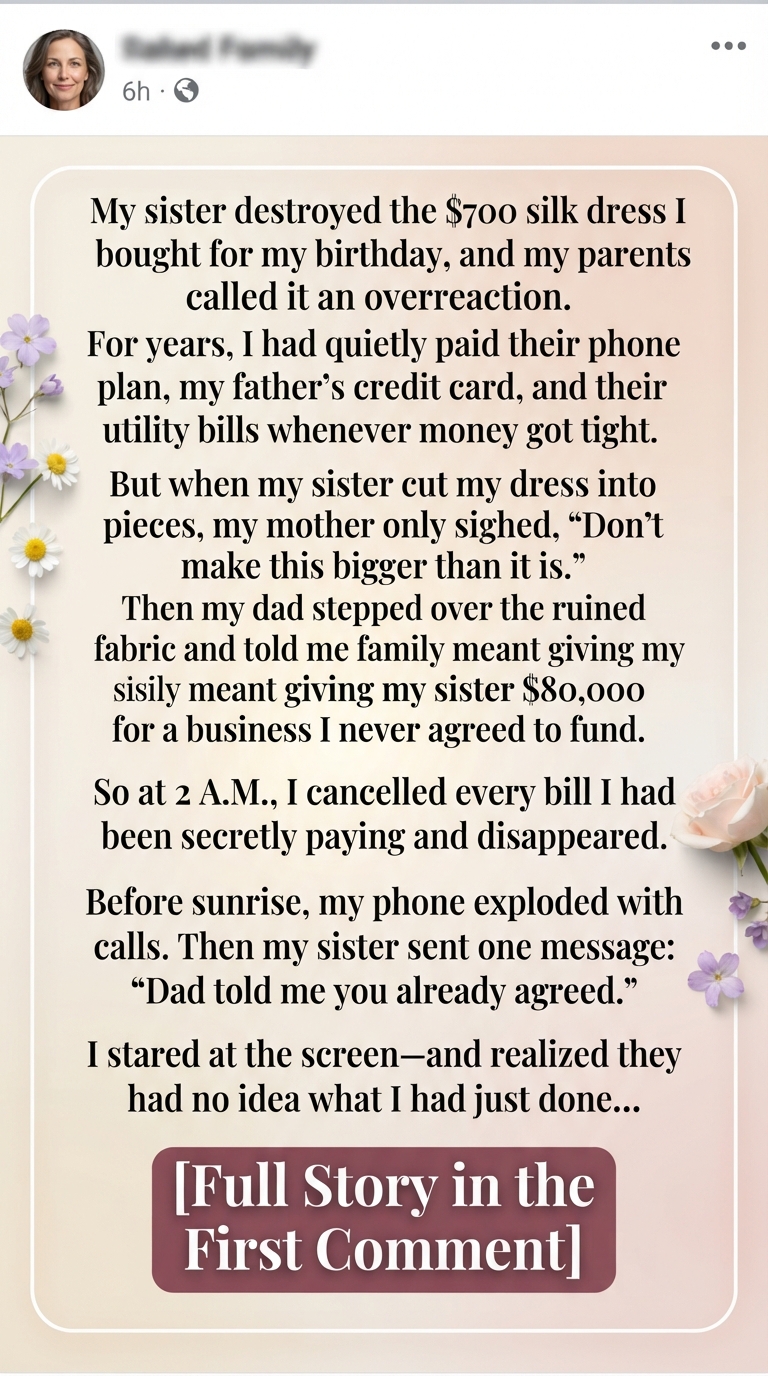
My sister destroyed the $700 silk dress I bought for my birthday, and my parents called it an overreaction.
For years, I had quietly paid their phone plan, my father’s credit card, and their utility bills whenever money got tight.
I never complained.
I never reminded them.
I never sent them an invoice.
I simply helped because they were my family.
But that night, something inside me finally broke.
My birthday had started beautifully.
I had taken the afternoon off work.
I bought myself a $700 silk dress I had been saving for months.
It was champagne-colored, simple, elegant, and exactly the kind of thing I normally talked myself out of buying.
I wanted one thing for myself.
A reminder that I was allowed to celebrate my own life.
I arrived at my parents’ house carrying a cake and a bottle of wine.
My mother opened the door.
“Happy birthday, sweetheart,” she said.
My father hugged me.
Then my younger sister, Madison, appeared from the kitchen.
She looked at my dress.
“You actually spent $700 on that?”
I smiled.
“It’s my birthday.”
She rolled her eyes.
“Must be nice.”
I ignored the comment.
Dinner started normally.
Then Madison began talking about her new business idea.
She wanted to open a luxury event-planning company.
She had already chosen a name.
She had already designed a logo.
She had already rented an office.
There was only one problem.
She didn’t have enough money.
“I need $80,000 to get everything running,” she announced.
I nearly choked on my drink.
My father looked directly at me.
I already knew what was coming.
“Your sister has a real opportunity here.”
I put my glass down.
“Dad, I don’t have $80,000 to give her.”
My mother looked surprised.
“You don’t have to give it all at once.”
“I said no.”
Madison laughed.
“You’re always acting like you’re so successful.”
I stared at her.
“I never said that.”
“You don’t have to.”
She stood up.
“You drive a nice car. You have a good job. You buy $700 dresses.”
I looked at my parents.
“That’s what this is about?”
My mother sighed.
“Don’t make this difficult.”
I couldn’t believe what I was hearing.
For years, whenever they were short on money, I had quietly covered their bills.
Their phone plan.
Their electricity.
Their water.
Their internet.
My father’s credit card.
Sometimes groceries.
Sometimes insurance.
I had never told Madison.
I had never told anyone.
I didn’t want my parents to feel ashamed.
But apparently, they had mistaken my kindness for an obligation.
Madison walked toward me.
“You should help family.”
“I already do.”
“Not enough.”
Then she grabbed the sleeve of my dress.
I pulled back.
“Madison, don’t.”
She laughed.
“You think you’re better than me?”
“No.”
“Yes, you do.”
Then she grabbed a pair of kitchen scissors.
Everything happened so quickly that I didn’t react.
She cut straight through the silk.
The sound was horrible.
A long tear opened across the dress.
I stared at it.
She cut again.
And again.
Within seconds, my $700 birthday dress was hanging in ruined strips around me.
Nobody moved.
I looked at my mother.
“Mom?”
She sighed.
“It’s just a dress.”
I looked at my father.
He stepped over a piece of torn silk on the floor.
“Don’t make this bigger than it is.”
I couldn’t speak.
My sister dropped the scissors.
Then my father said the words that ended everything.
“Family means helping Madison.”
I stared at him.
“How much?”
“Eighty thousand.”
I laughed.
Not because it was funny.
Because I suddenly realized something.
They weren’t asking me.
They had already decided.
I stood there in a ruined dress while the people I had spent years supporting demanded another $80,000.
My mother said,
“You can afford it.”
I looked at her.
“You don’t know what I can afford.”
She frowned.
“Of course we do.”
No.
They didn’t.
They didn’t know about my savings.
They didn’t know about my investments.
They didn’t know how much I had spent helping them.
And they definitely didn’t know what I was about to do.
I left without another word.
I drove home.
I took off the ruined dress.
I placed it on the floor.
Then I opened my laptop.
It was 2:03 a.m.
I logged into my banking account.
Then I opened every recurring payment connected to my parents.
Phone plan.
Canceled.
Electricity.
Canceled.
Water.
Canceled.
Internet.
Canceled.
Insurance.
Canceled.
My father’s credit card payment.
Canceled.
Their streaming subscriptions.
Canceled.
Their grocery delivery account.
Canceled.
Their automatic utility transfers.
Canceled.
Then I looked at the final monthly transfer.
The one I had been making for years.
I stopped it too.
I sat back.
For the first time in years, I wasn’t responsible for keeping their household running.
Then I opened my contacts.
I blocked my parents.
I blocked Madison.
I turned off my phone.
And I went to sleep.
At 5:47 a.m., I woke up to dozens of notifications.
Missed calls.
Voicemails.
Messages.
My father.
My mother.
Madison.
My aunt.
My cousin.
Then another call.
Then another.
I ignored them all.
At 6:12, a message from Madison appeared.
**“Dad told me you already agreed.”**
I stared at the screen.
Then another message arrived.
**“Why did the electricity company say the payment was canceled?”**
Then another.
**“Mom says the phone is going to be disconnected.”**
Then:
**“What did you do?”**
I didn’t answer.
For the first time, I wanted them to experience the consequences without me explaining them away.
At 7:30, my mother left a voicemail.
Her voice was panicked.
“Please call me. Your father’s card was declined.”
I listened.
Then deleted it.
At 8:04, my father called.
I answered.
“What did you do?”
His voice was furious.
I stayed quiet.
“You canceled everything?”
“Yes.”
“How could you do this to us?”
I almost laughed.
“How could I?”
“You know we’re depending on you.”
I looked at the ruined dress lying across my chair.
“You were depending on me.”
“We’re family!”
“So was I.”
Silence.
My father didn’t know what to say.
I continued.
“For years, I paid your bills because I wanted to help.”
“You didn’t tell us you were struggling.”
“I wasn’t struggling.”
“Then why stop?”
“Because you stopped treating my help like kindness.”
He became angry.
“You’re punishing us over a dress?”
“No.”
I took a breath.
“I’m stopping because you demanded $80,000 after your daughter destroyed something I bought for myself, and both of you told me it wasn’t important.”
My father said nothing.
Then my mother got on the phone.
“Madison was upset.”
“She cut my dress into pieces.”
“She made a mistake.”
“A mistake is spilling wine on something.”
I paused.
“Cutting it apart was a choice.”
My mother started crying.
“We’re your parents.”
“And I was your daughter.”
She went silent.
I hung up.
I thought that was the end.
It wasn’t.
Two days later, I received a letter from the bank.
My father’s credit card account was delinquent.
The utility companies had contacted them.
The phone company had suspended service.
My mother called from a neighbor’s phone.
She begged me to restore everything.
I told her no.
Then she said something I never expected.
“Your father told Madison you had agreed to give her the $80,000.”
I froze.
“He told her what?”
“He said you promised.”
“I never did.”
“I know.”
That was the first time my mother admitted it.
My father had told Madison that the money was guaranteed.
He had even helped her sign a lease for her business based on that promise.
She had already spent nearly $12,000 expecting my money.
Now she was furious.
Not at my father.
At me.
She sent me a message.
**“You ruined my business.”**
I replied with one sentence.
**“No. You built a business using money you never had.”**
She responded immediately.
**“Dad said you would pay.”**
I wrote:
**“Then ask Dad.”**
That sentence changed everything.
Madison went to my father.
And apparently, the argument was explosive.
Because my father finally admitted he had lied.
He had assumed I would eventually give in.
He had assumed that because I had always helped, I would keep helping.
He had never expected me to stop.
Neither had my mother.
Neither had Madison.
And that’s when I realized how much power I had given them without noticing.
My silence had taught them that my boundaries didn’t matter.
My generosity had taught them that there would always be another payment.
My forgiveness had taught them that they never had to apologize.
So I stopped.
Completely.
Months passed.
I didn’t speak to my family.
I focused on myself.
I rebuilt my savings.
I traveled.
I started taking art classes.
I bought myself another dress.
This time, it was even more expensive.
But the price wasn’t what mattered.
I bought it because I wanted it.
Not because I needed permission.
Not because I needed anyone to understand.
One evening, I received a handwritten letter from my father.
I almost threw it away.
Instead, I opened it.
He wrote:
“I don’t know when I stopped seeing you as my daughter and started seeing you as the person who could fix everything.”
I kept reading.
“I thought because you were capable, you weren’t hurt by what we asked.”
My eyes filled with tears.
Then he wrote:
“When you stopped paying everything, I realized how much of our life had been built on your sacrifice.”
He apologized.
For the credit card.
For the bills.
For the $80,000.
And for the dress.
But there was one sentence that stayed with me.
**“I thought you would always come back because you loved us. I didn’t understand that loving someone doesn’t mean allowing them to use you.”**
I folded the letter.
I didn’t immediately forgive him.
But I finally believed the apology was real.
Months later, I agreed to meet my parents.
We sat at a quiet restaurant.
My father looked older.
My mother looked tired.
Madison wasn’t there.
My father spoke first.
“We’re sorry.”
I nodded.
“I know.”
“We don’t expect you to pay anything anymore.”
“Good.”
He smiled sadly.
“You’re still blunt.”
“I learned.”
My mother reached across the table.
“We miss you.”
I looked at her.
“I miss who I thought my family was.”
She started crying.
I didn’t.
Because I had already cried enough.
My father asked,
“Is there a way back?”
I thought for a long time.
“Yes.”
His face brightened.
“But it won’t be the way it was.”
He nodded.
“What does that mean?”
“It means I can love you without funding you.”
He looked down.
“I understand.”
“And if Madison wants to build a business, she needs to build it herself.”
He nodded.
“And if someone destroys my belongings, they don’t get to tell me I’m overreacting.”
My mother whispered,
“You’re right.”
That was the first time she said it.
No excuses.
No defense.
Just two words.
You’re right.
Our relationship didn’t become perfect overnight.
It took time.
Madison eventually abandoned the business idea and found a job.
My father learned to manage his finances.
My mother stopped asking me for money.
And I learned something I should have learned years earlier.
Helping people is beautiful.
But helping someone doesn’t mean becoming responsible for their entire life.
Family isn’t a license to demand sacrifice.
Love isn’t an unlimited bank account.
And generosity isn’t consent.
The $700 dress was never really about the dress.
It was about everything that happened before it.
Every bill I paid quietly.
Every time I rescued them.
Every time I said yes when I wanted to say no.
Every time they assumed I’d handle it.
My sister didn’t destroy a dress that night.
She destroyed the version of me who believed I had to keep earning my place in my own family by sacrificing for everyone else.
And when I canceled those payments at 2 a.m., I wasn’t abandoning my family.
I was finally refusing to abandon myself.
A year later, I celebrated my birthday alone with a small group of friends.
I wore a beautiful silk dress.
Not the same one.
A new one.
My father sent me flowers.
My mother sent a card.
And inside the card was a sentence I never expected to read.
**“You don’t owe us anything. We are grateful you’re our daughter.”**
I smiled.
Then I put the card beside the flowers.
The old dress was gone.
But I kept one small piece of the torn silk.
I placed it inside a drawer with the acceptance letters, photographs, and other memories from my life.
Not because I was angry.
Because I wanted to remember the night I finally understood my worth.
At 2 a.m., I canceled every bill I had secretly been paying.
By sunrise, my family realized just how much of their life had been held together by someone they had taken for granted.
They thought they had lost my money.
They hadn’t.
They had lost access to it.
What they eventually got back was something far more valuable.
A daughter who could finally say no.
And a family that, for the first time, had to learn how to love her without a price tag attached.
