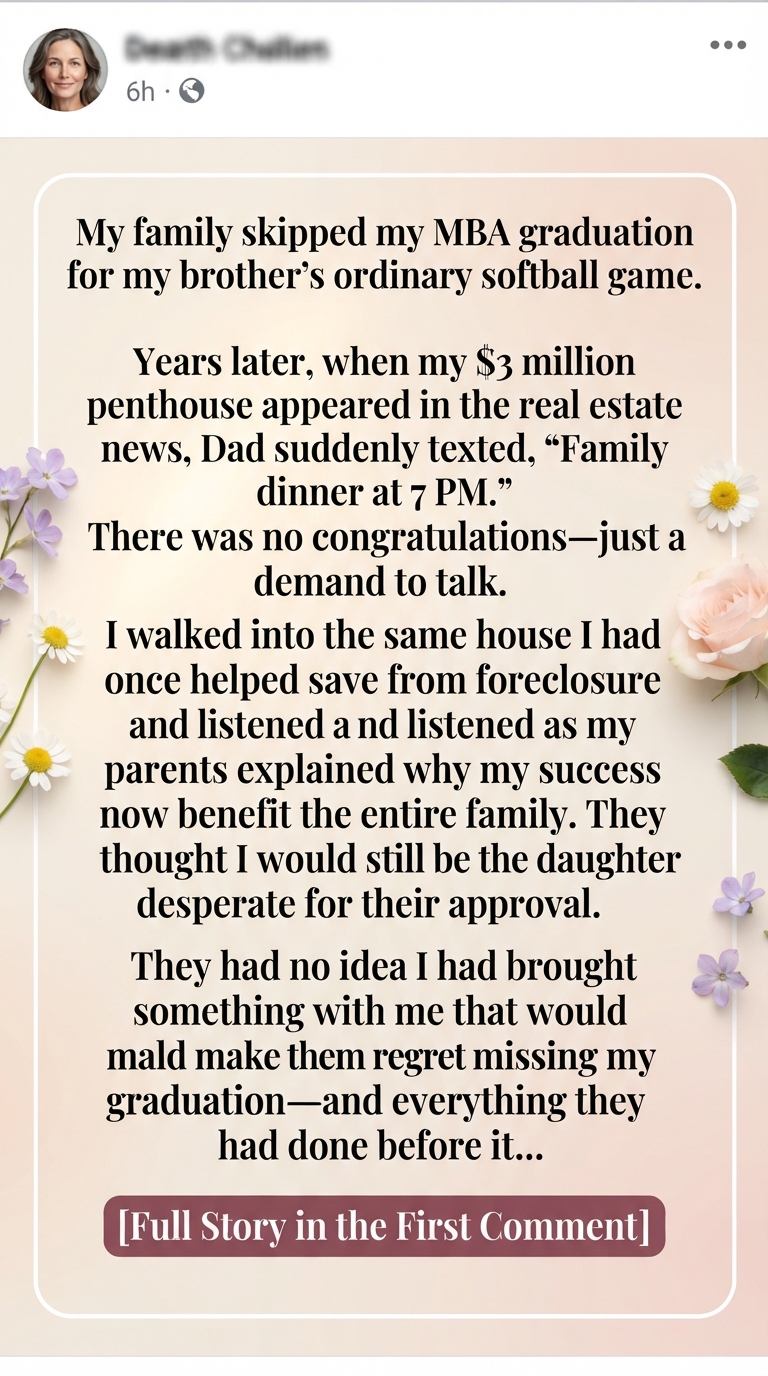
My family skipped my MBA graduation for my brother’s ordinary softball game. Years later, when my $3 million penthouse appeared in the real estate news, Dad suddenly texted,
“Family dinner at 7 PM.” There was no congratulations—just a demand to talk. I walked into the same house I had once helped save from foreclosure
and listened as my parents explained why my success should now benefit the entire family. They thought I would still be the daughter desperate for their approval.
They had no idea I had brought something with me that would make them regret missing my graduation—and everything they had done before it. For most of my life,
I had been the daughter who was expected to understand. If my brother needed something, I understood. If my parents were short on money, I understood.
If my achievements had to be pushed aside because my brother had a game, a party, a problem, or simply wanted attention, I understood. My brother, Tyler, was the golden child.
He wasn’t a bad person, exactly. He just grew up believing the world would rearrange itself for him. I was different. I studied. I worked. I saved.
And whenever someone asked what I wanted to do with my life, I usually gave the answer that made my parents proud. “I want to build something of my own.”
They always smiled politely. Then they would turn back to Tyler. When I received my acceptance letter to an MBA program at one of the best business schools in the state,
I thought that might finally change things. I remember calling Mom first. “I got in,” I said, trying not to cry. There was a pause. Then she said, “That’s wonderful, honey.
Tyler has practice tonight, though. Can we talk later?” I stood there holding the phone. “Sure,” I said. That was how it always happened.
My biggest moments were always scheduled around his smallest ones. I worked two jobs during my MBA. During the day, I attended classes. At night, I worked as a financial analyst.
On weekends, I helped my parents whenever they asked. And they asked often. One month, Dad called me because the mortgage on their house was three months behind.
“We’re going to lose the house,” he admitted. I remember driving over that evening. My childhood home looked exactly the same. The same porch. The same cracked flowerpot.
The same little dent in the garage door from when Tyler had backed into it years earlier. I sat at the kitchen table with Dad and opened my laptop. “How much do you owe?” He looked embarrassed.
“About $18,000.” I stared at him. “That much?” “We’ll pay you back.” I knew he couldn’t. Still, I transferred the money. Then I paid another $6,000 the following month when the property taxes came due.
Mom cried and hugged me. “You saved this family,” she whispered. For one brief moment, I believed she meant it. A few months later, Tyler needed money for a new car.
Dad told me he was “between jobs.” So I helped again. I didn’t complain. I thought that’s what families did. Then came my MBA graduation. I had worked for years for that day.
I rented my cap and gown. I invited my parents weeks in advance. I sent them the ceremony details. I even reserved seats. The night before graduation, Mom called.
“Sweetheart, don’t be upset.” Those words immediately made my stomach drop. “What happened?” “Tyler’s team made the playoffs.” I waited. “And?” “His game is the same morning as your graduation.”
I laughed because I thought she was joking. She wasn’t. “Mom, it’s my MBA graduation.” “I know.” “You told me you’d be there.” “We’ll celebrate with you afterward.”
I looked at the graduation invitation sitting on my desk. “Okay,” I whispered. The next morning, I walked across that stage alone. I searched the crowd anyway.
Maybe they had surprised me. Maybe they’d changed their minds. They hadn’t. My seat afterward was surrounded by families taking pictures. Mothers crying. Fathers holding flowers. Siblings cheering.
I stood there holding my diploma while my phone remained silent. Then, around noon, Mom finally texted. “Hope everything went well! How did Tyler’s game go?” I stared at the message for almost a minute.
Then I turned my phone off. Something inside me changed that day. Not dramatically. Not loudly. I simply stopped waiting. I stopped trying to earn their attention. I stopped explaining my worth.
And I started building my own life. Over the next several years, my career took off. I joined a small investment firm and eventually became a partner. I learned how businesses were bought, sold, built,
and rebuilt. I invested carefully. I made mistakes. I recovered. And slowly, I became financially independent. I didn’t tell my parents how much I earned. I didn’t tell them about my investments.
I didn’t tell them about the company I quietly started with two friends. I certainly didn’t tell them that, after years of work, I had become wealthy enough to buy a penthouse overlooking the city.
The penthouse cost $3 million. It had floor-to-ceiling windows, a private elevator, a rooftop terrace, and a view that stretched across the entire skyline. When I signed the papers,
I sat alone in the empty living room. I looked out over the city and smiled. I thought about the girl who had once stood alone at her MBA graduation. She would never have believed this was possible.
A week later, a real estate magazine published an article about luxury properties in the city. My penthouse was featured. My name wasn’t in the headline, but the purchase was public record.
My phone started ringing the next morning. The first call was from Dad. I didn’t answer. Then came a text. “Family dinner at 7 PM.” No congratulations. No “I’m proud of you.” No “How have you been?” Just a command.
I almost ignored it. But something told me to go. At exactly 7 PM, I pulled into my parents’ driveway. The same house. The same porch. The same cracked flowerpot. The house I had once helped save from foreclosure.
I walked inside. Mom hugged me immediately. “You look wonderful.” Dad smiled. “Sit down.” Tyler was already there. He looked older. Not unsuccessful, exactly. Just ordinary.
He was wearing an expensive watch. I knew immediately that someone had told him about my penthouse. Dinner was already served. Nobody touched their food. Finally, Dad cleared his throat.
“We need to talk about the family.” I almost smiled. “What about the family?” Dad leaned forward. “You’ve done very well for yourself.” “Thank you.” “You have more than enough now.” I waited.
Mom reached across the table. “We think it’s time you started helping the family the way you should.” I looked at her. “The way I should?” “You know what we mean.” Tyler finally spoke.
“You have a three-million-dollar penthouse.” I nodded. “So?” “So it’s excessive,” he said. I laughed softly. “It’s my money.” Dad frowned. “We’re your parents.” “I know.” “And Tyler is your brother.”
“I know.” Mom looked uncomfortable. “We’re not asking you to give everything away.” “What are you asking for?” Silence. Then Dad said it. “We want you to sell the penthouse.” I stared at him.
“What?” “It’s too much money tied up in one property. You could buy something smaller and use the difference to help the family.” Tyler leaned back. “We could finally fix the house.” Mom added,
“And Tyler is trying to start a business.” I looked at my brother. “What kind of business?” He shrugged. “Real estate.” I almost laughed. “You want me to sell my home to finance your real estate business?” “Not exactly.”
“Then exactly what do you want?” Dad placed a folder on the table. “We made some calculations.” I opened it. Inside was a list. Mortgage payments. Credit card balances. Tyler’s business expenses. Parents’ home repairs.
Car payments. Medical bills. Vacation expenses. And beside the total was a number. $612,400. I slowly closed the folder. “You want me to pay six hundred thousand dollars?” Dad shook his head.
“We want you to help us.” I looked around the table. The same people who had skipped my graduation. The same people I had rescued from foreclosure. The same people who had told me family came first.
Now they were calculating how much of my success belonged to them. I reached into my bag and placed another folder on the table. Dad’s expression changed. “What’s that?” “Something you should have received years ago.”
Mom opened it. Inside were copies of bank transfers. $18,000. $6,000. $9,500. $4,800. More payments followed. I had documented every dollar I’d given them. Dad’s face went pale. “You kept records?” “Yes.”
“Why?” “Because I learned something during business school.” I looked at him. “Family promises aren’t contracts.” Tyler scoffed. “So you’re keeping score?” “No.” I opened the folder again.
“I stopped keeping score a long time ago.” Then I pulled out the final document. Dad stared at it. His face changed completely. “What is this?” “It’s the deed.” Mom looked confused. “The house?” I nodded.
“Your house.” Dad stared at me. “I don’t understand.” “You shouldn’t.” I told them the truth. Years earlier, when I had saved their home from foreclosure, I hadn’t simply paid their overdue mortgage.
I had negotiated with the lender. I had also purchased the outstanding lien through a private investment vehicle I controlled. I had never told them. They thought I had simply given them money.
I had actually become the person who legally held the debt against the property. And over the years, I had quietly paid additional taxes and legal fees to keep the house from being seized.
Mom covered her mouth. “You own the debt?” “Yes.” Dad stood up. “You can’t do this.” “I already did.” Tyler suddenly became angry. “So what? You’re threatening to take our house?” “No.” I looked at him.
“I’m giving it to you.” Everyone froze. Dad slowly sat back down. “What?” “I paid everything. The debt is settled.” I pushed another document toward him. “The house is yours. Completely.
No mortgage arrears. No lien. Nothing.” Mom started crying. I continued. “But there is one condition.” Dad swallowed. “What condition?” “You stop treating me like an emergency bank account.” Nobody spoke.
“I don’t owe you my income,” I said. “I don’t owe Tyler a business. I don’t owe anyone an explanation for what I built.” Tyler looked furious. “You think you’re better than us now?” “No.” I stood up.
“I think I’m finally done believing I’m less than you.” Mom began sobbing. Dad looked down at the papers. For the first time in my life, he seemed to understand what his behavior had cost him.
“You were really hurt by graduation, weren’t you?” I looked at him. “I wasn’t hurt because you missed one ceremony.” I paused. “I was hurt because you showed me exactly where I stood.” His eyes filled with tears.
“You were never second.” I shook my head. “You just made me feel that way.” I walked toward the door. Then Dad said something that stopped me. “I watched the news about your penthouse.” I turned around.
He continued. “I saw your name beside that $3 million property.” He wiped his eyes. “And for the first time, I realized I had spent my whole life waiting for you to need us.” I said nothing. He looked at me.
“But you don’t need us anymore.” “No,” I said quietly. “I don’t.” Mom walked toward me. “Will you ever forgive us?” I thought about the graduation. The empty seat. The silent phone. The years of being overlooked.
Then I thought about the house. The childhood memories. The family I had once desperately wanted. “I forgive you,” I said. Mom cried harder. “But forgiveness doesn’t mean I go back.” She nodded. And I left.
For the first time, I didn’t feel guilty walking away. Months passed. I didn’t hear much from my family. Then one afternoon, I received a letter from Dad. He didn’t ask for money. He didn’t mention the penthouse.
He didn’t mention Tyler. He simply wrote that he was sorry. He said he had spent years confusing financial success with family responsibility. He said missing my graduation had been one of the biggest regrets of his life.
At the bottom, he wrote, “I hope one day you understand that we are proud of you. We just didn’t know how to show it until it was too late.” I read the letter twice. Then I put it in a drawer. Not because I hated him.
Because I was finally learning that peace didn’t require forgetting. A year later, I returned to my parents’ house. The porch had been repaired. The flowerpot was gone. The house looked different.
But when I walked inside, I saw the same old family photographs. Mom hugged me. Dad smiled. Tyler was there too. He didn’t ask for money. He asked me about my company. For the first time,
he seemed genuinely interested in what I had built. We talked for hours. There was no perfect reconciliation. No magical ending. But there was something better. Boundaries. Respect.
And the understanding that family wasn’t supposed to be a financial obligation. Before I left, Dad walked me to my car. “I wish we’d been there,” he said. I knew exactly what he meant. “My graduation.”
I looked at him. “So do I.” He nodded. Then he said, “But I’m glad you didn’t let us being absent stop you.” I smiled. “I almost did.” He looked surprised. “I spent years thinking I needed you to be proud of me.”
I looked back at the house. “Then I realized I needed to be proud of myself.” I drove home that night to my $3 million penthouse. I walked onto the balcony and looked across the city. Years ago,
I had stood alone on a graduation stage wondering why I wasn’t enough. Now I understood. I had never been the problem. I had simply been asking the wrong people to validate my worth.
My family skipped my graduation because they thought my brother’s ordinary softball game mattered more. Years later, they saw my success and assumed I owed them a piece of it. They were wrong.
I didn’t bring that folder to dinner to destroy my family. I brought it to finally close the chapter where I had to beg for a place at their table. And the greatest revenge wasn’t the penthouse.
It wasn’t the money. It wasn’t watching their faces when they realized I had become successful without them. The greatest revenge was walking away without needing them to regret anything at all.
Because sometimes the most powerful moment in your life isn’t when your family finally recognizes your worth. It’s when you stop needing them to. My family skipped my MBA graduation for my brother’s softball game.
Years later, they saw my $3 million penthouse in the news and suddenly remembered I was “family.” They came expecting money—but I brought the one thing they never expected: the truth about everything I had sacrificed for them.
Sometimes success isn’t about proving your family wrong. It’s about finally realizing you never needed their approval to become who you were meant to be.
