The night my marriage ended began with something as ordinary as dinner. I had spent the entire afternoon working from home, answering emails, finishing a report for my company,
and trying to ignore the strange tension that had been hanging over the house for weeks. My husband, Daniel, had barely spoken to me that day.
He had been pacing around the house, checking his phone constantly, and disappearing into the garage whenever I entered the room. I knew something was wrong,
but every time I asked him, he told me I was imagining things. By seven o’clock, I had prepared dinner and set the table. Daniel sat across from me without saying a word.
He barely touched his food. I finally looked up and asked, “Are you going to tell me what’s going on?” He stared at me for several seconds before saying,
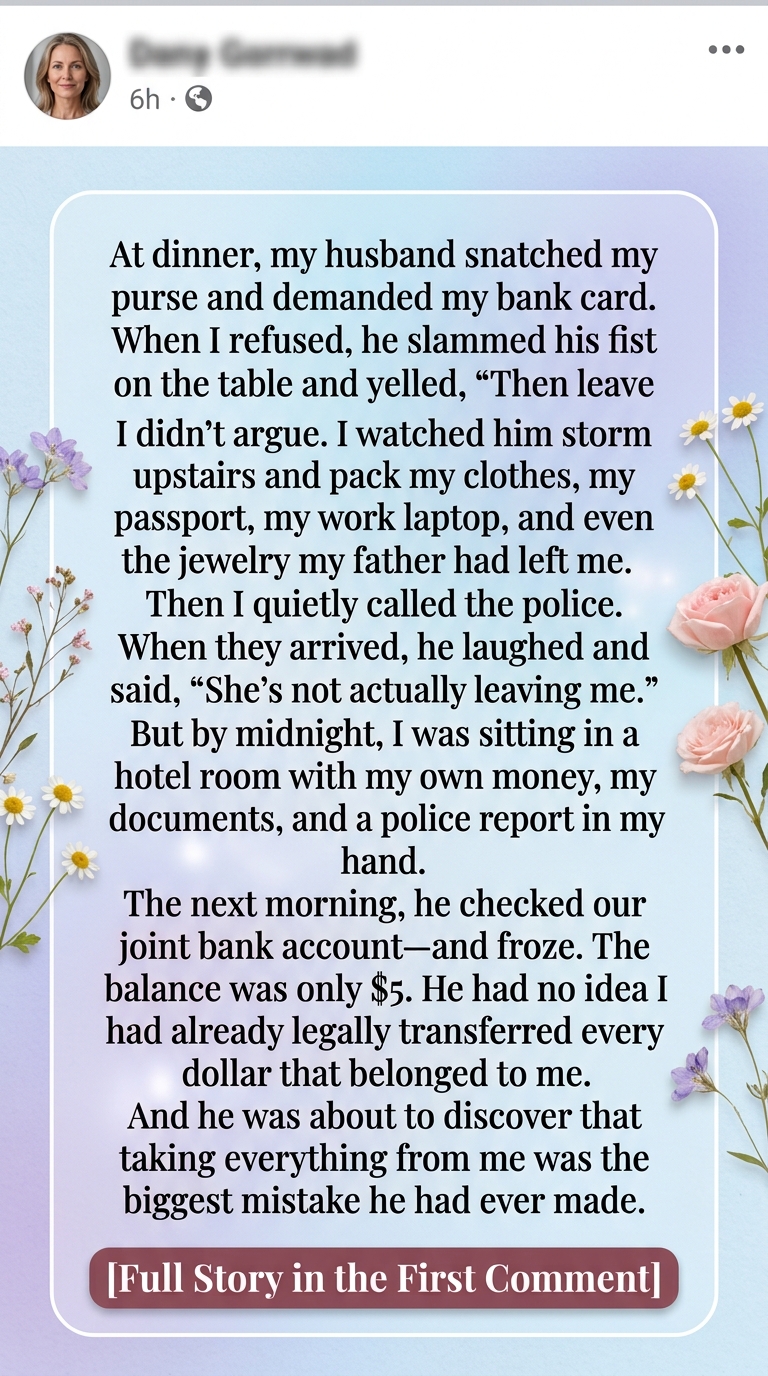
“Give me your bank card.” I thought I had misheard him. “What?” “Your bank card,” he repeated. “I need it.” I put down my fork. “Why?” His expression changed instantly. “Because I asked for it.”
“That’s not an answer.” He leaned across the table and grabbed my purse from the chair beside me. I reached for it, but he pulled it away. “Daniel, give me my purse.” Instead,
he opened it and started searching through it. When he found my wallet, he pulled out my debit card. I stood up. “Give that back.” He held it up between two fingers.
“You have enough money in your account. We need it.” “We?” I asked quietly. “Or you need it?” He slammed the card onto the table. “Stop making everything difficult.”
I took the card and put it back into my wallet. “I’m not giving you access to my personal account.” That was when he lost control.
He slammed his fist against the table so hard that the plates jumped. “Then leave with nothing!” he shouted. The room went completely silent. I stared at him.
He was breathing heavily, his face red with anger. “You heard me,” he continued. “If you want to walk out that door, you take nothing. No money. No furniture. Nothing from this house.”
I looked around the dining room. For years, I had believed this house was our home. I had helped choose the curtains, paid half the mortgage, bought most of the furniture,
and spent countless weekends repairing, cleaning, and maintaining the place. Yet in that moment, I realized Daniel had never thought of it as something we built together.
He thought it was something he controlled. I didn’t argue. I didn’t cry. I simply sat back down and looked at him. He seemed almost surprised by my silence. “What?” he asked. “Nothing,”
I said. “I’m just listening.” He stood up and stormed upstairs. I heard drawers opening and doors slamming. Then I heard him shouting from the bedroom. “Fine! I’ll pack your things!”
I remained downstairs for another minute. Then I quietly took my phone from my pocket and called the police. I explained that my husband was aggressively removing my belongings
and that I was afraid the situation could escalate. While I waited, I heard him dragging suitcases down the stairs. He had apparently decided to prove his threat.
He threw my clothes into bags without folding them. He took my passport from the bedroom drawer. He grabbed my work laptop from my office.
Then he went into the small safe where I kept the jewelry my father had left me after he died. I heard the safe click open. “Daniel,” I called from downstairs,
“put my father’s jewelry back.” He ignored me. A few minutes later, he appeared carrying another bag. “You wanted to leave,” he said. “So leave.” I looked at him carefully. “Those things don’t belong to you.” He laughed.
“Everything in this house belongs to me.” “We’ll see about that.” He rolled his eyes. “Who are you going to call? Your lawyer?” I didn’t answer. Then there was a knock at the door. Daniel froze.
Two police officers stood outside. His anger disappeared for a moment and was replaced by disbelief. “You called the police?” he asked. I nodded. One officer spoke calmly. “Sir,
we received a call regarding a domestic dispute. We’d like to speak with both of you separately.” Daniel started laughing. “This is ridiculous.
She’s not actually leaving me.” The officer looked at him. “That’s not something you get to decide.” Daniel tried to explain that the house was his,
that I was being dramatic, and that he had simply told me to leave. But the officer asked about the belongings he had packed. When they opened the bags, my passport, laptop, clothing,
and my father’s jewelry were all there. I showed the officers photographs of the jewelry, receipts for several items, and documents proving ownership of my personal property.
The officers told Daniel that he couldn’t simply take or destroy my belongings because he was angry. They documented what had happened and helped me gather the essentials I needed for the night. Before I left,
Daniel stood in the hallway with his arms crossed. “You’re really doing this?” he asked. I looked at him. “You told me to leave.” “I didn’t mean it.” “You said it twice.” He looked away.
I picked up my suitcase. “Goodbye, Daniel.” He laughed again. “You’ll be back tomorrow.” I didn’t respond. By midnight, I was sitting alone in a hotel room. I placed my passport on the desk.
My laptop was beside it. My father’s jewelry was safely locked in the hotel’s safe. And in my hand was the police report documenting what had happened. For the first time in months, I could breathe.
I sat on the edge of the bed and thought about all the warning signs I had ignored. Daniel had slowly taken control of everything. He criticized my spending. He questioned every purchase.
He complained whenever I saved money separately. He insisted that because we were married, he deserved access to everything I earned. Whenever I resisted, he called me selfish.
I had spent years trying to keep the peace, believing that if I worked harder and communicated better, our marriage would improve.
That night, I finally understood something important: peace isn’t real when one person has to surrender themselves to maintain it. The next morning, I woke up before sunrise.
I checked my phone. There were seventeen missed calls from Daniel. Then another message appeared. “You need to come home. We need to talk.” I didn’t answer. Instead,
I contacted my attorney. We had spoken months earlier about financial planning, because I had become increasingly concerned about Daniel’s behavior.
I had quietly documented my earnings, account statements, property contributions, and important documents. I had also made sure that money belonging solely to me was kept separate and legally protected.
My attorney confirmed that the steps I had taken were lawful and documented. Then, at around eight in the morning, my phone rang again. This time it wasn’t Daniel. It was a bank notification.
A large withdrawal attempt had been made from our joint account. It had been declined. I opened the account and stared at the balance. Five dollars. Exactly five dollars remained.
I knew what Daniel would see when he checked. And I knew he would think I had done something terrible. But the truth was much simpler: I had protected my own money before he could take it.
Money that belonged to me had been transferred into an account in my name through lawful financial arrangements. Nothing had been hidden from the bank. Nothing had been falsified. I hadn’t stolen his money.
I had simply stopped allowing him to treat my earnings as if they belonged entirely to him. At 8:17 a.m., my phone rang. Daniel. I let it go to voicemail. He called again. Then again.
Finally, a message arrived. “What did you do?” I didn’t answer. Another message came seconds later. “The account is empty.” Then: “You transferred the money.” Then: “Put it back.” I stared at the screen.
For years, whenever Daniel wanted something, he expected immediate obedience. Now he was discovering that he couldn’t command me anymore. I contacted my attorney and followed the legal process for separation
and division of marital property. Over the next several weeks, the reality of our situation became clear. Daniel had assumed that because he was louder, more aggressive, and more confident,
he would automatically control the outcome. He was wrong. Bank statements showed what each of us had contributed. Property records showed ownership. Receipts documented my personal belongings.
My father’s jewelry had been legally inherited by me and was never marital property. My work laptop belonged to my employer. My passport was my personal document.
Piece by piece, the story Daniel had told himself began falling apart. He had believed that saying “leave with nothing” made it true. It didn’t. A sentence spoken in anger couldn’t erase years of financial records,
legal documents, or my rights. Then came the court hearing. Daniel arrived looking confident. He had hired an attorney and apparently expected the entire matter to be settled in his favor.
When the judge asked about the night of the incident, Daniel claimed I had “abandoned the marriage.” My attorney presented the police report. Then came photographs of the packed bags, records of my personal property,
and documentation showing that Daniel had attempted to take possessions that were not his. When asked why he had packed my belongings, Daniel said, “Because she said she was leaving.” The judge asked,
“And why did she say she was leaving?” Daniel went silent. My attorney then presented the financial records. The money I had transferred before leaving was carefully documented.
It was not some secret fortune I had stolen from our marriage. It was money that could be traced to my personal earnings and assets.
The judge reviewed the records and instructed both sides to follow the applicable property-division process. Daniel’s face changed when he realized there would be no magical moment where he could simply declare everything his.
Months passed. I moved into a small apartment of my own. It wasn’t luxurious. It wasn’t the house I had once shared with Daniel. But every morning when I woke up, I felt something I hadn’t felt in years: peace.
I bought a secondhand table for my kitchen. I hung a photograph of my father above it. I put my favorite books on a shelf. I began cooking again—not because I had to, but because I enjoyed it.
I went back to seeing friends I had slowly stopped seeing. I started taking weekend trips. I focused on my career. And little by little, I stopped measuring my life by Daniel’s approval.
One afternoon, nearly a year after that dinner, I received an envelope in the mail. Inside was the final paperwork confirming the conclusion of our divorce. I read it twice.
Then I placed it on the table beneath my father’s photograph. I expected to feel devastated. Instead, I felt relieved. That evening, I cooked myself dinner and sat at the table alone.
I remembered the night Daniel had slammed his fist down and told me to leave with nothing. I remembered how frightened I had been. I remembered sitting in that hotel room with my passport, my laptop,
my father’s jewelry, and the police report beside me. And then I smiled. Because Daniel had been right about one thing. I had left. But I had not left with nothing.
I had left with my documents, my dignity, my independence, my career, my memories, and the knowledge that I could protect myself. More importantly,
I had left behind the version of myself who believed that keeping a marriage together was worth losing herself. Daniel had thought taking everything from me would make me powerless.
Instead, it forced me to discover how powerful I could be when I stopped asking permission to protect my own life. A few weeks later, I received one final message from him.
“I never thought you’d actually leave.” I looked at the words for a long time. Then I typed one sentence. “Neither did I.” I didn’t send it. I deleted the message and put my phone down.
There was no need for a final argument. No dramatic confrontation. No revenge. My life had already become the answer. The man who once told me I would leave with nothing had spent months discovering
that he had lost something far more valuable than money. He had lost the person who had spent years believing his promises.
And I had finally gained something money could never buy: the freedom to decide what my life would become. That night, I turned off the lights, locked my apartment door, and smiled at the quiet.
For the first time, the silence didn’t feel lonely. It felt like freedom.
