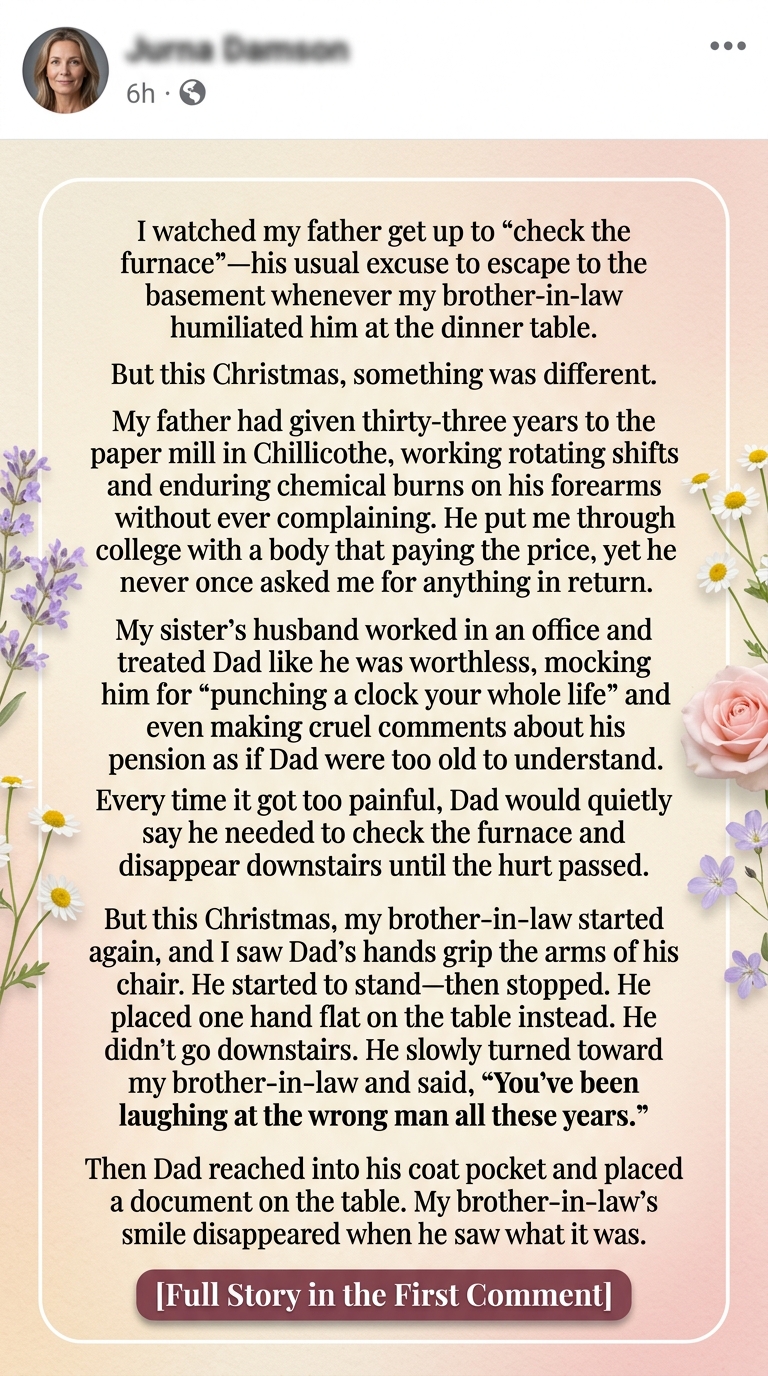
I watched my father get up to “check the furnace”—his usual excuse to escape to the basement whenever my brother-in-law humiliated him at the dinner table.
But this Christmas, something was different.
My father had given thirty-three years to the paper mill in Chillicothe.
Thirty-three years of rotating shifts.
Thirty-three years of waking before sunrise, coming home after midnight, and sleeping through holidays because the mill needed another man on the floor.
He had chemical burns scattered across his forearms that he rarely talked about. His knees ached when the weather changed. Some mornings, he needed both hands to push himself out of his chair.
But he never complained.
Not when the doctor told him his body was paying for decades of factory work.
Not when his pension turned out to be smaller than he’d hoped.
And certainly not when his own son-in-law treated him like he was some relic from another century.
My father had always believed that providing for your family was simply what you did.
He never asked for praise.
He never asked for gratitude.
And he never reminded me that the reason I had been able to attend college was because he had spent years destroying his back and lungs working overtime.
I remembered being eighteen, standing in our kitchen with my college acceptance letter trembling in my hands.
“I can’t afford this,” I’d said.
Dad had looked at me over his coffee.
“You don’t have to afford it,” he said.
“I don’t understand.”
“You’re going.”
“How?”
He smiled.
“I’ll figure it out.”
And he did.
He sold his fishing boat.
He worked extra shifts.
He stopped buying things for himself.
Years later, I learned he’d even borrowed against part of his retirement savings.
I had never forgotten that.
My sister’s husband, however, seemed determined to forget everything Dad had ever done.
His name was Greg.
Greg worked in an air-conditioned office downtown, wore expensive watches, and liked telling everyone how important his job was.
At family dinners, he had a particular habit.
He would wait until Dad was comfortable, then make a joke at his expense.
“So, Jim,” he’d say, “how does it feel finally being done with the punching clock?”
Dad would usually smile politely.
“Feels pretty good.”
Greg would laugh.
“I wouldn’t know. I’ve never spent my life waiting for someone else to tell me when I could go home.”
Another time, Greg looked at Dad’s old truck parked outside and said, “You ever think about upgrading? Or is that pension barely keeping the lights on?”
My father had stared at his plate.
My mother wasn’t around anymore to shut Greg down.
My sister, Rachel, would usually give her husband a warning look.
But she never actually stopped him.
And Dad never fought back.
Whenever it became too painful, he’d push his chair back.
“I’d better check the furnace.”
Then he’d disappear downstairs.
At first, I thought he actually had a problem with the furnace.
Then I noticed something.
The furnace was always fine.
Dad just needed somewhere to go.
Somewhere nobody could see the hurt on his face.
So I started going downstairs after him.
I’d find him sitting on an old wooden stool beside the furnace, staring at the concrete floor.
“You okay?” I’d ask.
“Fine.”
“You know you don’t have to listen to him.”
Dad would shrug.
“He’s young.”
“That doesn’t make it okay.”
“He’ll grow up.”
“He’s forty-six.”
Dad would chuckle.
“Then maybe he’s got a late start.”
That was Dad.
Always finding a way to excuse someone else’s cruelty.
Until Christmas.
That year, everyone had gathered at my parents’ old house.
The living room smelled like pine and cinnamon.
The tree stood in the corner, covered in ornaments we’d collected over decades.
Dad sat in his old recliner near the fireplace.
He wore the same flannel shirt I’d given him three Christmases earlier.
Greg had brought a bottle of expensive wine and spent the first hour talking about his promotion.
Then dinner came.
We were halfway through dessert when Greg looked at Dad.
“So, Jim, what’s the big plan now?”
Dad frowned.
“What do you mean?”
“You’ve been retired for years. Still sitting around collecting that pension?”
Dad nodded.
“That’s generally how pensions work.”
Everyone laughed except Greg.
He leaned back.
“You know, I just can’t imagine spending thirty-three years doing the same thing.”
Dad said nothing.
Greg continued.
“I mean, no offense, but you never really moved up, did you?”
I felt my stomach tighten.
“Greg,” I said.
He waved me off.
“I’m just talking.”
Then he looked at Dad.
“Punching a clock your whole life doesn’t exactly make you successful.”
The room went quiet.
Dad’s jaw tightened.
His hands gripped the arms of the chair.
Greg smiled.
“And now you’re living off a pension while everyone else is still working.”
That was when I saw Dad start to stand.
For one second, I thought I knew exactly what he was going to do.
“Check the furnace.”
But he didn’t.
He stopped halfway up.
His hand moved to the table.
He stood there, breathing slowly.
Then he turned toward Greg.
And for the first time in my entire life, I saw something in my father’s eyes I’d never seen before.
Not anger.
Not shame.
Something calmer.
Final.
Dad said,
“You’ve been laughing at the wrong man all these years.”
Greg’s smile disappeared.
Dad reached into his coat pocket.
He pulled out a folded document.
He placed it on the table.
Greg glanced at it.
Then his face changed.
“What is that?”
Dad pushed it toward him.
“Read it.”
Greg picked it up.
His eyes moved across the page.
Then stopped.
“What…?”
My sister leaned forward.
“What does it say?”
Greg didn’t answer.
I reached for the document.
It was a property deed.
But not just any property deed.
It was for the warehouse on the south side of Chillicothe.
The same warehouse Greg’s company had been trying to purchase for nearly two years.
I knew because Greg had talked about it at practically every family gathering.
His company wanted the property badly.
The location was perfect.
The building was already equipped with loading bays, storage areas, and rail access.
But the owner had refused to sell.
Greg had complained about it for months.
Now I understood why.
I looked at the name on the deed.
James Carter.
My father’s name.
“Dad,” I whispered.
He nodded.
“I bought it twenty years ago.”
Greg stared at him.
“You own that?”
Dad nodded.
“I do.”
“But…”
Greg looked confused.
“You’re retired.”
Dad smiled faintly.
“Retired from the mill. Not from thinking.”
My sister looked between them.
“Why didn’t you ever tell us?”
Dad shrugged.
“Didn’t seem important.”
Greg suddenly stood.
“You knew my company wanted that property?”
“For a while.”
“And you never said anything?”
“No.”
“Why?”
Dad looked at him.
“Because every time you talked about buying it, you talked about how stupid the old owner was for refusing your offer.”
Greg’s face reddened.
Dad continued.
“You never bothered finding out who he was.”
Silence filled the room.
Then Dad pulled another document from his pocket.
This one was thicker.
He laid it beside the deed.
“This is the purchase agreement.”
Greg picked it up.
Then another.
“Property appraisal.”
Another.
“Lease proposal.”
Another.
“Your company’s offer.”
Greg’s hands began to shake.
I looked at my father.
“Dad, what are you doing?”
He looked at me.
“Something I should’ve done a long time ago.”
He turned back to Greg.
“You’ve spent years believing a man’s job tells you his value.”
Greg swallowed.
Dad tapped the documents.
“These papers are worth more than your opinions.”
Nobody spoke.
Then Dad said something that made Greg sit down.
“I didn’t buy that building because I wanted to become rich.”
He paused.
“I bought it because I knew men like me were going to need work one day.”
Greg stared at him.
Dad explained that after thirty-three years at the mill, he’d seen too many workers get injured, laid off, or pushed aside.
So he’d started saving.
Quietly.
He invested every bonus and overtime check he could.
Eventually, he purchased the warehouse.
For years, he rented sections of it to small local businesses.
A welding company.
A furniture repair shop.
A family-owned packaging company.
A mechanic.
Five businesses were operating there.
Twenty-three people worked in the building.
And every one of them knew the landlord as “Mr. Jim.”
Dad wasn’t just collecting rent.
He kept the rent below market rate.
He helped struggling businesses stay open.
When one tenant couldn’t pay during a difficult winter, Dad told him to catch up when he could.
When another needed new equipment, Dad helped arrange financing.
He had quietly built something that supported an entire little community.
And none of us knew.
Greg finally spoke.
“So you’re refusing to sell?”
Dad looked at him.
“No.”
Greg’s eyes widened.
“You’re not?”
Dad shook his head.
“I’ll sell.”
Greg exhaled.
“But there’s one condition.”
“What?”
“You’ll pay the full market price.”
Greg nodded quickly.
“Fine.”
Dad smiled.
“And you’ll sign an agreement guaranteeing that every current tenant gets to stay for five years.”
Greg’s face fell.
“That could cost us.”
“I know.”
“And if we can’t agree?”
Dad leaned back.
“Then you don’t buy it.”
Greg stared at him.
For the first time since I’d known him, he had nothing clever to say.
Then my sister spoke.
“Dad… why didn’t you ever tell us any of this?”
Dad looked down at his hands.
“Because I didn’t want my children measuring my worth by what’s in my bank account.”
His voice softened.
“I wanted you to remember me as your father.”
I felt tears burning my eyes.
Dad looked at me.
“You remember college?”
I nodded.
“You were worried I’d regret spending the money.”
“I remember.”
“I never regretted it.”
He smiled.
“Not for one second.”
Then he looked around the table.
“I didn’t work thirty-three years because I wanted people to call me successful.”
He glanced at Greg.
“I worked because my family needed me.”
Greg lowered his eyes.
The room stayed quiet.
Finally, Greg stood.
He walked over to Dad.
For a moment, I thought he was going to argue.
Instead, he said quietly,
“I owe you an apology.”
Dad didn’t answer immediately.
Greg swallowed.
“I was wrong.”
Dad nodded once.
“I know.”
That was all.
No dramatic speech.
No shouting.
No revenge.
Just two men sitting across from each other with thirty years of assumptions finally stripped away.
A week later, Greg’s company signed the agreement.
They bought the warehouse at full market value.
Dad used part of the money to create a small scholarship fund at the local community college.
The scholarship was named after the paper mill workers of Chillicothe.
When I asked him why he didn’t put his own name on it, he laughed.
“Too much attention.”
He also set aside money for every one of his grandchildren.
But he kept enough for himself.
A comfortable home.
A new truck.
And, finally, a fishing boat.
The same kind he’d sold years ago to send me to college.
When I saw it parked beside his garage, I laughed.
“You bought another one?”
Dad smiled.
“Some things are worth getting back.”
That Christmas became the last time Dad ever said he needed to “check the furnace.”
Not because the furnace stopped working.
But because he never needed an excuse to escape from cruelty again.
Years later, whenever someone asked me what my father did for a living, I stopped saying he was a retired paper mill worker.
I simply said:
“He spent thirty-three years taking care of people.”
And that was the truth.
Greg had spent years measuring my father by his job title, his old truck, his clothes, and his pension.
He had mistaken quietness for weakness.
He had mistaken humility for failure.
And he’d mistaken a man who didn’t brag about his accomplishments for a man who had accomplished nothing.
But that Christmas, my father finally showed him the truth.
**The quietest person at the table may be carrying the most.**
And sometimes, the man everyone laughs at is the man who has been holding everything together all along.
