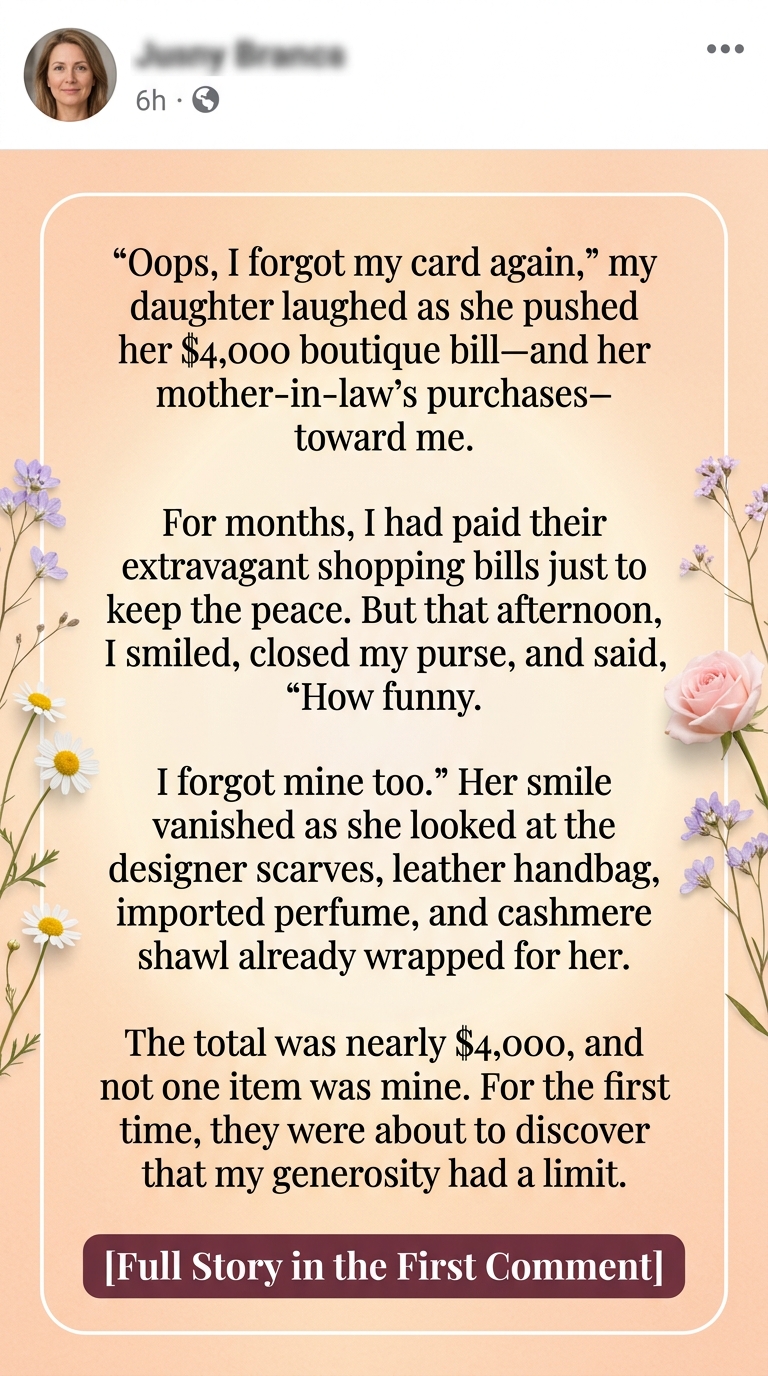
“Oops, I forgot my card again,” my daughter laughed as she pushed her $4,000 boutique bill—and her mother-in-law’s purchases—toward me.
For months, I had paid their extravagant shopping bills just to keep the peace. Every time we went shopping, the same thing happened.
“Mom, I’ll pay you back.”
“Mom, my card isn’t working.”
“Mom, you know how complicated things have been lately.”
And every time, I reached into my purse.
Not because I was rich.
Not because I enjoyed watching thousands of dollars disappear.
I did it because I loved my daughter.
After her father died, she was the only family I felt I had left. I had spent years working, saving, and building a comfortable life. I owned my home outright and had enough savings to live peacefully.
But my daughter had developed a taste for a lifestyle far beyond her income.
Designer clothes.
Luxury handbags.
Expensive dinners.
Weekend resorts.
And somehow, I always became the emergency fund.
Her husband, Daniel, rarely said anything. He simply stood beside her while she smiled and handed me another bill.
Then came his mother, Patricia.
Patricia had never hidden what she thought of me.
“You’re fortunate to have savings,” she once told me. “Family should share.”
I smiled politely.
I wanted peace.
So I paid.
Month after month, I watched my daughter and Patricia fill shopping bags while I quietly emptied my bank account.
I told myself it was temporary.
Until that afternoon.
We were inside an elegant boutique downtown. My daughter, Claire, had invited Patricia along for a “little shopping trip.”
There was nothing little about it.
A leather handbag cost $1,200.
A cashmere shawl was nearly $700.
Imported perfume was $300.
Designer scarves, shoes, and accessories pushed the total close to $4,000.
Claire looked delighted.
Patricia kept adding things to the counter.
“That one too,” she said.
Then Claire turned to me with her familiar smile.
“Oops, I forgot my card again.”
She pushed the bill toward me.
“And Patricia’s things are on there too.”
I looked down.
$3,986.42.
I slowly looked at the bags.
Not one item belonged to me.
Claire was already reaching for her handbag.
“Mom, can you just put it on your card? I’ll transfer it later.”
I smiled.
Then I closed my purse.
“How funny,” I said. “I forgot mine too.”
Silence.
Claire blinked.
“What?”
“I forgot my card.”
Her smile disappeared.
Patricia stared at me.
“But you always have your card.”
“I know.”
Claire laughed nervously.
“Mom, seriously. Don’t do this.”
“I’m serious.”
The sales associate stood awkwardly behind the counter.
Claire lowered her voice.
“You’re embarrassing me.”
I looked directly at her.
“No, Claire. I’m finally stopping you from embarrassing me.”
Her face turned red.
Patricia immediately stepped in.
“This is ridiculous. We’re family.”
I nodded.
“Exactly. And family shouldn’t treat one person like an ATM.”
Neither of them answered.
The sales associate quietly began removing the items from their bags.
The handbag went back.
The perfume went back.
The shawl went back.
The scarves went back.
Claire looked devastated.
But I wasn’t.
For the first time in months, I felt strangely light.
We left the boutique empty-handed.
The moment we reached the parking lot, Claire exploded.
“How could you do that to me?”
“I didn’t do anything to you.”
“You knew I didn’t have my card!”
“I did.”
“You could have helped me!”
“I have helped you.”
“Then why stop now?”
I took a breath.
“Because I finally realized that helping you wasn’t making your life better. It was teaching you that someone else would always pay for your choices.”
She stared at me.
Patricia crossed her arms.
“You’re being selfish.”
I looked at her.
“Maybe.”
Then I turned to Claire.
“But if loving you means destroying my financial security so you can live a lifestyle you can’t afford, then I can’t do that anymore.”
She said nothing.
That night, Claire called six times.
I didn’t answer.
The next morning, I sat at my kitchen table and opened my bank statements.
For the first time, I added everything.
Shopping.
Restaurants.
Hotels.
Beauty appointments.
“Emergency” payments.
Bills Claire promised to repay.
The number made my stomach turn.
In less than eighteen months, I had given my daughter more than $42,000.
She had repaid less than $2,000.
I printed every statement.
Then I created a folder.
I labeled it:
**“The Cost of Keeping the Peace.”**
Three days later, Claire arrived at my house.
She looked exhausted.
“Mom, can we talk?”
I invited her inside.
She sat across from me.
“I was angry,” she said.
“I know.”
“I thought you didn’t love me anymore.”
“That isn’t true.”
“Then why wouldn’t you pay?”
I slid the folder across the table.
“Because I love you enough to stop.”
She opened it.
Page after page.
Date.
Amount.
Purchase.
Payment.
She became silent.
“I never realized it was that much,” she whispered.
“I know.”
She looked up.
“Why didn’t you tell me?”
“Because every time I tried, you told me you needed me.”
Her eyes filled with tears.
“I was taking advantage of you.”
I didn’t answer.
She closed the folder.
“I’m sorry.”
That was the first apology she’d given me without asking for money afterward.
And somehow, that mattered more than the $42,000.
Things didn’t magically become perfect.
Claire had to learn to live within her income.
She returned some purchases and sold others.
Daniel eventually found a second job.
Patricia stopped calling me when she realized I wasn’t paying for her shopping anymore.
For several months, Claire and I kept our relationship carefully measured.
Then, one Saturday, she came over carrying two cups of coffee.
“No shopping,” she said.
I laughed.
“No shopping?”
“No shopping.”
We sat on the porch and talked for three hours.
About her father.
About my fears.
About the years I had spent trying to keep everyone happy.
Before she left, Claire hugged me.
“I thought your money was what made you my mother,” she whispered.
I held her tightly.
“No, sweetheart. My love made me your mother. The money was just something I confused with love.”
She cried.
So did I.
And from that day forward, I never forgot my card again.
I simply stopped carrying it for everyone else.
Months later, Claire invited me to lunch.
When the check came, she reached into her purse.
She smiled.
“I’ve got it, Mom.”
I smiled back.
And for the first time, I knew she meant it.
The $4,000 shopping bill had taught both of us something money never could:
**Generosity is beautiful—but when people mistake it for an obligation, saying “no” can be the most loving thing you ever do.**
