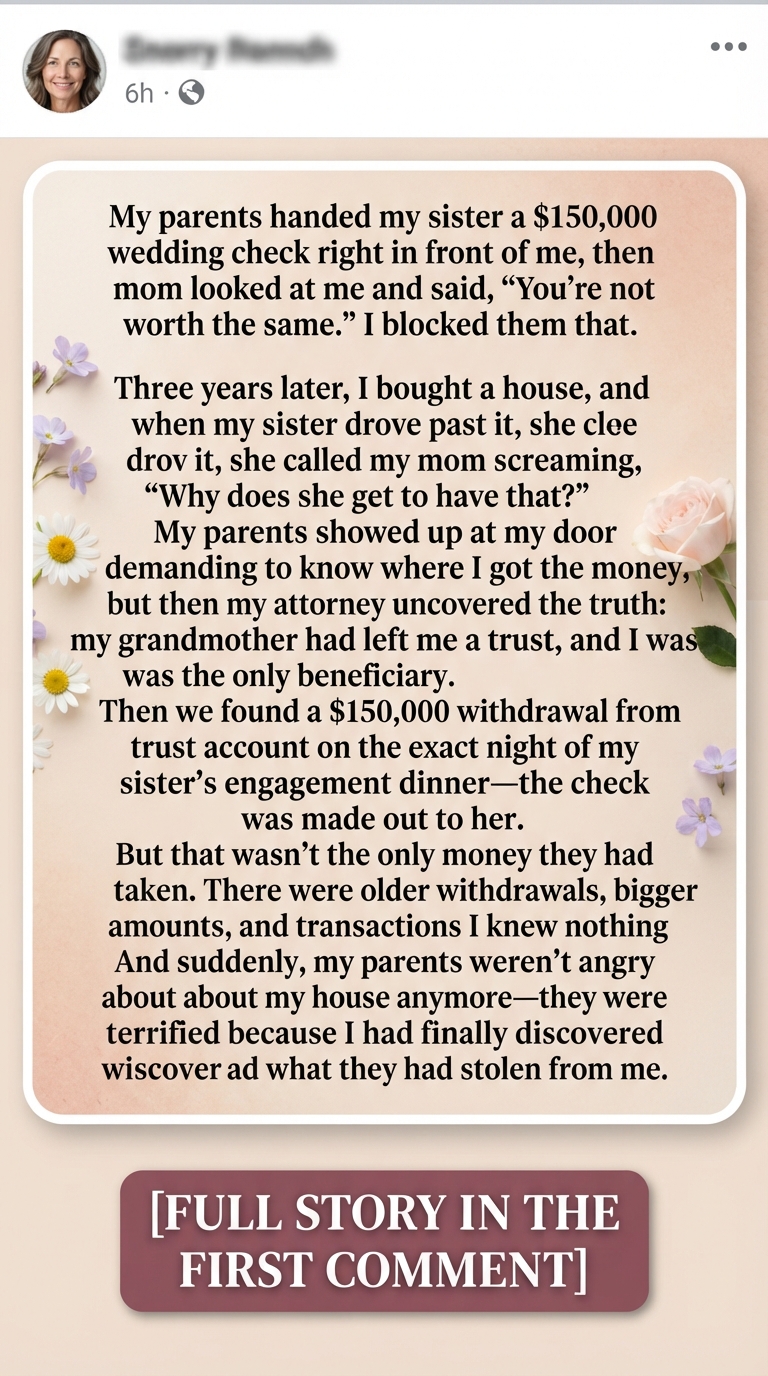
My parents handed my sister a $150,000 wedding check right in front of me, then my mom looked at me and said, “You’re not worth the same.” I didn’t argue. I didn’t cry. I simply walked away and blocked them that night.
For three years, I heard nothing from my family. Then I bought a house. It wasn’t a mansion, but it was mine. Every dollar had come from years of working, saving, and refusing to live beyond my means.
I thought my family was finally out of my life until one afternoon, my sister drove past my new house. She recognized my car in the driveway and immediately called my mother, screaming,
“Why does she get to have that?” The next morning, my parents showed up at my door demanding to know where I had gotten the money. My father accused me of lying, while my mother kept asking which bank account I had used.
I looked at them and said, “You gave my sister $150,000 three years ago. Why are you suddenly so interested in my money?” My mother replied, “That was different. She needed it.” I almost laughed.
Then she said something that made me stop. “Your grandmother never intended for you to have everything.” I froze. My grandmother had always been the only person in my family who treated my sister and me equally.
Before she died, she once held my hand and told me, “Never let anyone convince you that you’re worth less.” After her funeral, my parents told me Grandma had left nothing substantial.
I believed them. But now, something felt wrong. I hired an attorney and asked her to investigate my grandmother’s estate. A few days later, she placed a document in front of me and asked,
“Did your parents ever tell you about a trust?” I said no. She explained that my grandmother had created a trust years before her death, and I was the only beneficiary.
I stared at the paperwork in disbelief. My grandmother hadn’t left me nothing. She had left me a future. But then my attorney showed me the account history, and my stomach dropped.
There was a $150,000 withdrawal from my trust account on the exact night of my sister’s engagement dinner. The check had been made out to my sister. I whispered, “They gave her my money.” My attorney kept searching,
and then she found more. There was an $80,000 withdrawal, another for $65,000, another for $42,000, and several smaller transactions. Some had been used for my sister’s car, apartment, vacations, and business expenses.
Others had simply disappeared into accounts controlled by my parents. The $150,000 wedding check wasn’t the beginning. It was only the first transaction I had ever seen.
My parents had been taking money from my trust for years, and they had counted on me never asking questions. Suddenly, their obsession with my new house made sense. They weren’t angry because I had succeeded.
They were terrified that I had succeeded without them. When my attorney confronted them with the records, my father claimed they had only been helping the family.
My attorney placed the trust agreement on the table and calmly explained that they had no authority to distribute my assets to themselves or my sister. My mother began crying and said,
“We were only trying to help.” My attorney asked, “Then why were the transactions hidden?” Nobody answered. My sister finally admitted that she hadn’t realized the $150,000 was mine.
I looked at her and said, “You were holding the check.” She lowered her head and whispered that she thought our parents had saved the money for her. But they hadn’t. They had taken it from me.
The legal battle lasted for months. Some of the money was recovered, while some was gone for good. But for me, the most important thing wasn’t the money. It was finally knowing the truth.
My grandmother had never forgotten me. She had never believed I was worth less. She had planned for me, protected me, and trusted me. My parents were the ones who had stood between me and the truth.
One afternoon, after everything was settled, I walked into my house and placed a framed picture of my grandmother on the fireplace. Beside it, I placed a copy of the trust document. I didn’t put it there to brag.
I put it there to remind myself of what she had told me years ago: “Never let anyone convince you that you’re worth less.” My mother called one final time.
She cried and told me, “We’re still your family.” I looked around my home and quietly replied, “Family doesn’t steal from you and then make you feel guilty for succeeding.”
She began crying harder, but I had nothing left to say. I ended the call and blocked her number. I didn’t need revenge. I didn’t need their apology.
I finally understood that being treated as less valuable doesn’t make you less valuable. Sometimes the people who tell you that you’re worth less are simply afraid you’ll discover exactly how much you’re worth.
My grandmother knew my value before anyone else did, and she left me proof. They thought they had given my sister $150,000 and left me with nothing. They never realized that the money they gave her was mine all along.
And the house they were so angry about wasn’t proof that I had taken something from them. It was proof that I had finally built a life they could no longer control.
