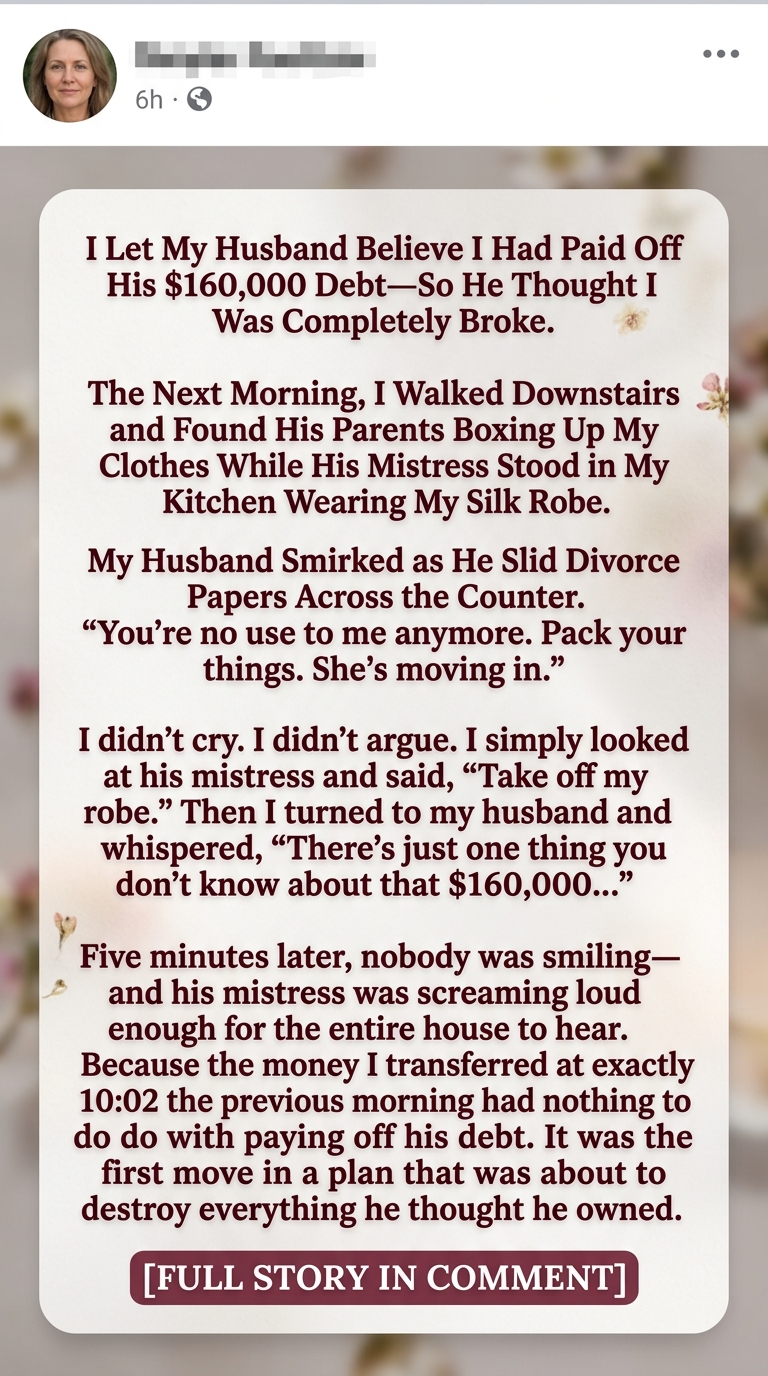
I Let My Husband Believe I Had Paid Off His $160,000 Debt—So He Thought I Was Completely Broke. I thought that was the end of the lie. I was wrong. The next morning, I walked downstairs and found my husband’s parents boxing up my clothes. My wedding photographs were already stacked beside the front door. My jewelry box was sitting open on the dining table. And standing in the middle of my kitchen was a woman wearing my silk robe. My silk robe—the one my husband had given me on our fifth anniversary. She was drinking coffee from my favorite porcelain mug as if she had lived there for years. Then my husband walked into the kitchen. He wasn’t nervous. He wasn’t ashamed. He was smiling. He slid a folder across the marble counter. “Divorce papers.” I stared at him, then at his parents, then at the woman wearing my robe. My husband leaned against the counter and said, “You’re no use to me anymore.” His mother crossed her arms. “Don’t make this harder than it needs to be.” I looked at my husband and asked, “What exactly did I do?” He laughed. “You emptied your savings to pay off my debt.” He tapped the folder. “You’re broke now.” My heart didn’t break, because I had already known this moment was coming. For six months, I had watched my husband change. He stopped asking how my day was. He stopped coming home on time. He stopped pretending to care about the little things. Then I noticed the hotel charges, the expensive dinners, the jewelry purchases, and finally, I found the messages. He had been having an affair with a woman named Claire. But the affair wasn’t the part that shocked me most. It was what they had been discussing. Claire had written, “Once the debt is gone, she’ll have nothing.” My husband replied, “Exactly. Her savings will be drained. She’ll have no choice but to leave.” Then Claire asked, “And the house?” My husband answered, “Mine.” That was when I understood. They weren’t simply planning to divorce me. They were planning to empty me first. The house was worth nearly $1.4 million. But there was something they didn’t know. The house wasn’t actually his. And neither was the company he thought he controlled. Three years earlier, when my husband started his construction business, I had quietly invested my inheritance into it. He told everyone he built the company himself. I let him. I didn’t need applause. I needed to know whether the man I married would ever appreciate what I had sacrificed for him. Instead, he became convinced that everything belonged to him. So when he told me his $160,000 debt was destroying his life, I pretended to panic. I sold some investments, moved money around, and told him I could pay the debt. He watched me transfer $160,000. Or at least, that’s what he believed. At exactly 10:02 the previous morning, I made the transfer. My husband hugged me afterward. Not because he loved me. Because he thought he had won. “You’re saving us,” he whispered. I smiled. “No. I’m saving myself.” He didn’t understand what I meant. He would soon. Because the $160,000 hadn’t gone toward paying off his debt. It had been transferred into an escrow account connected to a legal agreement I had signed months earlier. An agreement that would trigger the moment he filed for divorce and attempted to remove me from the property. And this morning, he had done exactly that. I looked at the divorce papers, then at Claire. “Take off my robe.” She laughed. “Excuse me?” I stepped closer. “I said take off my robe.” My husband suddenly looked irritated. “Stop embarrassing yourself.” I smiled. “I’m not embarrassed.” I reached for my phone. “I’m documenting everything.” His father slammed his fist against the counter. “This is our son’s house!” I turned toward him. “No.” Silence filled the kitchen. “It isn’t.” My husband laughed. “You’ve lost your mind.” I opened my phone and pulled up a document. “Would you like to know whose name is on the deed?” Nobody answered. I turned the screen toward them. “My name.” My husband’s smile disappeared. “That’s impossible.” “No.” I opened another document. “And would you like to know who owns 72 percent of the company you think you built?” His face went pale. I watched him read the document. Then I said quietly, “Me.” Claire stopped drinking her coffee. “What?” My husband stared at me. “You told me you were broke.” “I told you I paid $160,000.” He swallowed. “I watched you transfer it.” “Exactly.” His mother stepped forward. “So where did the money go?” I smiled. “Into the company.” My husband froze. The previous month, I had discovered that he had been secretly moving company money into an account controlled by Claire. I had hired forensic accountants. They found everything—the hotel bills, the jewelry, the private dinners, the forged expense reports, and the $160,000 debt. Much of it had been accumulated because he had been using company credit cards to finance his affair. So I had done something very simple. I paid the debt—but not for him. I paid the debt in exchange for taking control of the underlying financial obligations and triggering clauses in our shareholder agreement. He had unknowingly signed away his controlling interest months earlier because he was too arrogant to read the paperwork. His father grabbed the documents. “This is a mistake.” “No.” I shook my head. “It’s the first thing I’ve done correctly in months.” My husband suddenly turned toward Claire. “You knew about this?” She shook her head. “I didn’t know.” He stared at her. “You said she had nothing.” “I thought she did!” I laughed. “She told me she had spent everything!” I almost smiled. “That’s because I wanted you to believe it.” Five minutes earlier, everyone had been smiling. Now nobody was. Then Claire looked down at the silk robe. Her hands began trembling. “Why did you let me come here?” I looked at her. “Because I needed you here.” “What?” “I needed witnesses.” I had already called my attorney. He walked through the front door carrying a leather briefcase. Behind him were two investigators and a court-appointed financial auditor. My husband stared at them. “What is this?” My attorney placed a folder on the counter. “Notice of injunction.” My husband opened it. His hands began shaking. He read silently, then looked at me. “You can’t do this.” “I already did.” His mother began crying. His father started shouting. Claire ran upstairs, but she didn’t get far. She came back down carrying a suitcase. “You lied to me!” My husband shouted after her. She screamed back, “You told me she was broke!” I almost laughed because that was the most honest thing anyone had said all morning. Claire threw the suitcase down. “You told me this house would be mine!” My husband stared at her. “It will be.” She pointed at me. “She owns it!” Then she looked at him. “You said you owned everything!” He had no answer. I walked to the kitchen table and picked up the divorce papers. I flipped through them, then tore them in half. My husband stared. “What are you doing?” “I didn’t sign them.” “You don’t have a choice.” “Oh, I have a choice.” I placed the pieces on the counter. “And I’ve made mine.” My attorney stepped forward. “The divorce will proceed. But your wife has filed counterclaims involving marital assets, company funds, fraud, and unauthorized transfers.” My husband looked at me. “You planned all of this?” I shook my head. “No. I planned to give you a chance.” His expression changed. I continued, “I wanted to see whether you would choose me when you thought I had nothing.” He said nothing. “You failed.” Then I walked upstairs. Not to pack. Not to leave. But to change out of my wedding robe and put on a black suit. When I came back downstairs, my husband’s parents were standing near the door. I handed his mother a box. She opened it. Inside were the keys to the guesthouse. “You have until Friday to collect your belongings.” She stared at me. “You would throw us out?” I answered calmly, “You helped throw me out of my own home.” She lowered her head. My husband remained in the kitchen. For the first time since I had known him, he looked small. He whispered, “Did you ever love me?” I stopped. “Yes.” He looked hopeful. “Then why?” I looked him straight in the eyes. “Because loving you doesn’t require me to destroy myself for you.” Then I walked away. Six months later, the divorce was finalized. The court found that my husband had concealed financial assets and misused company funds. The company remained under my control. The house remained mine. And the $160,000? It was recovered as part of the settlement. Claire disappeared from his life almost as quickly as she had entered it. She had thought she was moving into a luxury home. Instead, she became the woman who had walked into another woman’s kitchen wearing her robe—only to discover that the woman she had replaced was the person who owned everything. As for my husband, he lost the company. He lost the house. He lost the lifestyle he had taken for granted. But the biggest thing he lost was the woman who had spent years believing he was worth saving. One year later, I stood in the same kitchen. The same marble counter. The same porcelain mug. The same silk robe hanging inside my closet. But everything felt different. My attorney called. “The final payment came through.” I smiled. “Good.” He asked, “What are you going to do with the money?” I looked around the house, then out the window. “I think I’m going to stop spending my life saving people who are determined to destroy me.” I hung up. And for the first time in years, the house was completely quiet. No lies. No secret messages. No footsteps coming home after midnight. No one telling me I wasn’t enough. I walked to the front door and opened it. Sunlight poured across the floor. I smiled because I finally understood something. My husband thought the $160,000 was the money that would make me powerless. He never realized it was the money that gave me the final piece of evidence I needed to take my life back. He thought he was divorcing a broke woman. Instead, he walked away from the woman who owned the future he had been planning to steal. And that was the one thing money could never buy back—me.
