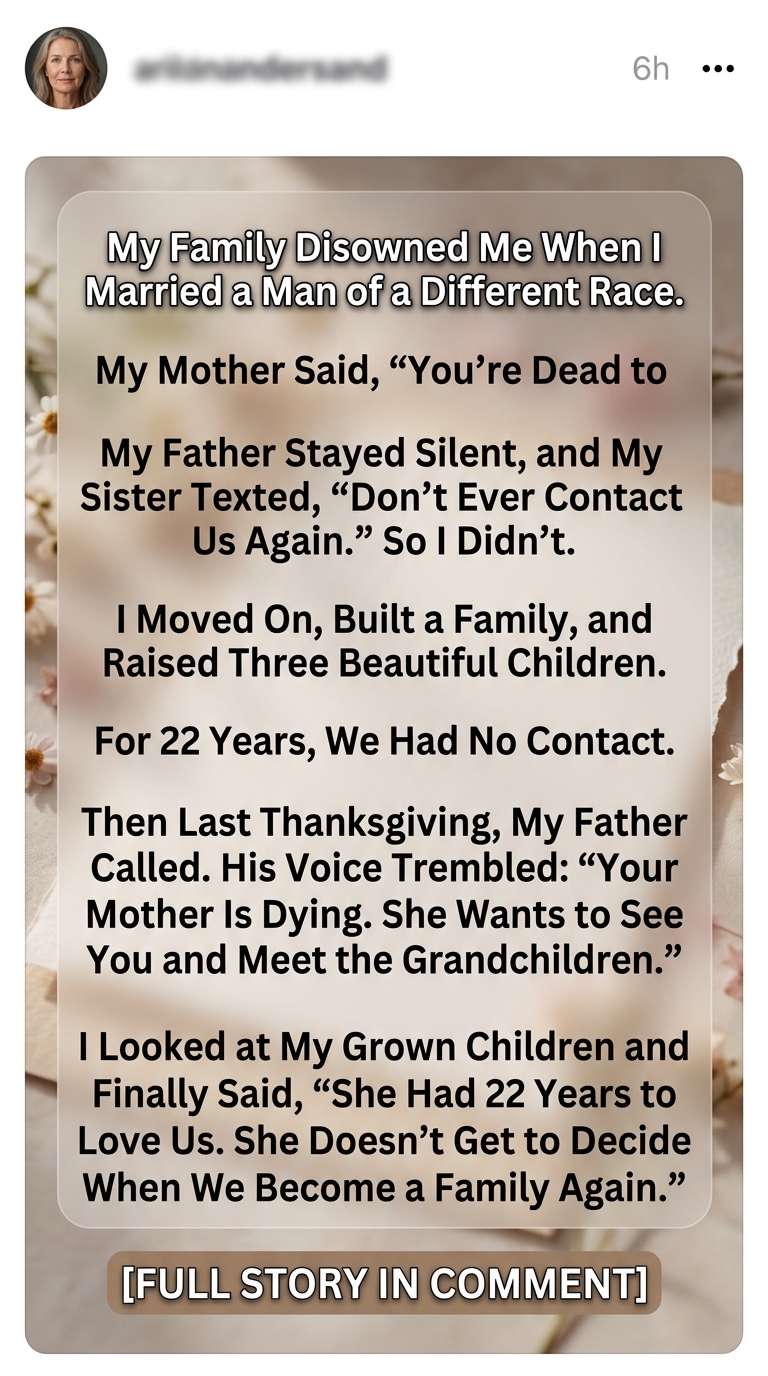
When I married Daniel, I thought my family would eventually accept us. I was wrong. My mother looked at my husband, then looked at me, and said the words that would stay with me for the next twenty-two years: “You’re dead to me.” My father stood behind her and said nothing. That silence hurt almost as much as her words. My sister didn’t even wait until we got home. She sent me one text: “Don’t ever contact us again.” I stared at that message for a long time, hoping another one would follow. It never did. So I stopped waiting. I married Daniel anyway. We built a small life together in a city where nobody knew our family history. We rented a tiny apartment, worked long hours, ate cheap takeout on Fridays, and laughed about the things we couldn’t afford. Daniel never asked me to choose between him and my family. He simply told me, “One day, they’ll realize what they lost.” I didn’t believe him. Years passed. We bought our first house. Then came our children. Three beautiful kids who inherited Daniel’s smile and my stubbornness. When our oldest was born, I stared at her tiny face and cried because my mother wasn’t there. When our second child took his first steps, I instinctively reached for the phone before remembering there was no one to call. When our youngest graduated from elementary school, my children asked why they had never met their grandparents. I told them the truth without filling their hearts with hatred. “Some people make choices because of fear,” I said. “But that doesn’t mean you have to carry their anger.” Twenty-two years passed. Twenty-two birthdays. Twenty-two Christmases. Twenty-two Mother’s Days. Twenty-two Thanksgivings. My children grew up without knowing the grandparents who should have been part of their lives. Daniel never spoke badly about my family. Not once. Sometimes I wondered if that made me love him more or hurt even more. Then, last Thanksgiving, my phone rang. I almost ignored it because I didn’t recognize the number. Then I heard my father’s voice. It was weak. Shaking. Older than I remembered. “Hello?” I said. There was a long silence. Then he said my name. Just my name. “Your mother is dying.” My heart tightened. I sat down at the kitchen table. “What?” “The doctors say she doesn’t have much time.” I closed my eyes. For twenty-two years, I had imagined hearing my father’s voice again. I had imagined anger. Apologies. Questions. Maybe even reconciliation. I had never imagined this. Then he said, “She wants to see you.” I didn’t answer. “She wants to meet the grandchildren,” he continued. I looked across the room. My three children were sitting together, laughing while they prepared dessert. They were adults now. They had careers, relationships, dreams, and lives of their own. They knew about the family they had never met, but they had never asked me to force a relationship. My father continued speaking. “She knows she made mistakes.” I swallowed hard. “Does she?” “Yes.” “Did she say that?” He hesitated. “She said she wants to make things right.” I looked at the clock. Twenty-two years earlier, my mother had looked directly into my eyes and told me I was dead to her. Now she wanted to see me because she was dying. I didn’t know what to feel. Anger? Sadness? Pity? Love? Maybe all of them. “Can I think about it?” I asked. “Of course.” Before hanging up, my father whispered, “She really wants to see you.” I ended the call. My children immediately noticed something was wrong. “Mom?” my daughter asked. “Who was that?” I sat quietly for a moment. Then I told them. “Your grandfather.” The room became silent. My oldest daughter put down her fork. “Grandpa?” I nodded. “He said Grandma is dying.” Nobody spoke. Finally, my youngest asked, “She wants to meet us?” “Yes.” My son looked at me. “Do you want to go?” That question broke something inside me. Because for twenty-two years, everyone had assumed I was waiting for my mother to come back. But the truth was more complicated. Part of me had been waiting. Another part had learned how to live without her. I looked at my children and said quietly, “She had twenty-two years to love us. She doesn’t get to decide when we become a family again.” Nobody argued. But my daughter reached across the table and took my hand. “Then you don’t have to go, Mom.” That night, I barely slept. I opened an old box I had kept in the back of my closet. Inside were photographs from my childhood. My mother holding me at the beach. My father teaching me to ride a bicycle. My sister and me sitting on the front steps. I stared at one picture for nearly an hour. My mother was smiling. I remembered that woman. That was the hardest part. She hadn’t always been cruel. She had once braided my hair before school. She had held me when I had nightmares. She had stayed awake when I was sick. And then one decision had changed everything. The next morning, I called my father. “I’ll come,” I said. He started crying. “Thank you.” “But I’m coming alone.” He was silent. “The children can decide for themselves if they ever want a relationship with her.” “I understand.” “And Dad?” “Yes?” “I’m not coming to pretend the past didn’t happen.” “I know.” When I arrived at the hospital two days later, my hands were shaking. I stood outside the room for almost five minutes before opening the door. My mother looked smaller than I remembered. Her hair was completely gray. Her hands trembled beneath the blanket. She turned her head. Our eyes met. For several seconds, neither of us spoke. Then she whispered, “You came.” I nodded. “You asked me to.” Tears filled her eyes. “I didn’t think you would.” I almost laughed. “Neither did I.” My father stood in the corner, crying silently. My mother reached toward me. I walked closer, but I didn’t take her hand. She noticed. “I’m sorry,” she whispered. Those two words were supposed to fix twenty-two years. They couldn’t. “For what?” I asked. She looked down. “For everything.” I sat in the chair beside her bed. “That’s a lot to say in two words.” She nodded. “I know.” Then she began crying. “I was afraid.” “Afraid of what?” “Of what people would say. Of what my family would think. Of losing the life I thought I had built.” She looked at me. “And I was wrong.” I didn’t tell her she was forgiven. I wasn’t ready. Instead, I told her the truth. “You missed everything.” Her face crumpled. “I know.” “You missed my wedding.” She closed her eyes. “I know.” “You missed the birth of all three children.” Tears ran down her cheeks. “I know.” “You missed birthdays, graduations, Christmas mornings, illnesses, first jobs, heartbreaks, and every ordinary day that makes a family a family.” She covered her face. “I know.” I looked at her. “And you can’t get those years back.” “I know,” she whispered. “But I wish I could.” That was the first time I saw my mother not as the woman who had rejected me, but as an old woman finally forced to face the consequences of her own choices. I still wasn’t ready to forgive her. But for the first time, I was willing to listen. She asked about my children. I showed her pictures. She cried over every one. “They’re beautiful.” “They are.” “Do they hate me?” I shook my head. “No. I never taught them to hate you.” She looked at me in disbelief. “Why?” “Because they deserved to grow up free from the anger you gave me.” She cried harder. A week later, my children made their own decision. They wanted to meet her. Not because I asked them to. Not because they felt guilty. Because they wanted to decide for themselves. When they walked into the hospital room, my mother couldn’t speak. My daughter approached first. “Hi, Grandma.” My mother covered her mouth and began sobbing. My son stood beside her. My youngest stayed near the door for a moment before slowly walking closer. My mother looked at all three of them. “I’m sorry,” she whispered. My son answered gently, “You don’t have to apologize to us for something you did before we were born. But you should probably tell our mom that.” My mother looked at me. “I am.” We stayed for two hours. They asked questions. She answered them. Some answers were uncomfortable. Some were painful. But for the first time, nobody was pretending. Before we left, my mother called me back. “Can I ask you something?” “What?” “Do you hate me?” I thought about it. “No.” Her eyes filled with tears. “Do you forgive me?” I looked at her. “I’m working on it.” She nodded. “That’s more than I deserve.” I didn’t promise her forever. I didn’t promise that everything would suddenly become normal. I didn’t promise to forget. But I promised one thing. “I won’t let what happened destroy the rest of my life.” Three weeks later, my mother died. I was there. My children were there. My father was holding her hand. She looked at me one last time and whispered, “I should have chosen you.” I squeezed her hand. “You should have.” She closed her eyes. And that was the last thing I ever said to her. At her funeral, my sister approached me. We hadn’t spoken in twenty-two years. She stood in front of me with tears in her eyes. “I was wrong too,” she said. I looked at her. “I know.” “Can we start over?” I took a long breath. “We can start with the truth.” She nodded. “Okay.” I hugged her. Not because twenty-two years disappeared. They didn’t. I hugged her because I finally understood something. Forgiveness isn’t pretending the wound never happened. It isn’t giving someone permission to hurt you again. Sometimes forgiveness simply means refusing to spend the rest of your life carrying someone else’s hatred. When I drove home that evening, my three children were in the car with me. My oldest reached forward and touched my shoulder. “Mom?” “Yeah?” “Are you okay?” I looked at them in the rearview mirror. “I think I finally am.” My mother had spent twenty-two years deciding that I didn’t belong in her life. But she didn’t get to decide the shape of mine. I had built a family without her. I had loved my husband. I had raised three incredible children. I had survived the rejection that once felt like it would destroy me. And now I understood something I wish I had known twenty-two years earlier: sometimes the family that rejects you teaches you how to build the family that never will. I pulled into our driveway. My children got out and walked toward the house. I stayed in the car for a moment, looking at the warm lights shining through the windows. Then I smiled. I had spent years believing my mother had taken my family away from me. She hadn’t. She had simply forced me to build one of my own. And as I walked through that door, surrounded by the people who had chosen me every single day, I finally realized that I hadn’t lost my family twenty-two years ago. I had found it.
