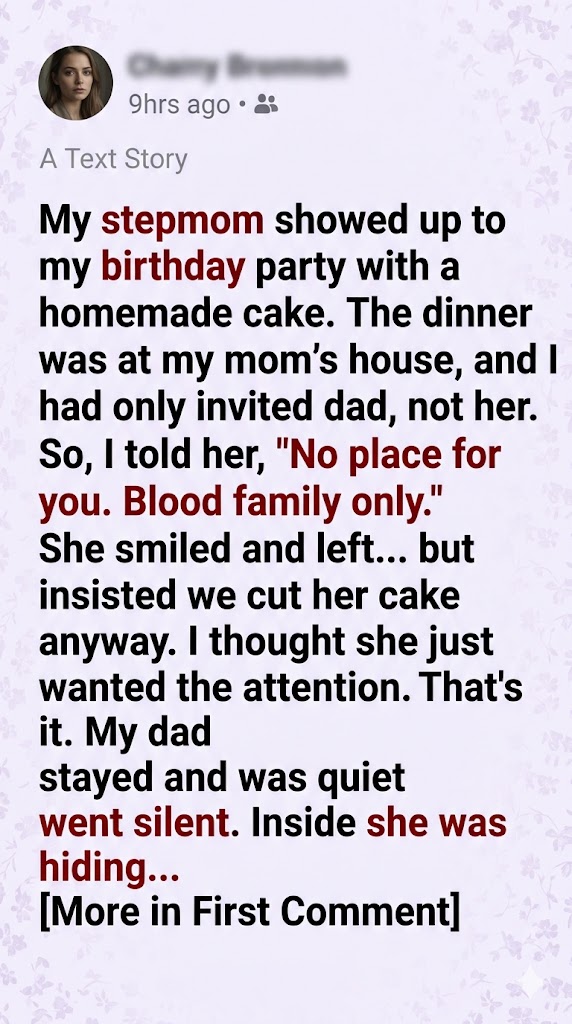
I had planned my birthday like someone trying to control the weather—carefully, obsessively, and with a quiet fear that something unpredictable might ruin it. In my mind, simplicity meant safety: just my closest family, no surprises, no emotional complications, and no blurred lines between past and present relationships. I wanted a calm evening where everyone knew exactly where they stood, especially when it came to my stepmom, whose presence in my life had always carried a complicated weight I never fully knew how to name. So when the day arrived, I thought I had done everything right. The table was set, the food was familiar, and I had mentally rehearsed how the evening would flow without awkward interruptions. But life rarely respects carefully drawn boundaries. The doorbell rang, and in that instant, before I even opened it, something in me already tightened. When I saw her standing there holding a homemade cake—slightly uneven frosting, soft edges, and a cautious smile—I felt a rush of emotions I didn’t pause to understand. She hadn’t been invited. That thought alone became louder than everything else. I remember how quickly I stepped into explanation instead of curiosity, telling her gently but firmly that tonight was meant for immediate family only. Her face didn’t change dramatically; instead, it softened in a way that made me feel both uncomfortable and strangely guilty. She simply nodded, placed the cake on the table near the entrance like it deserved to exist even if she didn’t, wished me a happy birthday, and asked if we could share it later. Then she left. I told myself I had handled it correctly, that I had protected the evening from confusion, but something about the way she walked away stayed lodged in my mind longer than I expected.
Dinner went on, but the rhythm I had imagined never fully formed. My dad, who usually filled silence with stories or jokes, was unusually quiet. At first I told myself he was just tired or distracted, but the longer the evening continued, the more his silence felt intentional, almost heavy. He stirred his food without really eating, occasionally glancing toward the table’s edge where the cake had been placed. I tried to ignore it, focusing instead on conversation with others, trying to steer attention back toward safer topics like work, travel, and everyday updates. Yet underneath all of it, there was a subtle discomfort I couldn’t shake. It wasn’t loud or confrontational—it was more like an emotional current running beneath the surface of the room. I told myself I had avoided drama by setting clear boundaries, but I didn’t consider that boundaries can sometimes feel like rejection to the people standing outside them. As plates were cleared and the meal transitioned toward dessert, I noticed my father’s expression shift slightly, as if he had been waiting for something that hadn’t yet been acknowledged. My mom suggested we should at least serve the cake so it wouldn’t go to waste, and I hesitated for only a moment before agreeing, still convinced that the evening could remain neatly controlled if we simply moved through it step by step. But even as I said yes, I didn’t realize I was about to confront something far less controllable than any dinner plan.
When I finally cut into the cake, the knife barely made its first slice before something unexpected happened. An envelope, slightly hidden within the layers, slipped onto the plate. The room fell quiet in a way that felt immediate and complete, as though even the air had paused to witness what was happening. I remember the sound of the knife against the plate stopping mid-motion, and the way every conversation evaporated without instruction. My hands hesitated before picking up the envelope, already sensing that whatever was inside would not be simple. The paper was soft, slightly textured, and clearly written by hand. Inside was a letter from my stepmom. As I read it silently, the words didn’t feel dramatic or performative—they felt careful, almost fragile. She wrote that she never wanted to replace anyone in my life, not my mom, not my memories, not my place in the family. She said her intention was never to step into spaces that didn’t belong to her, but rather to exist respectfully in the edges, offering care without demand. She explained how often she held herself back from small gestures because she feared being misunderstood, and how she had learned to celebrate me quietly rather than openly, just to avoid discomfort. Tucked behind the letter was a photograph from one of my school events. In it, I was smiling on stage, completely unaware of the crowd. In the background, slightly blurred and almost invisible unless you looked closely, she was standing off to the side, clapping. I had never noticed her there before.
By the time I looked up from the photo, the room felt different, as if the meaning of everything had subtly shifted while I wasn’t paying attention. My father finally spoke, his voice calm but weighted with something I hadn’t heard before. He explained that she had debated coming at all, afraid she might be seen as intrusive, but she still wanted to do something personal instead of sending a message or a store-bought gift. The cake, he said, wasn’t about celebration in the traditional sense—it was her way of participating without occupying space she thought she wasn’t allowed to take. As he spoke, I began to understand how differently the same situation can be experienced depending on where you stand. What I had perceived as an interruption had, for her, been an act of restraint. What I had labeled as overstepping had actually been careful hesitation shaped by years of uncertainty. I felt something uncomfortable rise in me—not anger, but embarrassment, the kind that comes when you realize your certainty was built on incomplete understanding. I thought about how quickly I had turned her away, how little I had asked, and how easily I had assumed intent without ever confirming it. The silence in the room no longer felt like tension—it felt like reflection, shared but unspoken.
That night, after everyone had gone home and the house had returned to its usual quiet, I couldn’t stop thinking about the envelope, the photo, and the way she had stood at the door holding that cake like it was something delicate rather than something disruptive. I called her, not because I had rehearsed what to say, but because staying silent suddenly felt heavier than admitting I had been wrong. When she answered, there was a brief pause, the kind that suggested she already knew why I was calling. I apologized—not formally, not perfectly, but honestly. I thanked her for the cake, for the note, for the years of quiet effort I had never properly seen. There was a softness in her voice when she responded, something relieved but not triumphant, as if she hadn’t been waiting to be validated, only understood. After we hung up, I sat for a long time thinking about how often people express love in ways that don’t announce themselves loudly enough to be immediately recognized. My birthday ended without candles or applause in the way I had planned, but it left me with something far more lasting: the realization that family is not always defined by presence in the center of a room, but sometimes by the quiet willingness to stand at its edges and still show up anyway.
