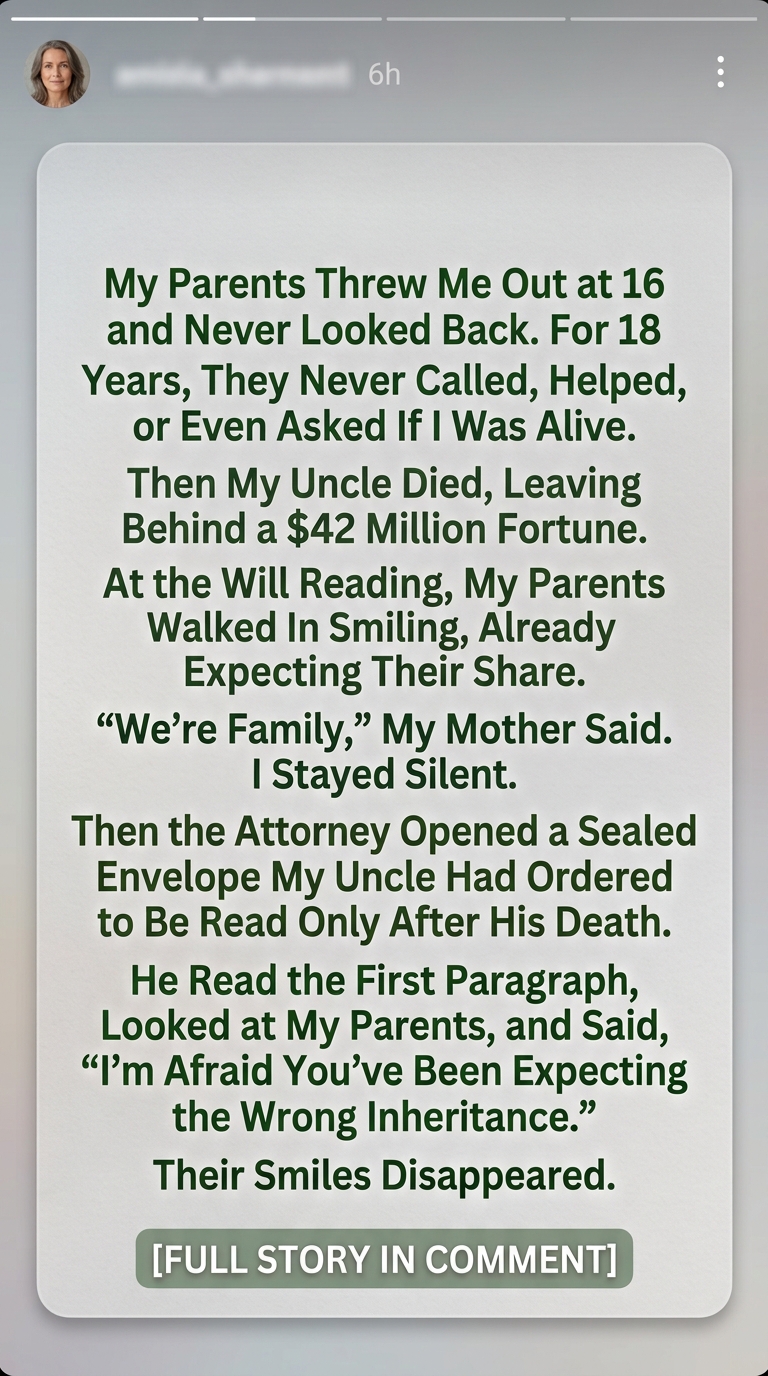
My parents threw me out of the house when I was sixteen and never looked back. For eighteen years, they never called, never sent money, never asked where I lived, and never once wondered whether I was alive. I learned very young that being related to someone didn’t always mean being loved by them. The night they put my suitcase on the porch, my mother stood in the doorway with her arms crossed. “You’re old enough to take responsibility for yourself,” she said. I stared at her in disbelief. “I’m sixteen.” My father wouldn’t even look at me. “Your uncle will help you.” I looked toward the road. “Will you at least call me?” My mother shook her head. “You need to learn how the real world works.” The door closed. I stood there with one suitcase, a backpack, and $37 in my pocket. My uncle, Thomas, found me that night. He didn’t ask why my parents had done it. He simply opened his car door and said, “Get in.” That was the beginning of the life I built. Uncle Thomas never treated me like a burden. He helped me finish high school. He paid for my first community college classes. He taught me how to balance a budget, how to negotiate a contract, and how to never sign anything I didn’t understand. But more importantly, he taught me something my parents never had: that family was a choice you made through your actions. Over the next eighteen years, I built a career, bought a small house, and eventually started my own company. I never became wealthy like Thomas, but I became independent. We spoke almost every week. He knew every important thing happening in my life. My parents knew none of it. I had no idea what they were doing either. I eventually stopped expecting them to come back. Then, one winter morning, my uncle called me. His voice sounded tired. “Come see me when you can.” I drove to his house that weekend. He was sitting in his favorite chair beside the fireplace. “I’m getting older,” he said. “And I have some things to put in order.” “Don’t talk like that.” He smiled. “Everybody dies eventually.” He handed me a folder. “Keep this safe.” “What’s inside?” “You’ll know when you need to.” I didn’t ask more questions. Six months later, Thomas died peacefully in his sleep. The funeral was small. A few business partners attended. Some longtime friends came. And, to my surprise, my parents showed up. My mother hugged me as if eighteen years hadn’t happened. “Oh, sweetheart,” she whispered. “We’re family.” I stepped back. “You haven’t spoken to me in eighteen years.” She sighed. “We had our reasons.” My father nodded solemnly. “Now isn’t the time for old arguments.” I said nothing. Two weeks later, everyone gathered at the attorney’s office for the reading of Thomas’s will. I arrived early. My parents came together, dressed as though they were attending a business meeting. My mother whispered to my father, “He always said family would be taken care of.” My father smiled. “We’re family. Of course we’ll receive something.” I sat across the room and said nothing. The attorney, Mr. Harrison, entered carrying a thick file. “Before we begin,” he said, “there is a sealed envelope that Mr. Thomas instructed me to open only after his death and only in the presence of the people named in it.” My mother leaned forward. “Was that necessary?” The attorney looked at her. “Very.” He removed a cream-colored envelope from the file. My name was written on the front. So were my parents’ names. My mother smiled. “Well, this should be interesting.” Mr. Harrison opened the envelope. He unfolded a letter and began reading. After the first paragraph, he stopped. He looked directly at my parents. Then he said, “I’m afraid you’ve been expecting the wrong inheritance.” Their smiles disappeared. My mother sat upright. “What does that mean?” The attorney continued reading. “To my sister and brother-in-law: If you are sitting in this room expecting to inherit from me because you are my relatives, then you have misunderstood the purpose of this letter.” My father frowned. “What is this?” The attorney kept reading. “For eighteen years, you chose not to have a relationship with your daughter. You did not call her. You did not support her. You did not ask whether she was safe. I did.” My mother’s face turned pale. I stared at the floor. “Thomas knew?” I whispered. The attorney nodded. “He knew everything.” He continued. “You may tell yourselves that you had reasons. You may even believe you were justified. But I watched your daughter become the person you refused to help her become.” My mother started crying. “That’s not fair.” The attorney stopped reading and looked at her. “Would you like me to continue?” She nodded weakly. “Yes.” “I have therefore structured my estate according to the person who actually stood beside her when she needed family.” My father’s face tightened. “How much are we talking about?” The attorney didn’t answer. He continued reading. “My estate, currently valued at approximately $42 million, will be placed into a trust.” My mother leaned forward. “A trust for the family?” “No,” the attorney said. “A trust for my niece.” My mother gasped. “Her?” The attorney nodded. “Your daughter.” My father slammed his hand on the table. “This is absurd.” The attorney calmly replied, “Mr. Thomas was very specific.” He continued reading. “She will receive control of the majority of the estate immediately, with the remaining assets transferred according to the terms I established. No portion of this inheritance is to be transferred to her parents.” My mother looked at me. “You knew about this?” I shook my head. “No.” She stared at me. “You knew he was leaving you everything.” “I didn’t.” “You lied to us.” I almost laughed. “You didn’t call me for eighteen years. Why would I tell you anything?” The room became silent. The attorney turned to another page. “There is one final condition.” My father looked nervous. “What condition?” “Your daughter is authorized to establish a family support fund from the estate if she chooses.” My mother immediately brightened. “Then she can give us—” “But,” the attorney continued, “Mr. Thomas specifically instructed that she is under no obligation to provide financial support to anyone who abandoned her.” My mother’s expression collapsed. The attorney closed the letter. “That concludes the sealed instructions.” My mother stared at me. “We’re your parents.” I looked at her for a long time. “I know.” “You can’t just cut us out.” “You cut me out eighteen years ago.” She began crying. “We made mistakes.” “You did.” My father finally spoke. “Your uncle turned you against us.” I shook my head. “No. You did that yourselves.” The attorney quietly gathered the documents. My parents left the room without another word. I stayed behind. “Did he really plan all this?” I asked. Mr. Harrison smiled sadly. “He planned it carefully.” He handed me another envelope. “This one is only for you.” I opened it. Inside was a handwritten letter. “Kiddo,” it began. I immediately started crying. Thomas had always called me that. “If you’re reading this, I didn’t get the chance to say goodbye. I’m sorry for that. But I want you to remember something. Money isn’t proof that you mattered. I hope you already know that. I helped you because you mattered long before I ever had money to give you.” I wiped my eyes and kept reading. “Your parents may come back when they realize what I’ve left you. Don’t confuse their interest in your inheritance with an interest in your life.” That sentence stayed with me. “If they come back, you decide what kind of relationship you want. But don’t let guilt make the decision for you.” I folded the letter carefully. Thomas had understood my parents better than I ever wanted to admit. Over the next year, the inheritance changed my life, but not in the way people might imagine. I didn’t buy a mansion. I didn’t buy expensive cars. I paid off my house, expanded my business, and created a foundation in Thomas’s name. The foundation provided scholarships for teenagers who had been forced to leave unstable homes. Every time I signed a scholarship check, I thought about the sixteen-year-old girl standing on the porch with a suitcase. I thought about what she needed back then. Someone to say, “You are worth helping.” My parents contacted me several times. At first, they apologized. Then they asked for money. Then they became angry when I refused. Eventually, I stopped responding. One afternoon, my mother showed up at my office. She stood outside my door crying. “I just want my daughter back.” I looked at her through the glass. Part of me wanted to believe her. Another part remembered that she had eighteen years to come looking for me. I invited her inside. “What do you want?” “A second chance.” “For what?” She looked confused. “To be your mother.” I shook my head. “You don’t get to become my mother now because I’m worth $42 million.” She cried. “I do love you.” “Maybe you do now,” I said quietly. “But love isn’t something you announce when there’s money involved. It’s something you show when there isn’t.” She had no answer. I didn’t throw her out. I didn’t scream. I simply told her that if she wanted a relationship with me, it would have to begin without money, without demands, and without pretending the past didn’t happen. She left. Months later, she sent me a handwritten letter. No requests. No mention of the estate. Just an apology. I didn’t forgive her immediately. Forgiveness, I learned, wasn’t something I owed anyone. It was something I could choose if and when I was ready. Years passed. I continued building the foundation. One day, I visited the high school I had attended after my uncle took me in. A scholarship recipient approached me after the ceremony. She was sixteen. She had been forced out of her home and was trying to finish school while working two jobs. She looked at me and said, “Thank you for believing someone like me deserved a chance.” I couldn’t speak for a moment. I thought of Thomas. I thought of the night he opened his car door and told me to get in. He hadn’t asked what I had done wrong. He hadn’t asked whether I was worth saving. He simply helped me. And that was the real inheritance. Not the $42 million. Not the houses. Not the investments. It was the knowledge that family isn’t proven by a surname, a bloodline, or a number written in a will. It’s proven by who shows up when you have nothing to offer. My parents walked into that attorney’s office expecting a fortune because they believed being related to Thomas made them entitled to his wealth. They left realizing they had been expecting the wrong inheritance. They thought my uncle was leaving behind $42 million. He was actually leaving behind something much more valuable: a final lesson about what family truly means. And every time I help someone who reminds me of the sixteen-year-old girl I used to be, I know exactly what Thomas would have wanted me to do. I don’t give them money because I feel sorry for them. I give them a chance because someone once gave me one. And that, more than anything my uncle left me, is the inheritance I intend to keep.
