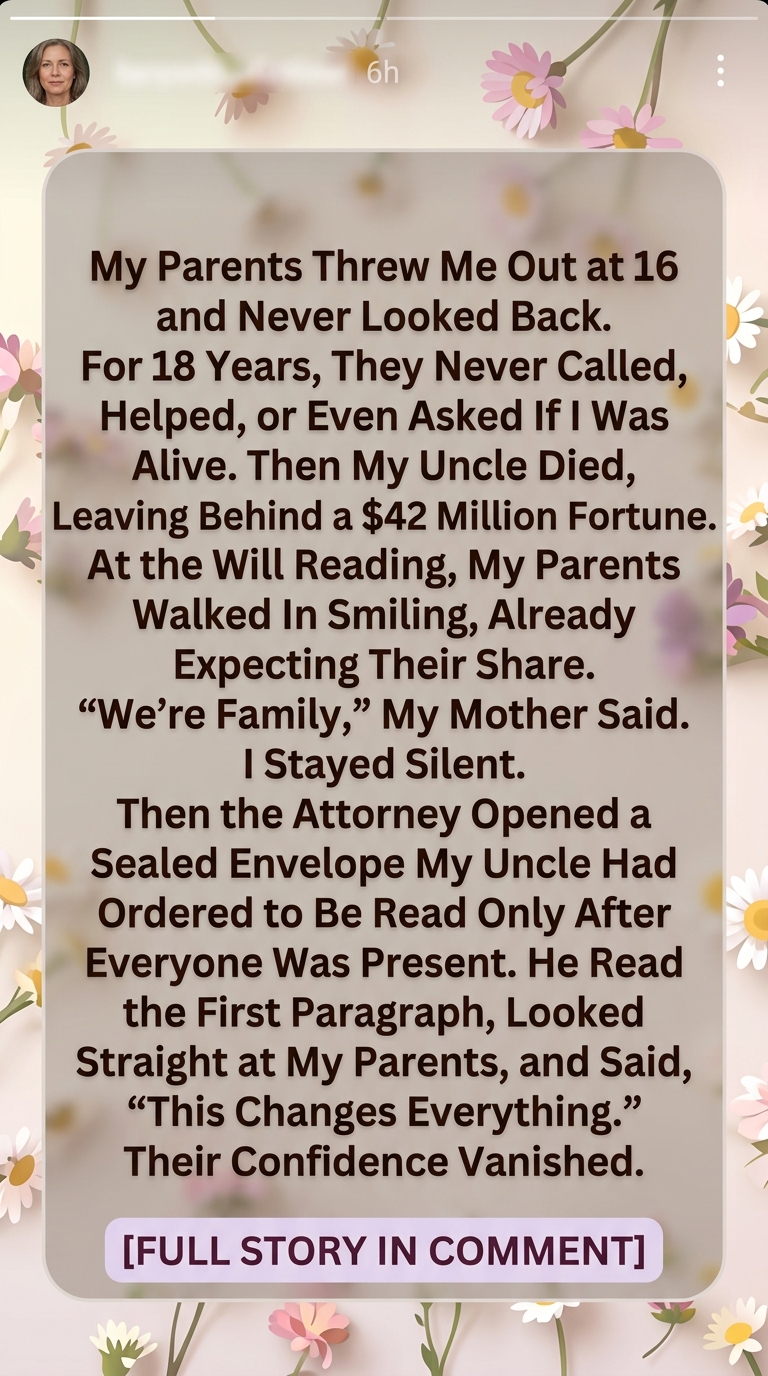
My parents threw me out of the house when I was sixteen, and for eighteen years, they never looked back. They didn’t call on my birthday. They didn’t ask where I lived. They never sent money when I was struggling. They didn’t attend my graduation, my first business opening, or even my wedding. For eighteen years, I existed without parents. At least, that’s what I believed. Then my uncle died and left behind a fortune worth forty-two million dollars. Suddenly, the people who had forgotten I existed remembered exactly who I was. The morning after the funeral, my mother called me for the first time in eighteen years. “Sweetheart,” she said, using a word she hadn’t called me since I was sixteen, “we need to talk about the estate.” I almost laughed. “What about it?” “We’re family,” she said. “Your uncle would have wanted everyone taken care of.” I stared at the phone. “Everyone?” “Of course.” Then she hung up. I knew immediately what she meant. She wasn’t calling because she missed me. She was calling because my uncle had money. My uncle Thomas had always been different from my parents. He was my father’s older brother, but unlike my father, he never believed children owed their parents obedience simply because they were born to them. When I was sixteen, my parents had told me to pack a bag and leave after an argument that had started over something so small I could barely remember it now. My father had pointed toward the front door. “If you don’t like our rules, get out.” I thought he was bluffing. He wasn’t. My mother stood in the kitchen and watched me put clothes into a garbage bag. I kept waiting for her to stop him. She never did. I slept that first night on a bench at a bus station. The next morning, I called my uncle. He drove four hours to find me. He brought me food, a blanket, and a pair of shoes because mine were falling apart. “You’re coming with me,” he said. I lived with him for several months. He helped me finish school, taught me how to work, and most importantly, taught me that being abandoned didn’t mean being worthless. When I eventually moved away, we stayed close. My parents never contacted me. Thomas did. Every month. Sometimes every week. “You eating?” he’d ask. “You working?” “You sleeping enough?” He never asked why I wasn’t calling my parents. He already knew. When Thomas died at seventy-two, I thought I had lost the last person who considered me family. Then came the will reading. It was held at the offices of his estate attorney, Daniel Mercer. I arrived early and sat alone in the waiting room. Then the elevator doors opened. My parents walked out together. My father looked older. My mother looked almost exactly as I remembered her, except for the expensive coat and diamond earrings. They smiled when they saw me. My mother opened her arms. “Oh, sweetheart.” I didn’t move. She lowered her arms slowly. “It’s been so long.” “Eighteen years.” My father cleared his throat. “We should put the past behind us.” “Why?” He looked confused. “Because we’re family.” My mother smiled. “And your uncle loved all of us.” I looked at them. “Did he?” They didn’t answer. The attorney entered the room. “Everyone is here.” My parents sat together. I sat across from them. Daniel opened a folder. “Mr. Thomas Whitmore’s estate is valued at approximately forty-two million dollars.” My mother inhaled sharply. My father leaned back with a satisfied expression. My mother whispered, “Your uncle always wanted to make sure his family was secure.” Daniel nodded. “He did.” He opened the will. “There are several charitable bequests, several property transfers, and several private trusts.” My parents exchanged a look. My mother leaned toward me. “Whatever happens, remember that we’re family.” I said nothing. Daniel read several names. Then he stopped. He closed the will. “Before I continue, there is a sealed envelope.” He held up a thick cream-colored envelope. “Mr. Whitmore instructed me not to open this until all immediate family members were present.” My father’s smile disappeared. “What does it say?” Daniel looked at him. “I don’t know.” He broke the seal. The room became silent. He unfolded a letter. He read the first paragraph quietly to himself. Then his eyes lifted toward my parents. “This changes everything.” My mother suddenly looked nervous. “What does that mean?” Daniel continued reading. “To the people who believed I would forget what happened eighteen years ago…” He stopped. My father leaned forward. “What happened eighteen years ago?” Daniel looked directly at him. “Your son was sixteen when you expelled him from your home.” My mother’s face went pale. My father froze. “Thomas knew?” I whispered. Daniel nodded. “He knew everything.” My mother stared at me. “You told him?” “No,” I said. “I never told him anything.” Daniel turned another page. “Mr. Whitmore wrote that he learned the truth that night.” My father shook his head. “That’s impossible.” Daniel looked at him. “He kept records.” He removed several photocopies from the envelope. “Bank withdrawals. Hotel receipts. School records. Medical bills. Statements from people who helped your son after he was forced out.” My mother covered her mouth. Daniel continued. “Your son contacted Thomas that night from a public phone.” I remembered it. I had called my uncle because I had nowhere else to go. I had forgotten the details. Apparently, he hadn’t. “Thomas arrived at the bus station at 5:40 the next morning,” Daniel said. “He found his nephew alone, hungry, and without adequate clothing.” My father stared at the table. My mother began crying. “Why didn’t he tell us?” she whispered. Daniel looked at her. “Because he said you knew.” My mother shook her head. “We didn’t know what would happen.” Daniel’s expression hardened. “You told your sixteen-year-old son to leave.” Silence filled the room. Then Daniel reached for another document. “Mr. Whitmore also instructed me to read this paragraph exactly.” He unfolded another page. “I leave my fortune not to the people who shared my blood, but to the person who proved that family is measured by what you do when someone has nothing.” My mother’s head snapped up. My father whispered, “No.” Daniel looked at me. “The majority of the estate goes to you.” My mother began shaking. “How much?” Daniel answered, “Approximately thirty-seven million dollars, including the primary residence, investment accounts, and controlling interests in several private companies.” My father stood abruptly. “That’s ridiculous.” Daniel calmly replied, “It is legally valid.” “Thomas wouldn’t do that.” “He did.” My mother turned toward me. “You knew?” “No.” “You knew about the money?” “No.” She stared at me. “Then why didn’t you tell us?” I almost laughed. “Tell you what? You didn’t speak to me for eighteen years.” My father sat back down. Daniel continued reading. “I have intentionally excluded my brother and his wife from the estate because I do not wish my nephew’s future to be used as a reward for abandoning him.” My mother cried harder. My father looked furious. “This is manipulation.” Daniel shook his head. “It’s a will.” My mother looked at me. “Please. We made mistakes.” I stared at her. “Mistakes?” She nodded. “We were young.” “You were adults. I was sixteen.” She looked down. “I know.” “No. You don’t.” My voice shook. “You don’t know what it was like sleeping in places where I couldn’t lock the door. You don’t know what it felt like watching other teenagers get picked up by their parents while I waited alone. You don’t know how many birthdays I spent wondering whether I had done something so terrible that my own mother could forget me.” My mother covered her face. My father remained silent. Daniel reached into the envelope one last time. “There’s another letter.” He handed it to me. “This one is addressed personally to you.” My hands trembled as I opened it. Thomas’s handwriting covered the page. “If you’re reading this, I’m gone. I’m sorry I couldn’t stay longer. I know you never wanted money from me. That’s why I trust you with it. Don’t spend your life proving you deserved love. You never had to earn it. Build something good. Help people when you can. And when someone who abandoned you comes back because you’ve become valuable, remember that their timing tells you something.” I couldn’t see the page anymore because my eyes had filled with tears. My uncle had known me better than anyone. Daniel gave me a moment before continuing. “There is one final condition.” I looked up. “What condition?” “You must establish a foundation in your uncle’s name.” I almost smiled. Of course. Even from beyond the grave, Thomas was still teaching me. “How much?” “Five million dollars.” My father suddenly looked interested. “Five million?” Daniel nodded. “For educational scholarships, housing assistance, and emergency support for young people who have been abandoned or displaced.” I looked down at the letter. Thomas hadn’t left me just money. He had left me a responsibility. I signed the documents. My parents remained silent. As we left the office, my mother followed me into the hallway. “Please,” she said. “Can we talk?” I stopped. “About what?” “About us.” I looked at her. “There is no us.” She cried. “I’m still your mother.” “You stopped being my mother when you watched me walk out that door.” She shook her head. “I never stopped loving you.” “Then you should have called.” She had no answer. My father came into the hallway. “Your mother is right. We made mistakes.” I looked at him. “What do you want from me?” He hesitated. “Nothing.” I waited. He looked away. “We just want a chance.” I nodded slowly. “A chance for what?” He didn’t answer. “To know me?” He nodded. “Then start by never asking me for money.” My father looked offended. “We wouldn’t.” I looked at him. “You already did.” We left. I didn’t give them a dollar. I didn’t buy them a house. I didn’t pay their debts. I didn’t punish them either. I simply refused to let their regret become my responsibility. Over the next two years, I built the foundation Thomas had requested. We funded scholarships for young people who had been abandoned. We paid emergency rent for teenagers aging out of foster care. We helped families avoid homelessness. We created a program that gave young adults access to education and job training. And every year, on the anniversary of the night I was thrown out, I visited the bus station where my uncle had found me. I never told anyone why. I would sit on the same bench for a few minutes and remember the sixteen-year-old boy who thought his life was over. Then I would remember Thomas arriving before sunrise. He hadn’t asked me what I had done wrong. He hadn’t asked whether I deserved another chance. He had simply said, “You’re coming with me.” Years later, my mother sent me a letter. It wasn’t about money. It wasn’t about the inheritance. It simply said, “I am sorry. I know sorry cannot change what happened. I don’t expect you to forgive me. I only want you to know that I finally understand what I lost.” I read it twice. Then I put it away. I didn’t respond. Maybe one day I would. Maybe I wouldn’t. Forgiveness, I learned, didn’t require reopening a door. Sometimes forgiveness meant refusing to carry the anger any further. The $42 million changed my circumstances. It didn’t change who I was. Thomas had already given me the thing that mattered most eighteen years earlier when he picked me up from that bus station. He gave me a place to sleep. He gave me food. He gave me dignity. He gave me proof that being abandoned by one family didn’t mean I was unworthy of another. At the end of the will reading, my parents had walked in expecting their share because they believed blood automatically entitled them to something. They walked out with nothing because they had forgotten the most important part of being family. Love isn’t something you claim when there is money on the table. It’s something you prove when there is nothing to gain. And when the attorney closed that sealed envelope, I finally understood why my uncle had waited eighteen years to tell the truth. He hadn’t been planning revenge. He had been protecting my future. He wanted my parents to sit in that room and hear, in front of everyone, what they had spent eighteen years trying not to remember. I wasn’t the child they had thrown away anymore. I was the person my uncle had believed in. And that was worth far more than the $42 million he left behind.
