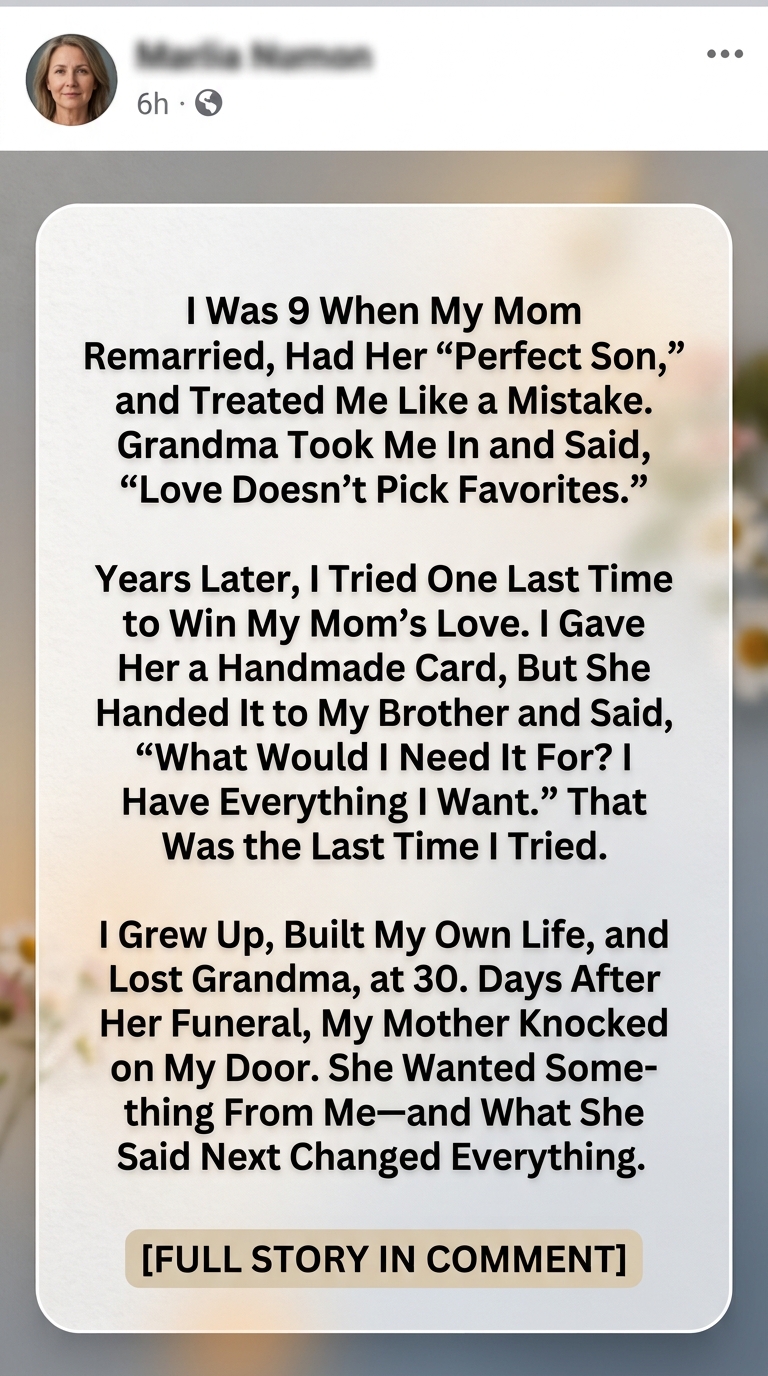
I was nine years old when my mother remarried, had her “perfect son,” and slowly began treating me like a mistake she wished she could erase. Before my stepfather came into our lives, I had believed my mother and I were inseparable. She used to braid my hair before school, kiss my forehead at night, and tell me I was her little girl. Then she married David. He was kind to her, successful, confident, and determined to give her the family she had always wanted. Less than two years later, my little brother Ethan was born. From the moment my mother held him, something changed. She called him her miracle. Her perfect boy. Her second chance at motherhood. And me? I became the child who was always “too sensitive,” “too difficult,” or “in the way.” At nine, I didn’t understand favoritism. I only understood that my mother looked at Ethan with the same love she used to look at me with, and somehow there wasn’t enough left over. When Ethan cried, she ran. When I cried, she told me to grow up. When Ethan got sick, she stayed home from work. When I had a fever, she told me Grandma could take care of me. Eventually, Grandma did more than take care of me. She took me in. I was eleven when she sat across from my mother at the kitchen table and said, “If you can’t make room for both children in your heart, I’ll make room for her in my home.” My mother didn’t fight her. That hurt more than anything. Grandma drove me home that night with two suitcases in the back seat. I cried the entire way. She didn’t tell me that my mother was wrong. She didn’t tell me to forgive her. She simply reached over at a red light and squeezed my hand. “Love doesn’t pick favorites,” she said. “Remember that.” I asked her, “Then why doesn’t Mom love me?” Grandma was quiet for a long time. Finally, she said, “Sometimes people give their love according to what they need, not according to what others deserve. That’s their failure, not yours.” I didn’t understand it then. I understand it now. Grandma raised me. She packed my lunches. She came to school plays. She helped with homework. She attended every parent conference. When I got my first job, she celebrated. When I got accepted into college, she cried. When I graduated, she stood in the front row holding flowers and shouting louder than everyone else. My mother didn’t come. Ethan had a soccer tournament. She sent me a text the next day that said, “Sorry we missed it. You understand.” I did understand. I understood that I had spent years waiting for a woman who had already made her choice. Still, part of me kept hoping. Maybe that’s what children do. Even when they’re hurt, some part of them keeps waiting for their mother to turn around and say, “I see you now.” At twenty-two, I tried again. At twenty-five, I tried again. At twenty-eight, I tried one final time. It was my mother’s birthday. I made her a handmade card because I remembered how much she used to love the cards I made when I was little. I spent hours drawing flowers around the edges and writing a simple message inside: “I hope someday we can be close again. I still love you.” I brought it to her house. Ethan was there. He was seventeen then, sitting on the couch playing a video game. My mother opened the door and smiled when she saw me. “Oh. You’re here.” I handed her the card. “Happy birthday, Mom.” She opened it, glanced at the front, and then handed it directly to Ethan. “Here. You can have this.” He looked confused. “Why?” She laughed. “What would I need it for? I have everything I want.” Something inside me broke quietly. I looked at her. She didn’t see it. Maybe she never would. I nodded. “Okay.” I walked out. I didn’t cry until I reached my car. That was the last time I tried. I stopped calling. I stopped sending birthday cards. I stopped asking whether she wanted to meet for coffee. I stopped trying to earn a place that should have been mine without asking. I built a life. I started my own business. I bought a small house. I made friends who became family. I fell in love. I married a man named Daniel who never once made me wonder whether I belonged. And Grandma was there through all of it. She was there when I got engaged. She helped choose flowers for my wedding. She danced with me at the reception even though her knees hurt. She whispered, “You built your own family.” I smiled. “Because you taught me how.” She kissed my cheek. “No. You taught yourself. I just reminded you that you were worth loving.” When Grandma turned eighty-seven, her health began to decline. I spent as much time with her as I could. On her final night, I sat beside her bed holding her hand. She looked at me and whispered, “Don’t spend your life waiting for someone to finally become who you needed them to be.” I started crying. “I know.” She squeezed my fingers. “Do you?” I nodded. “Yes.” She smiled. “Good.” She passed away two days later. I was thirty years old. Losing her felt like losing the only person who had ever truly seen me. At her funeral, my mother stood in the back. She didn’t come near me. She didn’t hug me. She didn’t say goodbye to Grandma. She simply watched from a distance. After the funeral, I went home and tried to figure out how to exist in a world without the woman who had raised me. Three days later, someone knocked on my door. When I opened it, my mother was standing there. I almost closed the door. “What do you want?” She looked tired. “Can I come in?” “Why?” She swallowed. “I need to talk to you.” “About Grandma?” “Yes.” I stepped aside. She entered slowly and sat on the couch. For several seconds, neither of us spoke. Then she said something I never expected. “Your grandmother left you everything.” I stared at her. “What?” “The house. Her investments. Her accounts. Everything.” I nodded slowly. “Okay.” My mother looked at me. “She left nothing to me.” I said nothing. “I need you to give me the house.” I almost laughed. “Excuse me?” “It’s the house I grew up in.” “It’s Grandma’s house.” “I’m her daughter.” “And I’m her granddaughter.” My mother leaned forward. “You don’t understand. I have nowhere to go.” I stared at her. “You have a house.” She looked away. “David left.” I froze. “What?” “Your stepfather left six months ago.” “And Ethan?” She hesitated. “He’s gone too.” I felt a strange sadness, but not the kind she expected. “Where did he go?” “California. He barely calls.” My mother looked down at her hands. “I have no one.” I wanted to say, “You have everything you wanted.” But I didn’t. I remembered Grandma’s words. Love doesn’t pick favorites. My mother pulled an envelope from her purse. “Your grandmother left this for you.” I took it. My name was written across the front in Grandma’s handwriting. My hands started shaking. “Why didn’t you give it to me at the funeral?” My mother looked away. “Because I wasn’t ready.” I opened it. Inside was a letter. “My darling girl,” it began. I had to stop reading for a moment. Then I continued. “If your mother comes to you after I’m gone, she may tell you she needs something. Before you decide what to do, I want you to know the truth.” My heart began pounding. I looked at my mother. She was crying. I continued. “When you were nine, your mother came to me and asked me to take you. She told me she couldn’t handle raising two children after remarrying. She said she needed a fresh start. I told her I would take care of you, but I made her promise something.” I looked up. “What?” My mother whispered, “Keep reading.” The letter continued. “I made your mother promise that she would never tell you why she sent you away.” My hands went numb. I looked at my mother. “Why?” She covered her face. “Because I was sick.” I stared at her. “What?” She lowered her hands. “When you were nine, I was diagnosed with a serious illness. I was terrified. Your stepfather wanted to leave. I thought you were going to lose both parents.” I couldn’t speak. “Ethan was already on the way. I didn’t know if I would survive. Your grandmother offered to raise you temporarily. But when I recovered, I…” She began crying. “I couldn’t face what I had done.” “So you chose Ethan.” She nodded. “Yes.” I looked back at the letter. Grandma had written: “Your mother loved you. But she was afraid. And fear made her selfish. She convinced herself that if she built a perfect new family, she could forget the parts of her life that frightened her.” My eyes filled with tears. “Why didn’t you tell me?” My mother whispered, “Because your grandmother made me promise. She said you deserved a childhood without feeling responsible for my illness.” I stared at her. “So when you rejected me…” “I was ashamed.” She cried. “Every time you came to see me, I wanted to tell you. But I couldn’t. I had convinced myself you were better off without me.” I shook my head. “You gave me away.” “I know.” “You let me believe you didn’t want me.” “I know.” “You handed my card to Ethan.” She closed her eyes. “That was unforgivable.” I waited. “Why did you do it?” “Because I was angry at myself.” She looked at me. “And when you gave me that card, it reminded me of the little girl I had abandoned. I couldn’t face her. So I pushed you away again.” I sat there in silence. For thirty years, I had believed my mother simply didn’t love me. The truth wasn’t that she didn’t love me. The truth was that she loved me badly. Fear, guilt, pride, and shame had twisted that love until it looked like rejection. That didn’t erase what she had done. It only explained it. My mother reached for my hand. I moved it away. She flinched. “I understand if you hate me.” “I don’t hate you.” She looked at me. “I don’t?” “No. But I don’t trust you.” Tears ran down her face. “That’s fair.” I looked at the letter again. There was another page. “There’s more.” I read it aloud. “I have left you the house because I want you to have the one thing you never had growing up: a place where you never have to wonder whether you belong.” I started crying. Grandma continued, “Do not give it away because you feel guilty. Do not give it away because your mother asks. If you choose to help her, help her because you want to, not because you owe her.” I looked at my mother. She whispered, “She knew me too well.” I nodded. “She knew both of us.” My mother stood. “I’m sorry.” I didn’t stop her. She reached the door, then turned. “I know I can’t undo thirty years.” I shook my head. “No.” “But if you ever decide you want a mother again…” She couldn’t finish. I stood there watching her. For the first time in my life, I saw my mother not as the woman who had rejected me, but as a deeply flawed person who had spent decades running from the consequences of her own choices. I didn’t know whether I could forgive her. But I knew I didn’t want to carry hatred forever. “Mom?” She turned. “You can come back tomorrow.” Her eyes widened. “Really?” “For coffee.” She nodded, crying. “Okay.” She left. The next morning, she came back. We sat at my kitchen table for almost two hours. She told me things she had never told me before. About her illness. About the fear she had carried. About how ashamed she was when Grandma took me. About how every birthday she bought me a gift but never found the courage to send it. I listened. I didn’t excuse her. I didn’t pretend the past hadn’t happened. But for the first time, we spoke honestly. Months passed. Our relationship remained fragile. Some days were good. Some days were painful. I never gave her Grandma’s house. I kept it exactly as Grandma intended. But I did help my mother find a smaller place to live. I paid the deposit—not because she was entitled to it, but because I chose to. One evening, she asked me, “Why did you help me after everything?” I thought about it. “Because Grandma taught me that love doesn’t pick favorites.” She started crying. “You became more like her than I ever deserved.” I smiled. “I don’t want to become you either.” She laughed through her tears. “Fair enough.” Years later, I still kept the handmade card I had made for my mother’s birthday. She had given it to Ethan, but he had never thrown it away. When he eventually found out what it meant to me, he returned it. On the front, the flowers were faded. Inside, my nine-year-old handwriting was still visible. “I love you, Mom.” I looked at those words for a long time. Then I put the card in Grandma’s old wooden box beside her final letter. Because eventually I understood something. The little girl who made that card had never been a mistake. She had simply been born into a family that didn’t know how to love her properly. Grandma did. And because Grandma did, I learned how to love myself. My mother had spent thirty years trying to escape the past. I spent thirty years learning from it. And when she finally knocked on my door, she didn’t find the little girl waiting desperately for her approval anymore. She found a grown woman who had already built a life, found her worth, and learned the truth Grandma had whispered when I was nine: Love doesn’t pick favorites. Real love makes room. And when someone doesn’t make room for you, you don’t have to shrink yourself to fit. You can walk away, build your own table, and invite the people who never make you question whether you belong.
