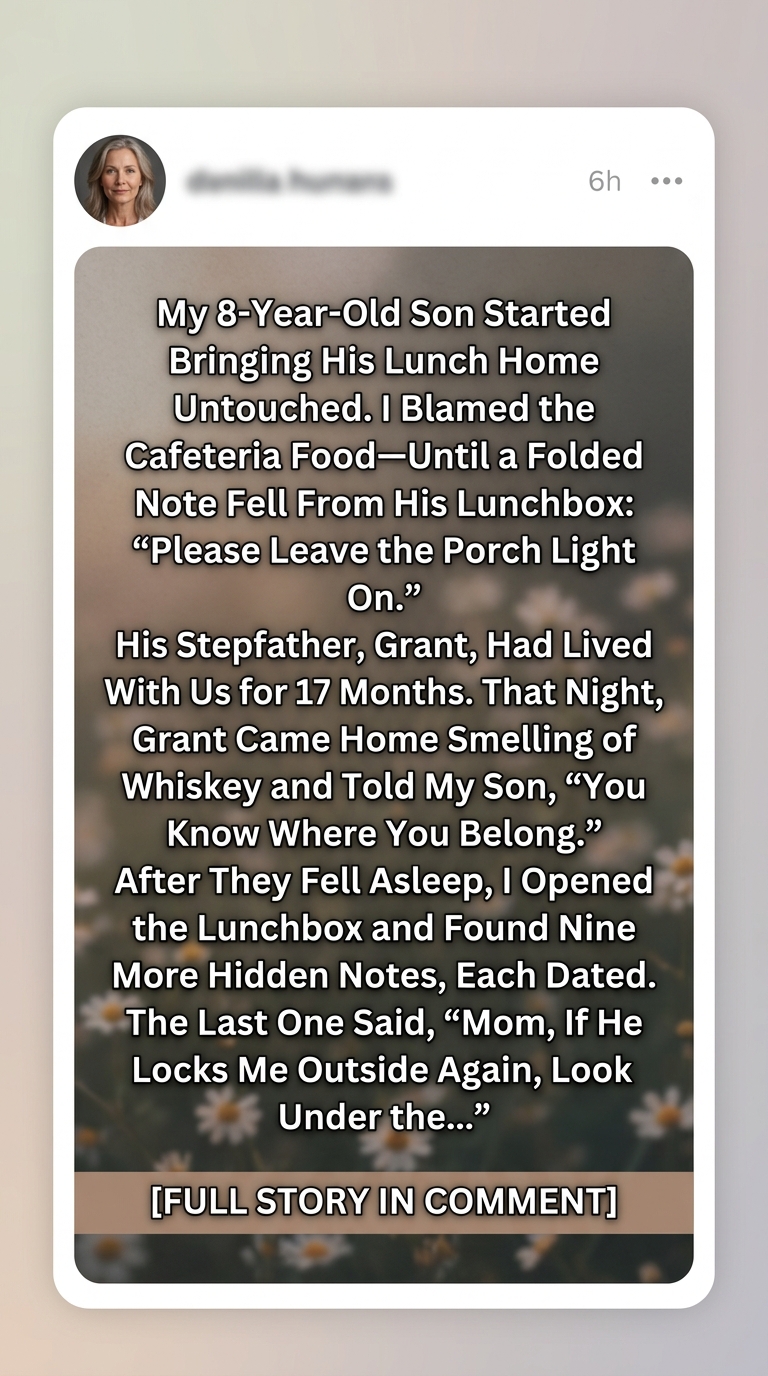
My eight-year-old son started bringing his lunch home untouched, and at first I blamed the cafeteria food. He had always been a picky eater, so when I opened his lunchbox one afternoon and found the sandwich, apple slices, and crackers exactly where I had packed them, I assumed he had simply decided he didn’t like what I made. “Was lunch bad today?” I asked. He shrugged. “Not hungry.” The next day, the same thing happened. Then the next. By Friday, I knew something was wrong. I sat beside him at the kitchen table and asked gently, “Honey, are you feeling sick?” He shook his head. “Are kids bothering you?” Another shake. “Did something happen at school?” He looked toward the hallway. “No.” That answer bothered me more than anything else. Because he hadn’t looked at me when he said it. I almost let it go. Then a folded piece of paper fell from beneath the lining of his lunchbox. I picked it up, expecting a drawing. Instead, I read four words written in my son’s careful handwriting: “Please leave the porch light on.” My stomach tightened. I looked at him. “What is this?” He immediately reached for the paper. “Nothing.” “Why do you need the porch light on?” He stared at the table. “Just because.” His stepfather, Grant, had lived with us for seventeen months. In the beginning, he had seemed perfect. He was patient with my son, helped with homework, fixed things around the house, and always told people how much he loved being a stepfather. But over the previous few months, something had changed. Grant had become impatient. He criticized the way my son ate. He complained about his toys being left in the living room. He started saying things like, “Boys need discipline.” I had dismissed it as strict parenting. That Friday night, Grant came home smelling of whiskey. My son was sitting on the couch reading. Grant walked past him, stopped, and said, “You know where you belong.” My son immediately lowered his eyes. I looked at Grant. “What does that mean?” He shrugged. “It means he needs to learn respect.” “He’s eight.” “Exactly.” I didn’t argue that night because I was watching my son. His shoulders had gone rigid. He wasn’t moving. He wasn’t even turning the pages. Later, after Grant and my son were asleep, I went downstairs and opened the lunchbox again. I removed the lining. Underneath it was another folded note. Then another. And another. Nine more notes. Each one had a date. My hands trembled as I spread them across the kitchen table. The first said, “Please leave the porch light on.” The second said, “He gets mad when you are at work.” The third said, “I don’t want to sleep downstairs anymore.” The fourth said, “Please don’t tell him I wrote this.” The fifth said, “He says you won’t believe me.” The sixth said, “He took my phone.” The seventh said, “I stayed in the bathroom until he went away.” The eighth said, “He told me Grandma wouldn’t want me.” The ninth said, “Please pick me up early.” I couldn’t breathe. I read the tenth note. It said, “Mom, if he locks me outside again, look under the…” The sentence ended there. I stared at the unfinished line. Then I remembered something. The porch. My son had asked me twice in the past month why the porch light was always off. I had assumed Grant was trying to save electricity. I went downstairs. I checked the back door. Locked. Front door. Locked. Then I stepped onto the porch. The light was off. I turned it on. My son had written something on the underside of the porch railing in pencil. A small arrow. I followed it toward the side of the house. Under the porch steps was a plastic storage bin. I pulled it out. Inside was my son’s missing backpack. His old phone. A blanket. Three library books. And a small digital recorder. I sat down on the porch steps. My hands were shaking so badly I almost dropped it. I pressed play. My son’s voice came through the tiny speaker. “Mom, I don’t know if you’ll hear this.” I covered my mouth. He continued. “I put this here because he said I wasn’t allowed to have my phone. Sometimes he makes me stay outside when he’s mad. He says I’m not part of the family.” My eyes filled with tears. Then another voice came through. Grant’s. “You don’t tell your mother anything. Do you understand?” My son’s voice whispered, “Yes.” Grant said, “She’ll believe me before she believes you.” I stopped the recording. I couldn’t listen anymore. I called my sister, Rachel, and told her to come over immediately. Then I called the police. I didn’t confront Grant. I didn’t want him to know I had found the evidence. When officers arrived, they reviewed the notes, the recorder, and the items under the porch. They told me to take my son somewhere safe before Grant woke up. Rachel arrived with her husband. We quietly packed my son’s things and left through the back door. We spent the night at her house. The next morning, investigators came to speak with my son in a safe environment. He told them everything. Grant had been locking him outside when he was angry. He had taken his phone. He had threatened to tell me that my son was lying. He had repeatedly told him that nobody would believe him. My son hadn’t known how to explain what was happening, so he started writing notes and hiding them in the only place he knew I checked every day: his lunchbox. The investigation uncovered more evidence. A neighbor had seen my son sitting outside late at night more than once. Another neighbor had security footage showing Grant leaving the house while my son remained outside. The recorder captured several conversations. The police also found messages on Grant’s phone that contradicted his claims that my son was always supervised. Grant was removed from the home and later faced charges related to child endangerment and other offenses. I changed the locks immediately. I changed the porch light too. But I left it on every night. My son noticed. “You don’t have to leave it on anymore,” he told me one evening. I knelt beside him. “I know.” “Then why do you?” I hugged him. “Because I want you to know something.” He looked at me. “What?” “You never have to be afraid to come home.” He started crying. “I thought you wouldn’t believe me.” I held him tighter. “I’m sorry you ever thought that.” He shook his head. “I tried to tell you.” “You did tell me.” I touched his lunchbox. “You found a way.” Months later, my son returned to school with a new lunchbox. He started eating lunch again. At first, he still brought half of it home. Then gradually, he began finishing everything. His teacher told me he had started laughing more. He joined a soccer team. He slept through the night. He stopped checking the windows whenever a car pulled into the driveway. Healing didn’t happen all at once. Some nights were difficult. Some sounds still scared him. But every time he was afraid, I reminded him, “You don’t have to handle scary things alone anymore.” One afternoon, I found him drawing at the kitchen table. He was drawing our house. There was a bright yellow circle above the front door. “What’s that?” I asked. “The porch light.” “Why did you draw it?” He smiled. “Because it’s always on now.” I hugged him. “Yes, it is.” Then he handed me another piece of paper. My heart stopped for half a second until I saw what it was. It wasn’t a warning. It wasn’t a secret message. It was a drawing of the three of us—my son, me, and my sister—standing beneath the porch light. At the top, he had written, “SAFE.” I cried when I saw it. Not because I was afraid anymore, but because I finally understood what all those notes had been trying to say. My son hadn’t needed me to be a detective. He needed me to notice. He needed me to believe him. He needed one safe place where the truth mattered more than appearances. And that was what I gave him. Years later, I kept those ten notes in a small box. I never showed them to him without asking. I didn’t want those pages to define his childhood. But I kept them because they reminded me of something I would never forget: children don’t always know how to say, “I’m afraid.” Sometimes they leave clues. Sometimes they go quiet. Sometimes they stop eating. Sometimes they write four words and hide them where they hope the right person will find them. My son had been telling me he needed help long before I understood the language he was using. And I will always be grateful that, eventually, I listened. The porch light stayed on every night after that. Not because my son needed permission to come home. Because he deserved to know that home would always be the place where the door was open, the truth was safe, and his voice would be heard.
