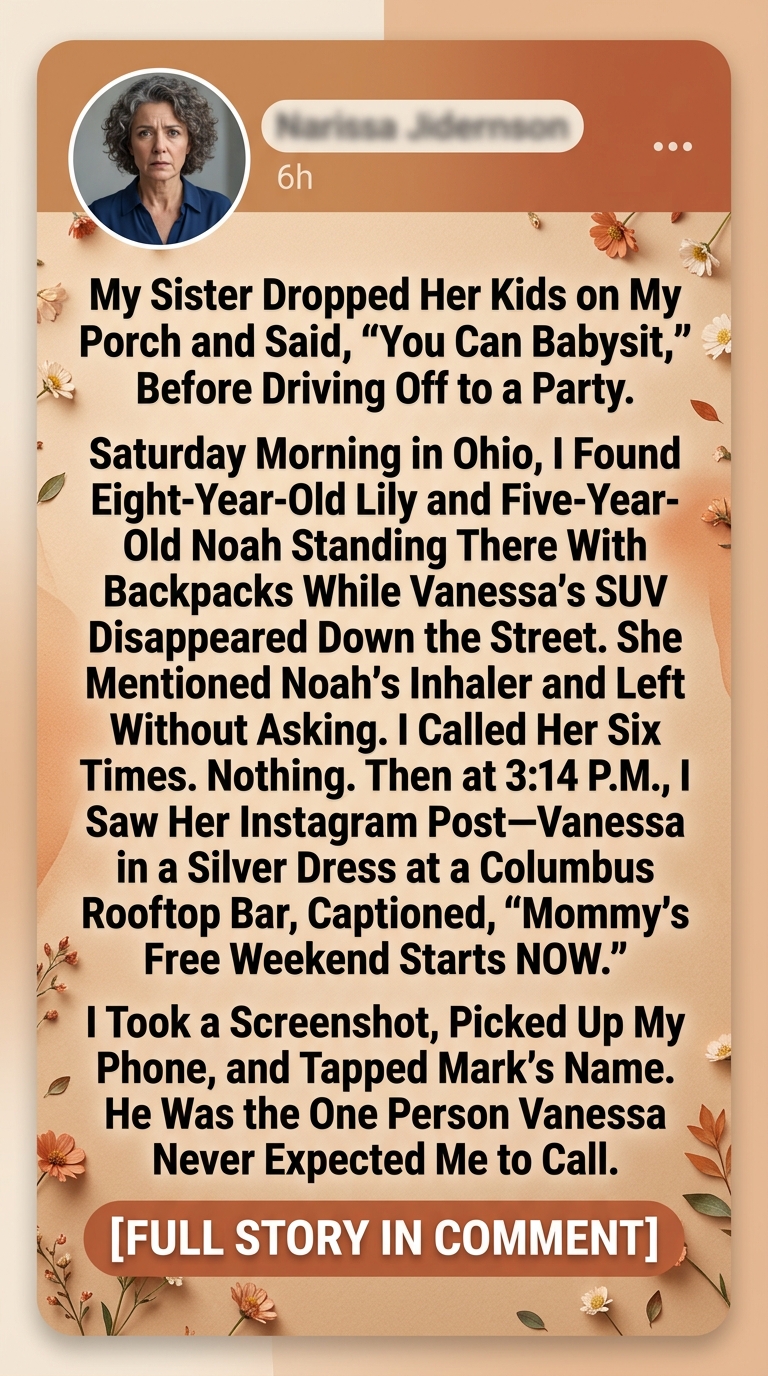
My sister dropped her kids on my porch and said, “You can babysit,” before driving off to a party. Saturday morning in Ohio, I found eight-year-old Lily and five-year-old Noah standing there with backpacks while Vanessa’s white SUV disappeared down the street. Noah was clutching his stuffed dinosaur, and Lily had tears in her eyes but was trying desperately not to cry. “Mom said you’d watch us,” she whispered. I looked toward the street. Vanessa was already gone. She hadn’t asked me. She hadn’t called. She hadn’t even knocked. She had simply left two children on my porch as if I were a free daycare service. I called her. No answer. I called again. Nothing. Six calls later, I finally stopped trying. Then, at exactly 3:14 that afternoon, my phone buzzed with an Instagram notification. Vanessa had posted a picture from a Columbus rooftop bar. She was wearing a silver dress, holding a champagne glass, smiling beneath strings of lights. The caption read, “Mommy’s Free Weekend Starts NOW.” I stared at that picture for several seconds. Then I looked at Noah, who was sitting on my couch struggling to breathe comfortably. His inhaler was sitting beside him. Vanessa had mentioned it casually before driving away, like she was dropping off a grocery bag. “He may need this later.” That was it. No instructions. No emergency contact. Nothing. Lily was coloring at the kitchen table when I picked up my phone again. I opened my contacts and scrolled past names I hadn’t called in years. Then I stopped at one name. Mark. My finger hovered over it. Mark was the one person Vanessa never expected me to call. He was her former husband. Lily and Noah’s father. And the last person Vanessa wanted anywhere near the truth. I pressed call. He answered on the second ring. “Hello?” His voice was cautious. “Mark,” I said. “It’s Claire.” There was a pause. “Claire? Is everything okay?” I looked at the two children in my living room. “No,” I said quietly. “It isn’t.” I told him everything. The porch. The backpacks. The inhaler. The six unanswered calls. Then I sent him the screenshot of Vanessa at the rooftop bar. He didn’t respond for almost a full minute. Finally, he said, “She told me the kids were spending the weekend with her.” My stomach tightened. “Apparently not.” Another silence. Then Mark asked, “Where are they?” “With me.” “Are they safe?” “Yes. But Noah’s breathing has been bothering him.” I heard Mark inhale sharply. “I’m coming.” Forty-five minutes later, a dark pickup pulled into my driveway. Mark stepped out looking exhausted, like he had driven the entire way with his jaw clenched. The moment Noah saw him, he jumped off the couch. “Daddy!” Mark dropped to his knees and hugged him. Lily ran after him. For the first time all day, both children smiled. I stood in the doorway watching them, and something inside me broke. Because I suddenly realized this wasn’t just about one irresponsible Saturday. This had been happening for much longer. Mark sat at my kitchen table while the children ate sandwiches. “She told me she was taking them to her friend’s cabin,” he said. “She said she needed family time.” “Apparently family time means a rooftop bar.” He looked down at the screenshot again. His expression changed. “I need to tell you something.” I folded my arms. “What?” “Vanessa has been telling me for months that you were interfering with her parenting.” I almost laughed. “Me?” “She said you were obsessed with criticizing her. She told me you were jealous because she had a better life.” I stared at him. “Mark, she dropped her kids on my porch without permission.” “I know.” “And this isn’t the first time.” His eyes lifted. “What do you mean?” I hesitated. Then I told him about the other times. The Tuesday she left Lily at my office because she “forgot” a school pickup. The night Noah slept on my couch because Vanessa said she had a work emergency, only for me to discover the next morning that she had been at a concert. The Sunday she asked me to keep the kids for “two hours” and didn’t return until nearly midnight. Mark listened without interrupting. When I finished, he rubbed his forehead. “She told me you were exaggerating.” “She tells everyone what she needs them to believe.” Mark looked toward the living room. “She told me she wanted full custody because I was unstable.” That surprised me. “You?” “Apparently.” He gave a bitter smile. “I thought the court might believe her. She’s been documenting everything. Every disagreement. Every argument. Every time I complained about the kids being left with strangers.” “She’s documenting you?” “Yes.” I slowly pushed my phone across the table. “Then maybe we should document her.” Mark looked at me. “Claire…” “I’m not saying we start a war. I’m saying we stop pretending this is normal.” He looked down at the phone. “You really want to get involved?” I thought about Lily trying not to cry on my porch. I thought about Noah struggling to breathe. “I already am.” That evening, Mark took the children to his house. Before leaving, he hugged me and said, “Thank you.” I watched his truck disappear and assumed that would be the end of it. I was wrong. At 10:47 that night, Vanessa called. “How dare you?” she screamed the second I answered. “Excuse me?” “You called Mark.” “Yes.” “Those are my children.” “Then maybe you should have stayed with them.” Silence. I heard her breathing heavily. “You had no right.” “Neither did you.” She started shouting about boundaries, betrayal, and family loyalty. I let her talk. Then I said one sentence. “Next time you leave your children somewhere without permission, I’m calling the police.” She went silent. “You wouldn’t.” “Try me.” I hung up. The next morning, Mark called me. His voice sounded different. Serious. “Claire, I found something.” “What?” “There are charges on my old credit card.” “What kind?” “Hotels. Restaurants. Rideshares. Bars.” “Vanessa?” “The card was supposed to be canceled.” He paused. “There’s more.” Mark told me he had started looking through old financial records after our conversation. He discovered that Vanessa had been using money from an account they had both contributed to before their divorce. Small withdrawals at first. Then larger ones. Thousands of dollars had disappeared over the previous year. “She told me it was for the kids,” he said. “It wasn’t.” “Can you prove it?” “I’m trying.” Two days later, I received a message from Mark with a photograph attached. It was a bank statement. One transaction caught my attention immediately. $1,850. A luxury hotel in downtown Columbus. The date matched the same weekend Vanessa had claimed she was taking the children to her mother’s house. Another charge was for a rooftop restaurant. Then another. And another. Suddenly, the Instagram picture wasn’t just proof that she had abandoned her kids. It was part of something bigger. Mark contacted his attorney. His attorney told him not to confront Vanessa and to preserve everything. Meanwhile, Vanessa changed tactics. She called our mother. She called our brother. She called anyone who would listen. Her version was simple: I was jealous of her, Mark was trying to punish her, and everyone was conspiring against her. Then she made the biggest mistake of all. She showed up at my house. She arrived in the same silver dress from the Instagram picture. She stood on my porch with sunglasses on and said, “You need to give me the screenshot.” I stared at her. “No.” “Delete it.” “No.” “Claire, you don’t understand what you’re doing.” “I understand exactly what I’m doing.” She stepped closer. “Those are my children.” “Then act like their mother.” Her face hardened. “You think Mark is going to take them from me?” “I don’t know what the court will decide.” “He won’t.” “That’s not my decision.” She stared at me for several seconds. Then she smiled. “You really think Mark is going to thank you when he realizes what kind of person you are?” I didn’t answer. She turned around and walked away. That night, Mark called again. “She came to your house?” “Yes.” “Did she threaten you?” “Not directly.” He exhaled. “Claire, I need you to listen to me. I found something else.” “What?” “A folder on her laptop.” He told me that his attorney had advised him to preserve any evidence legally available to him. Inside the folder were photographs, receipts, and messages. But one file stood out. It was a document Vanessa had created months earlier. A custody narrative. It listed supposed examples of Mark being “neglectful,” including incidents that had never happened. At the bottom was a section titled: “Potential witnesses.” My name was there. Next to it, Vanessa had written: “Claire will probably side with me if pressured.” I stared at the message Mark had sent me. “She thought you would lie for her?” “Apparently.” I shook my head. “She never knew me.” But there was one more thing neither of us expected. A week later, Mark received a call from the school. Lily’s teacher wanted to speak with him. She told him Lily had been unusually anxious for months. She frequently asked whether her father was angry with her. She had also started carrying a small notebook in her backpack. The teacher asked Mark whether he knew why. He didn’t. When he picked Lily up that afternoon, he gently asked her. “What’s in the notebook?” Lily looked at him nervously. “Mom told me not to show anyone.” Mark’s face went pale. “Why?” Lily whispered, “Because she said Daddy would take us away.” Mark didn’t pressure her. He simply told her she could tell him anything. After a few minutes, Lily opened the notebook. Inside were dates. Times. Places. Short sentences written in an eight-year-old’s handwriting. “Mom left us with Mrs. Parker.” “Mom said Daddy doesn’t need to know.” “Mom went out again.” “Noah cried.” “Mom said not to tell Aunt Claire.” Mark called his attorney immediately. The attorney told him the notebook might be important, but more importantly, Lily needed reassurance, not interrogation. A custody evaluator was eventually involved. School records were reviewed. Financial records were reviewed. Messages were reviewed. The Instagram post was reviewed. And the truth became impossible to ignore. Vanessa had built an entire story about herself being the responsible parent while repeatedly leaving the children with relatives, neighbors, and babysitters without properly informing Mark. She had also used money intended for shared child expenses on personal entertainment. None of those facts alone determined the custody outcome. But together, they created a documented pattern that the court had to consider. Then came the hearing. Vanessa arrived with her attorney wearing a serious expression. She looked at me across the hallway and shook her head as if I had betrayed her. Mark sat quietly beside his lawyer. The judge reviewed the evidence. Vanessa insisted the Instagram post had been harmless. She claimed the children were supposed to stay with me and that she had simply forgotten to tell Mark. Then her attorney asked me questions. “Did your sister ever tell you she was going to leave the children with you?” “No.” “Did she ask permission?” “No.” “Did she provide medical instructions for Noah?” “No.” “Did you attempt to contact her?” “Six times.” “Did she answer?” “No.” “How did you know where she was?” I held up the screenshot. “She posted it publicly.” Vanessa looked down. The judge reviewed it. Then the financial records were introduced. The hotel charges. The restaurant charges. The withdrawals. The messages. The notebook. By the end of the hearing, Vanessa’s story had changed several times. Finally, the judge asked her directly, “Why were the children left on the porch?” Vanessa looked at me. Then at Mark. Then at the floor. “I needed a break,” she whispered. The judge responded calmly, “Needing a break does not relieve a parent of the responsibility to arrange appropriate care.” There was no dramatic shouting. No movie-style verdict. Just a series of practical decisions focused on the children. Mark received expanded custody while the court continued reviewing the broader situation. Vanessa was required to follow specific parenting and communication arrangements. Financial issues were handled separately. And I was no longer expected to serve as an emergency babysitter whenever Vanessa wanted a night out. Three months later, I was sitting on my porch when Lily and Noah came running up the driveway. Lily had a school project in her hands. Noah was carrying his stuffed dinosaur. “Aunt Claire!” Lily shouted. “Look!” She showed me a drawing of our house. There were four stick figures standing in front of it. Me. Mark. Lily. Noah. Above them, she had written: “People Who Show Up.” I felt tears fill my eyes. “I love it,” I told her. She smiled. “Daddy says you saved us.” I shook my head. “No, sweetheart. Your dad showed up. Your teacher paid attention. Lots of people helped.” I looked at Mark. He smiled. “She’s right,” he said. “You made the call that started everything.” Vanessa eventually moved to another apartment and began following the court-ordered parenting schedule. Our relationship never returned to what it had been. I stopped trying to convince her that I wasn’t her enemy. I stopped answering every angry message. I stopped letting guilt turn into permission. Months later, she sent me one final text. “I hope you’re happy with what you’ve done.” I stared at it for a long time. Then I typed one sentence. “I am happy that the kids know they can call someone when they need help.” I never sent anything else. I deleted the draft. I didn’t need the last word. I had already learned something that Saturday morning on my porch: being family doesn’t mean allowing someone to use you. Love doesn’t mean staying silent when children are being put in the middle of adult choices. And sometimes, the most important call you make isn’t the one that starts a fight. It’s the one that brings the right person to the door. Mark had been the one person Vanessa never expected me to call. She thought calling him would destroy her story. Instead, it gave him the chance to hear the truth. And for Lily and Noah, that phone call changed everything.
