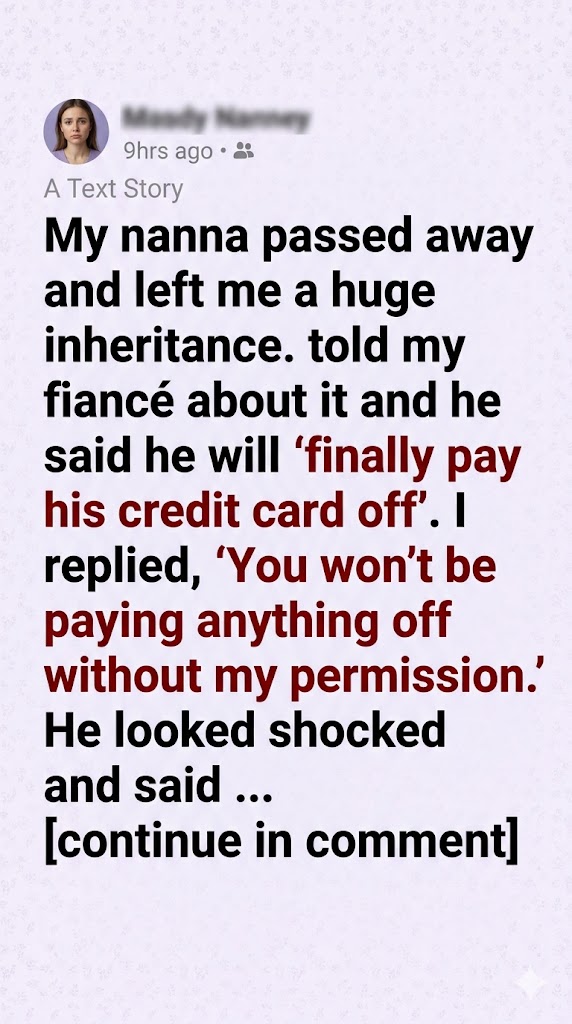
My nanna passed away and left me a huge inheritance. I told my fiancé about it and he said he will “finally pay his credit card off.” I replied, “You won’t be paying anything off without my permission.” He looked shocked and said, “What do you mean? We’re getting married. What’s yours is mine.”
I remember just standing there, the heat rising to my cheeks. We’d only been engaged for five months. And though I loved him—or thought I did—something about his response made my stomach turn. It wasn’t the words themselves, but the tone, like he felt entitled to something he didn’t earn. Like the decision had already been made without me.
I cleared my throat and said, “That’s not how this works. This money came from my grandmother. She trusted me with it. It’s not just a windfall—it’s her life’s work.” Even as I said it, I felt something shift between us, something subtle but irreversible.
He laughed nervously and tried to backtrack. “I’m just saying… we have debt, and it’d be nice to go into marriage with a clean slate. Don’t you think?” His smile didn’t quite reach his eyes.
Maybe if he had said it differently, asked instead of assumed, I wouldn’t have felt so guarded. But something inside me clicked. It was like a quiet bell went off in my head, warning me to pay closer attention. And once you hear that kind of warning, you can’t unhear it.
For the next few weeks, I did.
We had already been living together in a small apartment. I started noticing how often he ordered things online, despite claiming we were “tight on cash.” Packages arrived almost daily. He always seemed to have a new pair of sneakers or the latest gadget, and yet, when rent came around, he barely scraped by. There were excuses—always excuses.
Once, I asked him how much he owed in total. He shrugged. “I don’t know… maybe fifteen, twenty thousand? But it’s not a big deal. Everyone has debt.” He said it so casually, like it was nothing, like I was the strange one for caring.
That didn’t sit right with me.
So one night, while he was watching a game, I went to the kitchen and pulled out my laptop. I didn’t want to snoop, but I needed to understand what I was getting into. If we were going to be married, transparency had to go both ways. And deep down, I already knew I wasn’t going to like what I found.
I checked our shared bank statements. What I found made my heart sink. He wasn’t just in debt—he was reckless. Multiple payments to online casinos. Two purchases from a luxury watch site. Payments to some “consultant” I’d never heard of. The amounts weren’t small. They were escalating.
Read Also: My Stepmom Was Secretly Using My Little Sister’s Christmas Money – I Made Her Regret It
And the dates… some of them lined up with nights he told me he was “working late.”
The next morning, I confronted him. He didn’t deny it. Instead, he looked annoyed, like I was the problem, like I’d crossed a line he had no issue crossing himself.
“Why are you going through my stuff?”
“Because we’re supposed to be a team,” I said, trying to stay calm. “And teams don’t keep secrets. You told me you had a little debt. You didn’t mention gambling.”
He scoffed and muttered something about how I wouldn’t understand. His voice dropped, defensive, almost hostile. It wasn’t just denial—it was deflection.
That’s when I knew.
The inheritance wasn’t the issue. It just revealed the cracks that were already there. My grandmother had always told me, “Money doesn’t change people, it just shows you who they already are.” Now I finally understood what she meant. And I couldn’t unsee it.
Still, I didn’t walk away immediately. I wanted to be sure. I suggested couples counseling. He refused.
He said, “We’re fine. You’re just overreacting. Everyone has debt. Everyone makes mistakes.” But his tone had hardened, and there was something else beneath it now—resentment.
But his “mistakes” kept piling up. One night, I caught him on his phone in the bathroom, whispering. When he came out, I asked who he was talking to.
He snapped, “None of your business,” and stormed out of the apartment. The door slammed so hard the walls seemed to shake.
He didn’t come back until the next afternoon. No explanation. No apology. Just silence, like I was supposed to accept it and move on.
I started sleeping with the bedroom door locked. Not because I thought he’d hurt me—but because I no longer felt safe sharing a space with someone I didn’t fully know. That realization alone kept me up at night.
A week later, I sat him down. I told him I was putting the wedding on hold. I needed space. I didn’t say the word “breakup,” but we both felt it lingering in the air, heavy and unavoidable.
He reacted like I’d betrayed him.
“You’re just like everyone else,” he hissed. “You get a little money and suddenly think you’re better than me.” His words were sharp, but his eyes gave something else away—panic.
That hit deep, but I didn’t let it show.
I moved in with a friend for a while. Took time to think. Grieve my nanna properly. Reflect on everything. For the first time in months, I could hear my own thoughts clearly.
Then, something unexpected happened.
A letter arrived in the mail. From a woman named Carla. She introduced herself as my fiancé’s “former partner”—not girlfriend, but business partner. The envelope was thick. Too thick to be casual.
She had seen my name on a legal filing and thought I should know the truth.
Read Also: “The Man My Mother Disliked—Until She Realized He Reflected Her Own Story”
Apparently, two years ago, they’d started a side hustle together—something involving flipping electronics. But according to her, he ran off with most of the profits and left her to deal with unpaid taxes and supplier debts.
She attached copies of emails, transactions, even screenshots of text messages. Promises made. Promises broken. Patterns that felt disturbingly familiar.
I was stunned. And more than that—I was scared of how close I had come to tying my life to his.
That same week, I got a call from my bank. Someone had tried to access my savings account. The one where the inheritance was.
I froze.
I had told him the name of the bank once, in passing. Just once. And suddenly, everything snapped into place—the urgency, the entitlement, the anger when I said no.
But the attempt failed because I had set up two-factor authentication.
That was my last straw.
I called him and told him to come get his things. When he arrived, he acted like nothing had happened. Like we were just having a minor disagreement.
“You’re really gonna throw us away over money?”
“No,” I said quietly. “I’m throwing it away over trust. Or the lack of it.” And for the first time, I felt completely certain.
He didn’t argue. Just grabbed his bag and left. No apology. No fight. Just an eerie kind of calm, like he had already moved on to his next plan.
A week later, I changed all my passwords, closed the joint account, and went for a walk near the lake where my nanna used to take me when I was little. I brought one of her scarves and sat on the bench where we’d once had long talks.
I cried. Not because I was heartbroken, but because I felt a strange mix of relief and grief. I missed her. I missed the version of myself who had believed everything would work out just because I loved someone. That version of me felt very far away now.
But I was also proud. Proud that I’d paid attention. That I’d chosen peace over pressure. That I had listened when something deep inside me whispered, “This isn’t right.”
That fall, I signed up for a financial literacy course. Not because I didn’t trust myself, but because I wanted to honor the gift my grandmother left me. I wanted to do something meaningful with it. Something she would recognize as wise.
I also started volunteering at a local women’s shelter. One of the programs involved teaching women how to manage money after leaving difficult relationships. It felt healing to give back in that way. Like I was turning something painful into something purposeful.
Then came the twist I didn’t see coming.
One night after class, an older woman approached me. Her name was Sharon. She said she recognized my last name and asked if I was related to Mrs. Collins—my grandmother.
Read Also: She Had Just Found Her Confidence—Then One Dinner Shattered It All
Turns out, she had been my nanna’s neighbor years ago. They used to garden together, share tea, talk about life.
She smiled and said, “Your grandmother once told me she was saving for something special. She didn’t say what. But now I know. It was you.” Her voice was gentle, certain.
That moment undid me. I cried right there in the community center parking lot. Not out of sadness, but because, for the first time, everything made sense. The inheritance wasn’t random. It was intentional. It was trust.
A few weeks later, I took a portion of the inheritance and started a small scholarship fund in my nanna’s name for girls pursuing education in finance or entrepreneurship. It wasn’t huge, but it felt right. It felt like a continuation of her story.
Life moved on.
One year later, I met someone new. Not flashy, not smooth. Just kind. The kind of kindness that doesn’t ask for anything in return.
He offered to split the bill on our first date, and I smiled. Not because I expected him to pay, but because he didn’t assume. Because there was respect in that small gesture.
We took things slow. Slower than I ever had before.
I didn’t tell him about the inheritance for months. And when I did, he shrugged and said, “That’s great. I just hope you do something that makes you proud with it.” No curiosity about the amount. No hidden calculation. Just support.
And I did.
I bought my first home, small but sunlit, with a garden in the back just like Nanna’s. I grew tomatoes and basil, and sometimes just sat on the porch with a cup of tea and her scarf in my lap, feeling like she was still with me in the quiet moments.
Looking back, I realize the inheritance wasn’t the blessing. The clarity it gave me—that was. It didn’t just give me security. It gave me sight.
It showed me who I was really marrying. It taught me that love without respect isn’t love. That someone who sees your worth won’t try to claim what’s yours—they’ll protect it with you.
If you’re reading this and going through something similar, let me say this: listen to your gut. Pay attention to what people do, not just what they say. And don’t ignore the small red flags—they rarely stay small.
And know that walking away from the wrong person is how you make space for the right one.
Because sometimes, the best inheritance isn’t money.
It’s clarity.
It’s wisdom.
It’s peace.
It’s becoming the person your younger self—and maybe your nanna—would be proud of.
