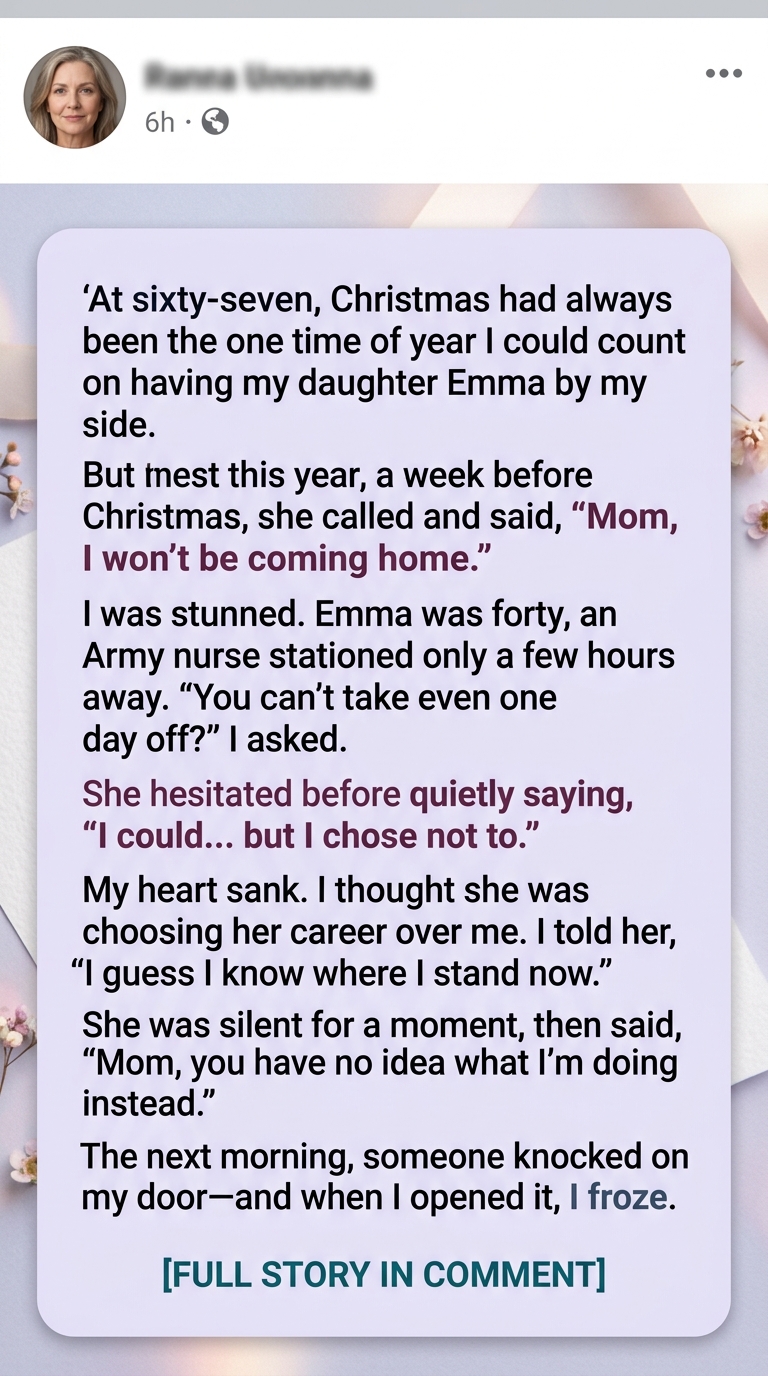
At sixty-seven, Christmas had always been the one time of year I could count on having my daughter Emma by my side. But this year, a week before Christmas, she called and said, “Mom, I won’t be coming home.” I was stunned. Emma was forty, an Army nurse stationed only a few hours away. “You can’t take even one day off?” I asked. She hesitated before quietly saying, “I could… but I chose not to.” My heart sank. I thought she was choosing her career over me. I told her, “I guess I know where I stand now.” She was silent for a moment, then said, “Mom, you have no idea what I’m doing instead.” The next morning, someone knocked on my door—and when I opened it, I froze. Standing on my porch was an elderly man I had never seen before, holding a small wrapped box and wearing an old Army jacket. Behind him sat a little girl in a wheelchair, bundled in a red blanket. “Are you Margaret?” the man asked. I nodded slowly. “Yes.” He looked at me with tears in his eyes. “Then I think you should know what your daughter has been doing.” I stepped aside and invited them in. The little girl smiled shyly. “My name is Sophie.” I looked at the man. “Who are you?” He took off his cap. “My name is Daniel. I served with Emma’s father.” My heart stopped. I hadn’t heard that name spoken in years. Emma’s father, David, had died when she was only twelve. For decades, Christmas had been the one holiday when I felt his absence most strongly. Emma had always been the one who made the house feel full again. She would arrive with groceries, laugh at my terrible cooking, decorate the tree, and insist on watching the same old Christmas movie we had watched every year since she was a child. So when she told me she wasn’t coming, I had felt more than disappointment. I had felt abandoned. Daniel sat at my kitchen table. Sophie sat beside him. “Emma asked me to come here,” he said. “She said you deserved to know why she wasn’t coming home.” I stared at him. “Then why didn’t she just tell me?” Daniel smiled sadly. “Because she wanted you to see it instead of hearing it.” He handed me the wrapped box. “This belonged to your husband.” My hands began shaking. I opened it slowly. Inside was an old photograph of David in uniform, standing beside a younger Daniel. Beneath it was a handwritten note. I recognized David’s handwriting immediately. “Margaret, if you’re reading this, I hope Emma is old enough to understand what this means. There are people in this world who spend Christmas alone because everyone assumes someone else will care.” I looked up. “Where did this come from?” Daniel explained that years ago, David and he had served together overseas. During one deployment, David had helped establish a small tradition among their unit: every Christmas, soldiers would identify families of fallen service members or struggling veterans who had nobody to visit them. After David died, Emma had continued the tradition quietly. I stared at him. “Emma?” He nodded. “Every Christmas for the last twelve years.” My eyes filled with tears. “She never told me.” “She didn’t want praise.” Daniel pointed toward Sophie. “This year, she asked us to help a family that needed her more than she thought you needed her.” Sophie looked down at her blanket. “My dad is deployed,” she said softly. “My mom died last year.” My heart broke. “I’m so sorry.” Daniel nodded. “Sophie has been living with her grandmother. Her grandmother is sick. Emma met them through the military hospital.” He paused. “Emma arranged for Sophie and her grandmother to spend Christmas somewhere safe. But there was another problem.” “What problem?” “Sophie had never had a real Christmas.” I looked at the little girl. She smiled shyly. “I had Christmas once, but I don’t remember it.” I covered my mouth. Suddenly, everything made sense. Emma wasn’t choosing her career over me. She was choosing someone who had nobody else. Daniel reached into his coat and handed me another envelope. “Emma asked me to give you this tomorrow morning.” “Tomorrow?” He smiled. “She’ll be here.” I opened it. Inside was a letter. “Mom, I’m sorry I made you think I was choosing something over you. I should have explained. But I knew if I told you where I was going, you’d insist I come home anyway. And I needed you to understand why I couldn’t. Twelve years ago, Dad’s old Army friend found me and told me about something Dad used to do. He believed no family should feel forgotten during the holidays. So every Christmas, I find someone who needs a little family. Sometimes it’s a veteran. Sometimes it’s a widow. Sometimes it’s a child who doesn’t understand why everyone else gets to celebrate while they have an empty chair. I didn’t tell you because I knew you’d be proud. But I didn’t want you to be proud. I wanted you to understand. You taught me that Christmas wasn’t about who sat at our table. You taught me it was about making room at it.” I couldn’t read anymore. Tears blurred the page. Sophie reached for my hand. “Are you Emma’s mom?” she asked. I nodded. “Yes.” “She said you’re nice.” I laughed through my tears. “She says that?” Sophie nodded. “She said you make the best cinnamon rolls.” I smiled. “Your Emma has been exaggerating.” Daniel laughed. Then he said something that made my heart ache. “Emma arranged for Sophie to spend Christmas with you.” I stared at him. “With me?” “If you’re willing.” I looked at Sophie. She was holding a small stuffed bear. “I’d like that,” she whispered. “Then you’re staying,” I said. “Both of you.” The next morning, Emma arrived at sunrise. She stepped through the door carrying a duffel bag and stopped when she saw the living room. There was a Christmas tree covered in ornaments. Presents sat underneath it. Sophie was asleep on the couch. Daniel was drinking coffee at the kitchen table. I stood near the fireplace. Emma looked at me nervously. “Mom…” I walked toward her. “You should have told me.” Her eyes filled with tears. “I know.” “I thought you didn’t want to come home.” “I always want to come home.” I hugged her. “Then don’t ever make your mother guess.” She laughed and cried at the same time. “I’m sorry.” I pulled away and looked at her. “Your father would be proud.” She froze. “Really?” “Yes.” I held up the old photograph. “He started this tradition. You just carried it forward.” Emma looked at Daniel. “You told her?” He smiled. “She deserved to know.” Sophie woke up a few minutes later. Emma knelt beside her. “Merry Christmas.” Sophie smiled. “Merry Christmas.” Then she looked at me. “Grandma?” I nearly dropped the plate I was holding. “What did you call me?” She smiled. “Can I call you Grandma?” I looked at Emma. She was crying. “Of course,” I whispered. “You can call me whatever you want.” That Christmas was unlike any Christmas I had ever known. We ate too much food. We watched old movies. Sophie opened presents slowly, as if she was afraid they might disappear. She received a doll, a winter coat, art supplies, and a small red bicycle that we would eventually need to modify for her wheelchair. Emma spent most of the day beside her. Daniel told stories about my husband that I hadn’t heard in decades. And for the first time since David died, I heard someone laugh while talking about him. That evening, Emma and I stood in the kitchen washing dishes. “Mom?” “Yes?” “Are you still angry?” I smiled. “No.” “Were you really that hurt?” I turned off the water. “Yes.” She nodded. “I’m sorry.” “I know.” I dried my hands. “But I learned something too.” “What?” “Sometimes the people we love are doing something beautiful that we don’t understand yet.” Emma smiled. “You sound like Dad.” I laughed. “Your father would say I stole it from him.” We hugged. Before bed, I walked into the living room. Sophie was asleep beside the Christmas tree. Daniel was sitting quietly in a chair. Emma had draped a blanket over Sophie. I stood there watching them and suddenly understood what my daughter had meant. Christmas had never really been about having Emma beside me. I had simply believed it was. Christmas had always been about love making room for someone who needed it. And my daughter had spent twelve years learning that lesson better than I had. The following year, Emma came home for Christmas. But she didn’t come alone. She brought three Army families with her. A widowed mother. A young veteran recovering from an injury. And a little boy whose father was deployed overseas. My house was loud. Crowded. Messy. Perfect. I looked around my kitchen and laughed. “Emma,” I said, “there’s barely room to walk.” She smiled. “You always said there was room for one more.” I looked at her and realized that the daughter I thought had left me behind had actually spent years carrying my love into places I could never reach. And that Christmas, I finally understood her words. She hadn’t chosen her career over me. She had chosen to make sure someone else wasn’t alone. And somehow, in doing that, she had brought home more love than I could ever have imagined.
