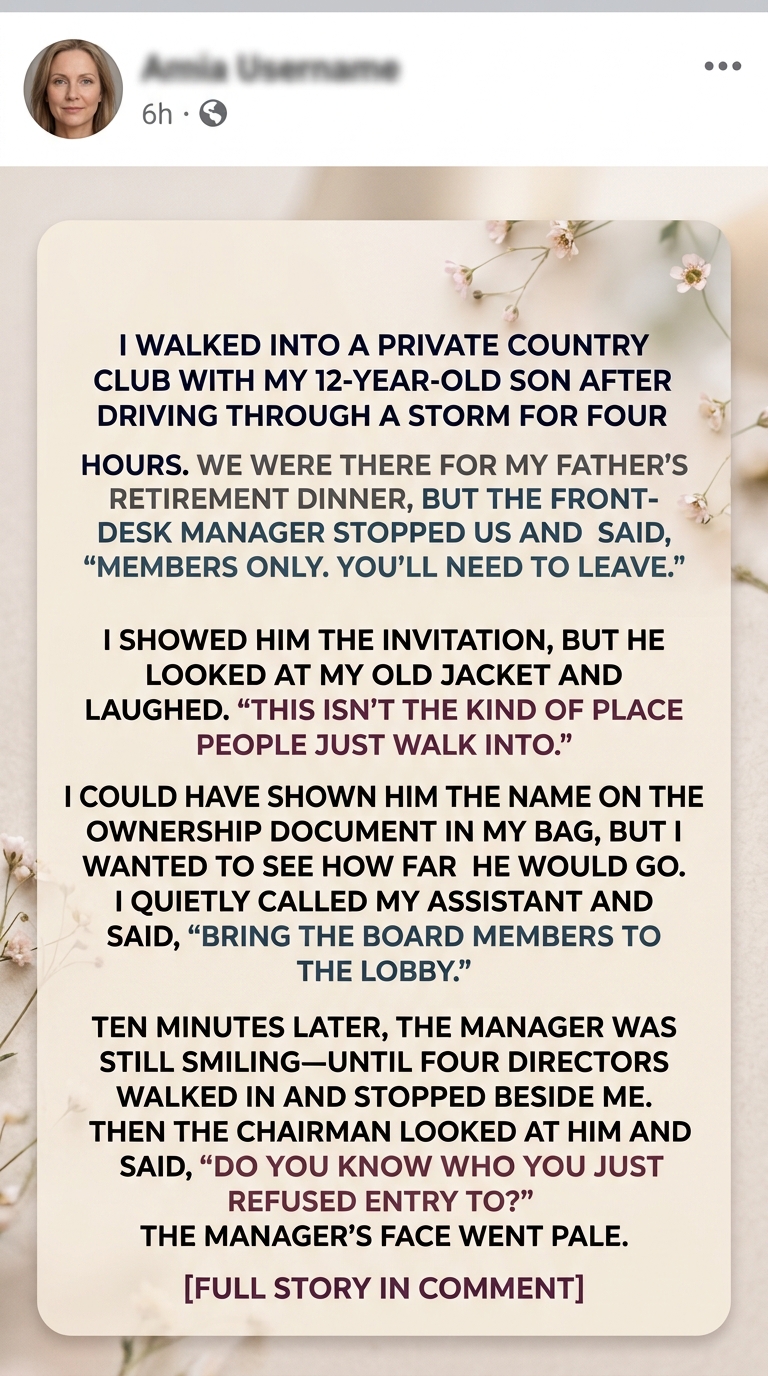
I drove through four hours of rain with my twelve-year-old son sitting quietly in the passenger seat, watching lightning flash across the windshield, because I had promised him we would make it to his grandfather’s retirement dinner no matter what. The invitation had arrived three weeks earlier, printed on thick cream paper with my father’s name embossed across the top. “Private Country Club. Formal Dinner. Family and Board Members.” My father was retiring after thirty-five years in the financial industry, and apparently this dinner was the celebration everyone in his professional circle had been talking about. I almost didn’t go. My relationship with my father had never been simple. We spoke, but we rarely talked. We loved each other, but we had spent years learning how to hide disappointment behind polite conversations. Still, when he called me personally and said, “I want you there,” I promised I would come. My son, Ethan, had never been inside a place like that. He kept looking at the invitation in the cup holder. “Dad, is this where rich people eat?” I laughed. “Probably.” He looked down at his sneakers. “I don’t think my shoes are fancy enough.” “Your shoes are fine.” “What about your jacket?” I glanced at the old navy jacket hanging over the back seat. It was worn at the cuffs and faded around the collar. I had owned it for almost ten years. “What’s wrong with my jacket?” “Nothing,” he said. “It’s just old.” “So am I.” He laughed. “You’re not old.” By the time we reached the country club, the rain had become a wall of water. The driveway was lined with tall trees and stone lanterns. The building itself looked less like a club and more like a private estate, with massive windows glowing warm against the storm. I parked near the entrance, grabbed the invitation, and walked inside with Ethan beside me. The lobby was enormous. Marble floors. Crystal chandeliers. Dark wood walls. A fireplace taller than Ethan. Men in tailored suits and women in elegant dresses stood around holding champagne glasses. Ethan immediately became quiet. I put a hand on his shoulder. “Stay close.” We had barely taken five steps when a man behind the front desk raised his hand. “Excuse me.” I stopped. “Yes?” He looked at Ethan first, then at me. His eyes traveled down to my old jacket and then to my son’s rain-soaked sneakers. “Members only.” I pulled out the invitation. “We’re here for the retirement dinner.” He barely glanced at it. “The event is private.” “That’s why we were invited.” He smiled in a way that wasn’t friendly. “Sir, I understand, but this is not the kind of place people just walk into.” Ethan looked at me. I could see embarrassment spreading across his face. “Dad, maybe we’re at the wrong building.” “No,” I said quietly. “We’re not.” I showed the manager the invitation again. “My father’s name is Daniel Mercer. He’s the guest of honor tonight.” The manager looked at the name and shrugged. “Mr. Mercer has a lot of guests.” “I’m his son.” The manager’s smile became even thinner. “I’m sure you are.” I stared at him. “What’s your name?” “Richard.” “Richard what?” “Richard Hale, front-desk manager.” I nodded. “Richard, I’m telling you we’re expected.” “And I’m telling you that you need to be a member or accompanied by one.” I reached into my bag. Ethan watched me. I could have pulled out the ownership documents. I could have shown Richard the certificate bearing my name. I could have shown him the board authorization, the acquisition papers, and the legal documents proving that the private club standing behind him was owned by a holding company I had purchased three years earlier. But I didn’t. Instead, I put my hand back in my bag. “Okay,” I said. Richard smiled. “Thank you for understanding.” I turned toward Ethan. “Come here.” He stepped closer. “Are we leaving?” “Not yet.” I pulled out my phone. Richard frowned. “Sir?” I ignored him and called my assistant. “Maya, it’s me.” “Yes?” she answered. “I’m at the club.” There was a pause. “You’re already there?” “Yes.” “Everything okay?” “Not exactly. Can you bring the board members to the lobby?” Silence. “All of them?” “All available directors.” “How quickly?” “Ten minutes.” “I’ll handle it.” I ended the call. Richard stared at me. “Sir, if you’re trying to make a scene—” “I’m not.” “Because we have security.” “That’s fine.” Ethan whispered, “Dad, what are you doing?” I crouched beside him. “I’m waiting.” “For who?” I smiled. “You’ll see.” Richard continued checking in guests, occasionally glancing at us as if hoping we would become uncomfortable enough to leave. Ethan leaned against my arm. “I don’t like this place.” “Neither do I.” “Then why are we staying?” “Because sometimes you need to see how people treat you before they know who you are.” “Why?” “So you know whether they respect people or just respect status.” He thought about that. “So we’re testing him?” “Not exactly.” I looked toward Richard. “He’s showing us who he is.” Eight minutes passed. Then the main doors opened. A man in a charcoal suit entered with three others behind him. They were members of the club’s board. I recognized every one of them. The first was Victor Lang, chairman of the board. Beside him was Elaine Brooks, vice chair. Behind them were two directors who had been involved in the acquisition. Richard immediately straightened. His expression changed. “Mr. Lang?” Victor walked across the lobby. He looked at me, then at Ethan, then back at me. “You made it.” I nodded. “Barely.” Victor looked confused. “What happened?” Before I could answer, Richard stepped forward. “Sir, there was a misunderstanding.” Victor looked at him. “What kind of misunderstanding?” Richard swallowed. “They weren’t on the approved guest list.” Victor’s eyebrows rose. “They?” He looked at me again. “You don’t know who this is?” Richard shook his head. “He said he’s Mr. Mercer’s son.” Victor’s face went completely still. “He is.” Richard’s smile disappeared. “Yes, sir.” Victor walked toward me. “I’m sorry. I should have been here when you arrived.” I shook his hand. “It’s fine.” Elaine looked at Richard. “Do you know who you’re speaking to?” Richard’s mouth opened, but no words came out. Victor finally said it. “That’s Alexander Mercer.” Richard blinked. “The owner?” “Yes.” Ethan looked up at me. “Dad?” I smiled slightly. “Yes.” Richard looked at the board members, then at me, then at my old jacket. “Owner?” Victor nodded. “The majority owner of the club.” Richard’s face lost its color. “I—I didn’t know.” “That’s the point,” I said. “You didn’t know.” Richard started speaking quickly. “Sir, if I had known—” I raised my hand. “If you had known what?” He stopped. “That I owned the club?” “Yes.” “Would you have treated me differently?” He didn’t answer. “Would you have treated my son differently?” Still nothing. Ethan looked at the floor. That was what bothered me most. Not the insult. Not the refusal. It was the fact that my son had watched an adult decide he wasn’t important because of what he was wearing. I turned to Victor. “I don’t want him fired.” Richard looked surprised. “You don’t?” “Not yet.” Victor nodded. “Understood.” “I want him to understand what happened.” I looked at Richard. “You saw my jacket and decided I didn’t belong here.” “I apologize.” “You saw my son’s shoes and decided he didn’t belong here.” “I’m sorry.” “You looked at an invitation from your own guest of honor and assumed it wasn’t real.” Richard lowered his head. “Yes.” “And when I told you I was his son, you laughed.” Richard swallowed. “I shouldn’t have.” “No, you shouldn’t have.” Ethan suddenly spoke. “Dad?” I looked at him. “Can we just go to Grandpa?” I smiled. “Absolutely.” We started walking toward the ballroom. Richard stepped aside. As we passed him, I stopped. “Richard.” He looked up. “Yes, sir?” “Tomorrow morning, I want a report on how many guests have been turned away because they didn’t look wealthy enough to belong here.” His face tightened. “Yes, sir.” “And I want the club’s guest policy rewritten. No one gets judged by clothing, car, accent, or appearance.” Victor nodded. “We’ll have it done.” “And one more thing.” I looked at Richard. “You’re going to stay at the front desk tonight.” He looked confused. “Sir?” “You’re going to welcome every guest who walks through that door.” He nodded slowly. “Yes, sir.” “And you’re going to remember the man you almost turned away.” We entered the ballroom. My father was standing near the stage talking to several executives. The moment he saw me, his face lit up. “Alex!” He walked over and hugged me. It was the first real hug we’d shared in years. Then he saw Ethan. “And there’s my grandson.” Ethan smiled. “Merry Christmas, Grandpa.” My father hugged him tightly. “You made it.” I looked at him. “We almost didn’t.” His smile faded slightly. “What happened?” I glanced toward the lobby. My father followed my eyes. He saw Richard standing behind the desk, looking unusually serious. Then he looked at me. “Did someone give you trouble?” I nodded. “A little.” “Who?” “I’ll tell you later.” My father studied my face. “Alex, this is my night, but if someone treated you badly—” “Dad,” I said, “it’s handled.” He looked relieved. “Come on. I want you to meet some people.” The evening continued. My father gave his retirement speech. He talked about his career, his mistakes, his mentors, and the people who had supported him. But halfway through his speech, he looked directly at me. “There is one person in this room I haven’t thanked publicly enough.” I knew immediately. “My son, Alex.” The room became quiet. “When I started my career, I thought success meant building something people could see. Alex taught me that success is also about building something that protects the people you love.” My throat tightened. My father continued. “He has built a life I am proud of, even when I didn’t always understand his choices.” People applauded. Ethan looked at me. “Dad, Grandpa’s talking about you.” “I know.” “You’re famous.” I laughed. “Not exactly.” After dinner, my father and I stood outside under the covered terrace. The storm had passed. “You bought this place three years ago,” he said. “Yes.” “And you never told me.” “You never asked.” He laughed. “Fair enough.” He looked toward the lobby. “What happened with Richard?” I told him everything. My father sighed. “That’s unfortunate.” “It is.” “Are you going to fire him?” “No.” “Why?” “Because firing him teaches him that making one bad judgment has consequences. Keeping him and forcing him to change teaches him why the judgment was wrong.” My father nodded. “That’s very different from how I would have handled it.” “I know.” He smiled. “You’ve become your own man.” I looked out at the wet driveway. “I had a good teacher.” He put a hand on my shoulder. “I wasn’t always a good one.” “You were enough.” We stood there quietly. Then Ethan came running outside. “Dad! Grandpa! Come see!” We followed him inside. He had a small notebook in his hand. “I wrote something.” “What is it?” I asked. He read from the page. “Never judge someone by their clothes because you might be wrong about who they are.” My father smiled. “That’s a good lesson.” Ethan looked at Richard behind the desk. “Can I give it to him?” I nodded. Ethan walked across the lobby and handed him the paper. Richard read it. His eyes became wet. “Thank you,” he said. Ethan shrugged. “It’s okay.” Then he walked back to us. Richard called after him. “Ethan?” Ethan turned. “Yes?” “I’m sorry.” Ethan smiled. “Okay.” And that was it. No shouting. No humiliation. No dramatic punishment. Just a twelve-year-old boy giving a grown man a lesson he should have learned years earlier. Six months later, the club had changed. The new guest policy was posted publicly. Staff received training on respectful treatment. The board created a scholarship program for employees’ children. And Richard stayed at the club, eventually becoming one of the most respected managers there. He told me once that the night I arrived in the old jacket changed the way he looked at people forever. “I thought I was protecting the club from people who didn’t belong,” he said. “Then I realized the bigger danger was becoming the kind of person who decides who belongs.” I kept that sentence. Not because it was flattering. Because it was true. People often think power is about being able to walk into a room and make everyone bow. It isn’t. Real power is knowing you could humiliate someone and choosing not to. It’s knowing you could use your position to destroy someone and choosing instead to teach. And sometimes, the most important lesson you can give your child isn’t how to prove people wrong. It’s how to remain kind when you have every reason not to. A year after that Christmas dinner, Ethan and I returned to the club for another family event. He was wearing the same sneakers. I was wearing the same old navy jacket. When we walked through the doors, Richard was waiting at the front desk. He smiled and said, “Welcome home, Mr. Mercer.” I looked at my son. Ethan smiled. This time, nobody needed to know who owned the building. Because we already knew something more important. We didn’t need a title, a tailored suit, or a name on a document to prove that we belonged anywhere. We belonged wherever we chose to stand.
