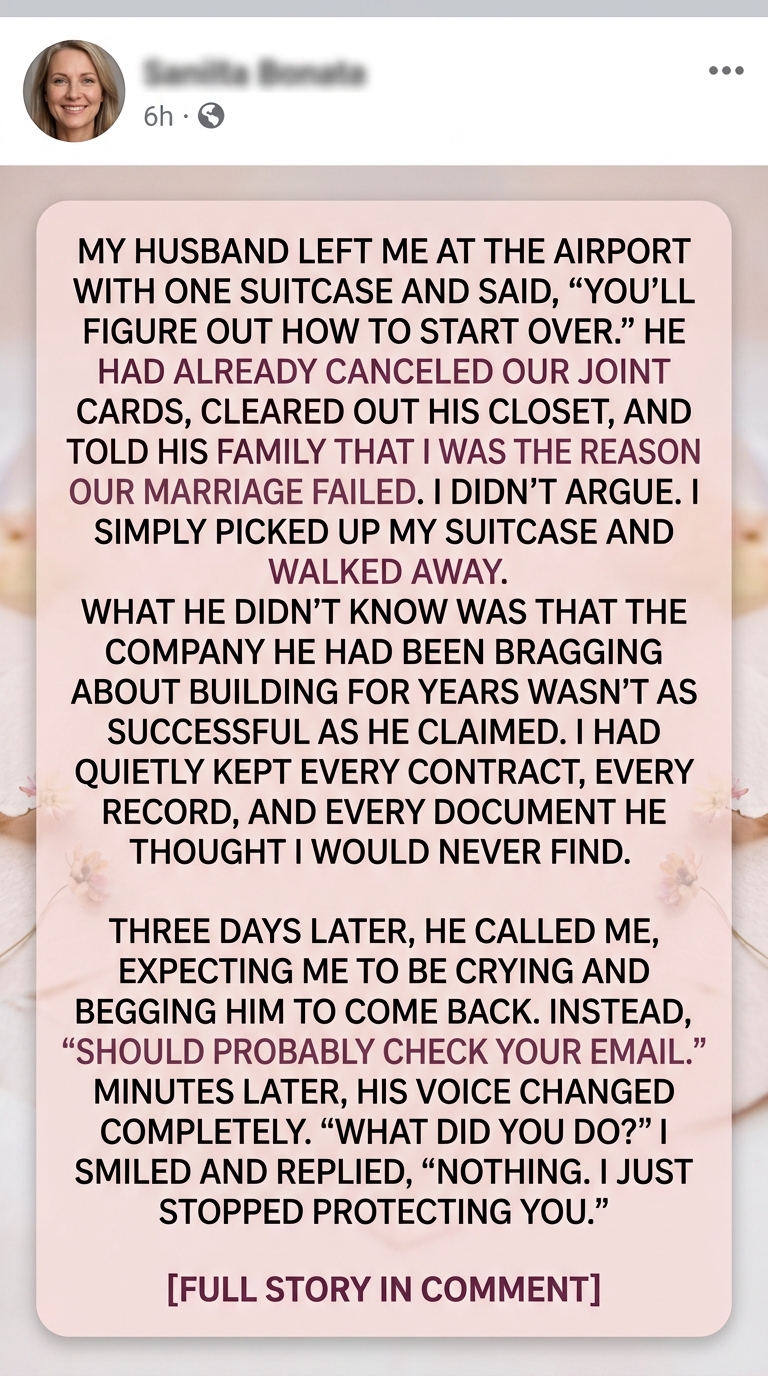
My husband left me at the airport with one suitcase and said, “You’ll figure out how to start over.” He said it casually, almost like he was dropping a coworker off at a hotel instead of abandoning the woman he had been married to for fourteen years. He didn’t hug me. He didn’t apologize. He didn’t even look back when he walked away. I stood beside the luggage carousel with one suitcase, one handbag, and a phone that had suddenly become almost useless because every joint account, credit card, and shared financial app had already been shut down. The airport was crowded with people rushing toward reunions, vacations, and Christmas celebrations. Around me, families hugged. Children ran toward grandparents. Couples held hands. And I stood completely alone while the man I had built my life around disappeared through the sliding glass doors. His name was Daniel. My name was Claire. For fourteen years, I had been the woman behind his success. At least, that’s what I thought. Daniel had spent years telling everyone that he had built his company from nothing. He loved saying that sentence. “I started with one laptop and a dream.” His family repeated it constantly. His mother called him a self-made businessman. His brother called him a genius. His friends introduced him as “the guy who built everything himself.” And I never corrected them. I never told anyone that the first major client came through a contract I negotiated. I never told them that I spent countless nights reviewing invoices while Daniel slept. I never told them that when the company couldn’t make payroll during its second year, I quietly used money from my personal savings to keep the employees paid. I never told them that the first office lease had my signature on it because the landlord didn’t trust Daniel’s new company. And I certainly never told them that for the last six years, I had been quietly maintaining a private archive of every contract, every payment record, every ownership document, every tax filing, and every communication related to the business. I wasn’t planning to use any of it against him. I kept those records because someone had to know the truth. That afternoon at the airport, Daniel had no idea how important that archive would become. I picked up my suitcase and walked toward the exit. I didn’t cry. Not yet. I found a small hotel near the airport and checked into a room with a single bed and a window overlooking the parking lot. When I turned on my phone, there were dozens of messages. His mother: “I hope you’re happy now.” His sister: “You destroyed Daniel’s life.” His brother: “You should have tried harder.” Then came the message from Daniel. “I gave you a chance. Don’t make this uglier.” I stared at the screen. A chance? He had thrown me out. He had canceled our joint cards. He had emptied his closet. He had told his family that I was the reason the marriage failed. And now he was calling it a chance. I typed three words. “I understand. Goodbye.” Then I put the phone down. The next morning, I received an email from our accountant. It wasn’t addressed to Daniel. It was addressed to both of us. “Please confirm receipt of the attached financial reconciliation before the end of the week.” I opened the attachment. I knew immediately what I was looking at. The company’s cash position was far worse than Daniel had admitted. Several major clients were behind on payments. One contract had already been terminated. Another had been disputed. And there were loans secured against company assets that Daniel had never mentioned to me. I sat quietly in the hotel room reading every page. Then I noticed something else. One of the company’s largest outstanding liabilities had been personally guaranteed by Daniel. Another was connected to a property he had transferred into a separate company six months earlier. I knew that company. I had found the paperwork months ago. It had been created without my knowledge. Daniel had been moving assets around while telling everyone the business was thriving. I opened my private archive. I had everything. The original contracts. The amendments. The payment histories. The emails. The transfer documents. The signed agreements. Even the messages in which Daniel discussed moving certain assets so they would be “out of reach.” I sat back and stared at the screen. Suddenly, the airport made sense. He hadn’t abandoned me because the marriage was failing. He had abandoned me because he thought he could separate himself from me before the financial problems became public. He wanted me gone before anyone asked questions. For three days, I said nothing. I didn’t contact his family. I didn’t call our friends. I didn’t post anything online. I simply organized my documents. On the fourth morning, I received a call from Daniel. I almost didn’t answer. But I did. “Hello?” His voice was soft. Almost gentle. “Claire.” “Yes?” “How are you?” I looked out the hotel window. “I’m fine.” There was a pause. “I thought you’d be more upset.” “I was.” “Your mother-in-law said you haven’t contacted anyone.” “I haven’t.” “I assumed you’d call.” “Why?” He laughed nervously. “Because we’ve been together fourteen years.” I didn’t answer. He sighed. “Claire, I know this is difficult, but maybe we should talk.” “About what?” “About us.” I smiled sadly. “There is no us, Daniel. You made that clear at the airport.” His voice hardened slightly. “I was angry.” “You canceled my cards.” Silence. “You emptied your closet.” Silence. “You told your family I destroyed the marriage.” More silence. Then he said, “I was trying to protect myself.” I closed my eyes. There it was. The truth, finally. “From what?” I asked. “You know what.” “Actually, Daniel, I don’t.” He breathed heavily. “Look, I just need a little time.” “For what?” “To straighten things out.” “With the company?” Silence. I knew then. He didn’t know how much I knew. “What happened to the company?” I asked. “Nothing.” “Daniel.” “It’s fine.” “Then why did the accountant send me a reconciliation showing almost seven hundred thousand dollars in outstanding obligations?” He stopped breathing for a moment. “You saw that?” “Yes.” “Claire, don’t get involved.” “It’s our company.” “It’s my company.” I stared at the wall. For fourteen years, that sentence had never mattered. Now it mattered more than anything. “Is that what you told everyone?” I asked. “That you built it alone?” “I did.” “You know that’s not true.” “Don’t start.” “I have the contracts, Daniel.” His voice changed. “What contracts?” “The original ones.” Silence. “The payment records.” Nothing. “The ownership documents.” His breathing became heavier. “Claire.” “The emails.” “Stop.” “The ones where you discussed moving assets into another company.” He whispered, “Where did you get those?” I smiled. “You should probably check your email.” “What did you do?” I answered quietly, “Nothing. I just stopped protecting you.” I ended the call. Twenty minutes later, my phone exploded with notifications. Daniel’s attorney had sent me a letter demanding that I preserve all company records. I laughed quietly. Preserve them? I had been preserving them for years. Then another email arrived. This one was from the company’s largest investor. “We need an immediate meeting.” I agreed. That afternoon, I met with two attorneys and the company’s outside accountant. I brought my archive. I placed everything on the table. The attorney opened the first folder. “Where did you get these?” “I was responsible for administrative records.” “Are these originals?” “Copies of the originals.” He looked through the pages. “These transfer documents are significant.” “I know.” “Did Daniel authorize these?” “Yes.” “Were you involved?” “No.” “Did you benefit?” “No.” The attorney leaned back. “Then I need to ask you something very important.” “What?” “Why didn’t you tell anyone sooner?” I looked down at my hands. “Because I thought I was protecting my husband.” The room became quiet. “And now?” “Now I’m protecting myself.” The next week changed everything. The investors demanded an independent review. The company’s financial records were examined. Several transactions that Daniel had described as routine were questioned. The separate company he had created became part of the investigation. His family stopped calling me. Then his mother called. “Claire, what are you doing to my son?” I answered calmly. “Nothing.” “He’s terrified.” “I didn’t make him hide the numbers.” “You were his wife.” “Exactly.” “You should be helping him.” “I spent fourteen years helping him.” She started crying. “He loves you.” I closed my eyes. “Love doesn’t give someone permission to destroy your life.” She had nothing to say. A week later, Daniel called again. “Please.” I had never heard him say that word before. “Please what?” “Meet me.” “Why?” “Because I need to explain.” “You had fourteen years.” “I made mistakes.” “You made decisions.” “I was scared.” “So you left me at an airport?” He didn’t answer. “You canceled my cards?” Silence. “You told your family I was the problem?” Silence. “You moved company assets?” “I was trying to save the business.” “You were trying to save yourself.” His voice broke. “I thought you would stay.” That sentence hurt more than everything else. Not because it was romantic. Because it revealed what he had believed all along. He thought I would always stay no matter what he did. “That’s where you were wrong,” I said. The divorce proceedings began. Daniel initially tried to argue that the business was entirely his. His attorney claimed I had no meaningful role in the company. Then the contracts appeared. The first major client had signed after I negotiated the agreement. The first office lease had my guarantee. The payroll rescue had come from my personal account. There were emails from employees thanking me for keeping the company alive during difficult months. There were financial statements showing my contributions. There were even messages from Daniel himself saying, “Claire is the reason we made it through this quarter.” He couldn’t deny his own words. During one meeting, his attorney looked at me and said, “You kept extraordinary records.” I answered, “I learned to.” Eventually, the financial review uncovered enough information that several of Daniel’s business decisions became matters for his attorneys and accountants to address. I never exaggerated anything. I never made accusations I couldn’t prove. I simply handed over what I had. Facts did the rest. Daniel’s company survived, but it became much smaller. Several assets were sold to settle obligations. The property he had transferred into the separate company was pulled into the financial review. The image he had spent years building disappeared almost overnight. His family stopped calling him a genius. His friends stopped introducing him as a self-made millionaire. And me? I rented a small apartment overlooking a quiet park. For the first time in fourteen years, every dollar in my account belonged to me. I bought a new laptop. I opened my own consulting business. I began working with small companies that needed help organizing contracts and financial systems. Within six months, I had more clients than I could handle. One afternoon, my assistant walked into my office. “There’s someone here to see you.” “Who?” “Daniel.” I sighed. “Send him in.” He entered looking completely different. He was thinner. Tired. No expensive watch. No confident smile. He sat across from me. “You look well.” “I am.” He nodded. “I heard your business is doing well.” “It is.” He smiled sadly. “I’m glad.” I waited. “Why are you here?” He looked down. “I wanted to apologize.” I said nothing. “I treated you horribly.” Still nothing. “I blamed you because it was easier than admitting I had failed.” I looked at him. “You didn’t fail because of me.” “I know.” “You failed because you lied.” He nodded. “I know that now.” “Good.” He took a deep breath. “Do you hate me?” I thought about the airport. The suitcase. The canceled cards. The messages. The lies. The years I had spent protecting him. Then I shook my head. “No.” His eyes lifted. “I don’t hate you.” “Then maybe…” I stopped him. “Don’t confuse forgiveness with another chance.” He looked down. “I wasn’t going to ask.” “Good.” We sat quietly for a moment. Then he said, “You know what hurts the most?” “What?” “You didn’t destroy me.” I stared at him. “What?” “I spent months telling myself you’d ruin everything. But you didn’t. You just stopped covering the cracks.” I looked out the window. “Those cracks were already there.” He nodded. “I know.” Before he left, he placed a small box on my desk. “What’s this?” “Your wedding ring.” I looked at it. “I thought you kept it.” “I couldn’t.” I closed the box. “You should keep it.” “Why?” “Because it’s part of your story too.” He stood. “Goodbye, Claire.” “Goodbye, Daniel.” After he left, I opened my desk drawer and took out the airport boarding pass I had saved without knowing why. It had been four years since that day. Four years since I stood alone with one suitcase while the man I loved walked away. I used to think that moment was the end of my life. It wasn’t. It was the moment my life stopped belonging to someone else. I never went back to the old house. I never asked for an apology from his family. I never tried to destroy him. I didn’t need revenge. I needed freedom. And I learned something that took me fourteen years to understand: protecting someone from the consequences of their own choices isn’t always love. Sometimes it’s the thing that allows them to keep hurting you. Daniel thought leaving me at the airport meant he was taking control of the ending. He thought I would cry, beg, call, and eventually come back. Instead, I picked up my suitcase and walked away. He thought I had nothing. He was wrong. I had the truth. I had the documents. I had the courage to stop hiding them. And most importantly, I had finally stopped protecting the person who never protected me. The last time Daniel called, he didn’t ask me to come back. He simply said, “I understand now.” I smiled and answered, “I hope you do.” Then I hung up. Outside my office window, the city was glowing under the evening sun. My assistant knocked on the door. “Your next client is here.” I closed the old archive folder and placed it back in the cabinet. “Send them in.” I didn’t need those documents to hurt anyone anymore. I kept them because they reminded me of who I had been—and how far I had come. Daniel once told me I would figure out how to start over. He was right. I just figured out how to start over without him.
