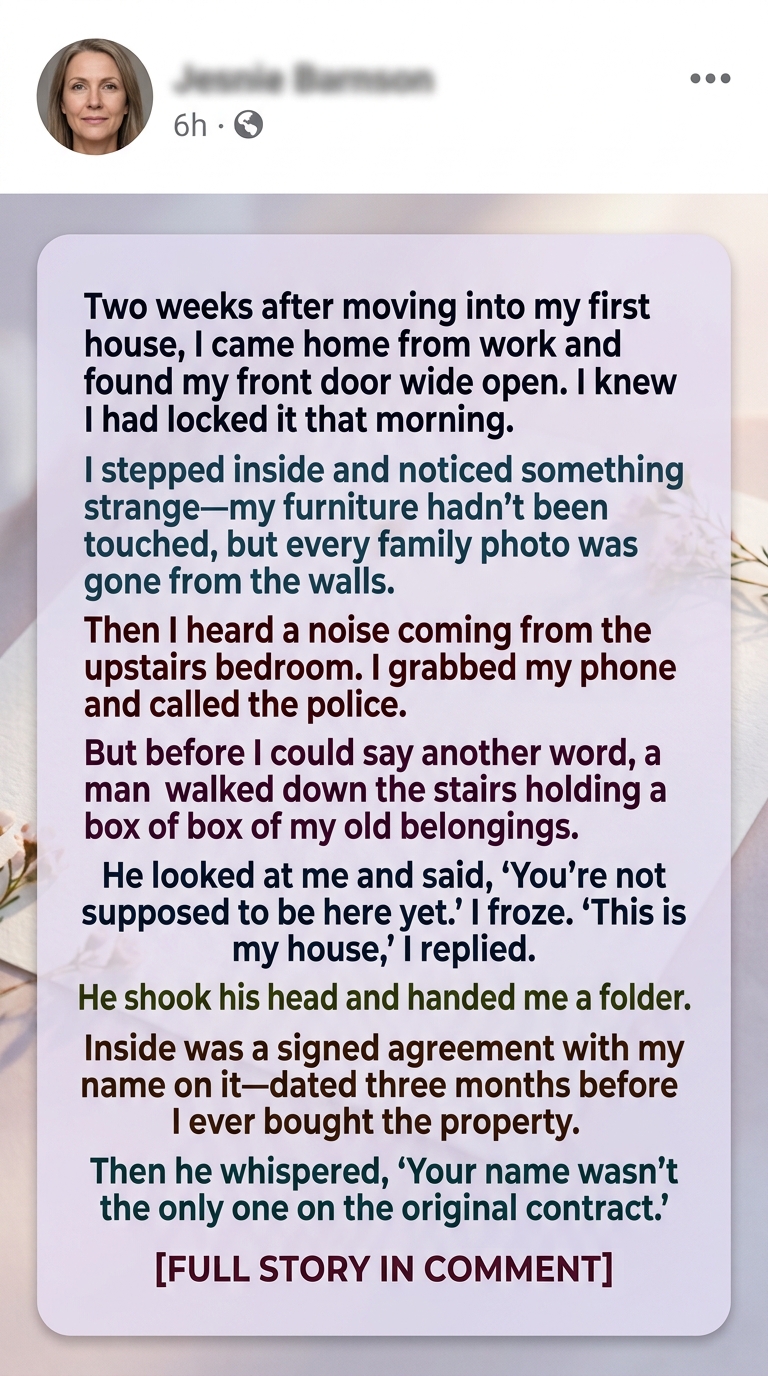
Two weeks after moving into my first house, I came home from work and found my front door wide open. I knew I had locked it that morning. I always locked it twice, checked the handle, and pulled on it before leaving. It had become a habit after spending most of my adult life renting apartments where I never felt completely safe. But that evening, as I pulled into my driveway and saw the front door standing open, every instinct in my body told me something was wrong. I stopped the car several feet from the house. For a few seconds, I just stared. The porch light was on even though I hadn’t left it on. The curtains moved slightly behind the living-room window. I reached for my phone and called the police. “What’s your emergency?” the dispatcher asked. “Someone is inside my house.” I gave her my address. “Are you inside?” “No.” “Stay outside. Officers are on the way.” I stepped out of my car but stayed near it. Then I noticed something even stranger. There were no signs of forced entry. The lock wasn’t broken. The windows weren’t damaged. Whoever had entered hadn’t needed to break anything. They had simply opened the door. I waited. Then, against my better judgment, I took one step toward the house. “Ma’am,” the dispatcher said through the phone, “please stay in your vehicle.” “I am,” I lied. I wasn’t. I was standing on the porch. I could hear something inside. A faint movement upstairs. Then a drawer closing. My heart started pounding. “Someone’s upstairs,” I whispered. “Please stay outside.” I stepped through the open doorway. The living room looked normal at first. My couch was still there. My television was still mounted on the wall. The dining table hadn’t moved. Nothing appeared stolen. Then I looked at the walls. Every family photograph was gone. I stood frozen. There had been eight photographs hanging there. My parents’ wedding photo. My grandmother’s portrait. A picture of me at sixteen. My brother and me at the lake. My parents standing in front of their old house. Every single one was gone. The hooks were still in the wall. The empty spaces looked almost like missing teeth. “Why would someone steal photographs?” I whispered. Then I heard footsteps upstairs. I raised my phone again. “The person is moving,” I told the dispatcher. “Get out of the house,” she ordered. Before I could turn, a man’s voice came from the staircase. “You’re not supposed to be here yet.” I looked up. A man was walking down the stairs holding a cardboard box filled with my belongings. My old school notebooks. A framed photograph of my parents. A wooden jewelry box I hadn’t seen since my grandmother died. I couldn’t move. “Who are you?” I asked. He stopped halfway down the stairs. “You shouldn’t have come home.” “This is my house.” He shook his head. “Not according to the agreement.” My hand tightened around the phone. “The police are coming.” He didn’t look worried. Instead, he walked the rest of the way down and placed the box on the floor. “Then you’d better read this first.” He handed me a folder. Inside was a signed agreement with my name on it. I stared at the signature. It looked like mine. The date was three months before I had ever bought the property. “What is this?” I asked. He pointed to the signature. “You tell me.” “I never signed this.” “That’s what I expected you to say.” I flipped through the pages. The agreement appeared to give another person temporary occupancy rights, access to the property, and control over certain personal belongings stored inside. But there was one sentence that made my stomach drop. “The purchaser acknowledges the prior interest of the secondary party.” I looked at him. “Who is the secondary party?” He didn’t answer. “Who?” He took a breath. “Your name wasn’t the only one on the original contract.” Before I could ask another question, police sirens sounded outside. Two officers entered with their hands near their equipment. “Step away from the woman,” one officer ordered. The man raised his hands. “I’m not here to hurt her.” “Who are you?” “My name is Thomas Reed.” The officer looked at me. “Do you know him?” “No.” Thomas looked at me. “That’s not entirely true.” I stared at him. “I’ve never met you.” He nodded slowly. “Not that you remember.” The officers separated us. They checked the house. There were no signs of forced entry, no weapons, and no obvious damage. Thomas told them he had entered with a key given to him by the previous owner. I showed them my purchase documents. The deed was in my name. The officer looked at Thomas. “Why are you in this house?” Thomas pointed at the folder. “Because I have a legal agreement giving me access.” “Signed by whom?” “Her.” “She says she didn’t sign it.” “Then someone signed it for her.” I felt a chill. The police took copies of everything. Thomas agreed to leave the house while the matter was reviewed. Before he walked out, he looked at me. “You need to find your brother.” My heart stopped. “What does my brother have to do with this?” Thomas said nothing. Then he left. My brother, Daniel, had been dead for seven years. He had died in a car accident when he was twenty-nine. I had spent years trying to accept it. My parents had never recovered. I hadn’t spoken his name often because it hurt too much. I looked at the box Thomas had left behind. On top was a photograph of Daniel and me when we were children. It had been taken in front of the same house I now owned. I picked it up with shaking hands. “That’s impossible,” I whispered. I had never seen that house before I bought it. At least, I thought I hadn’t. The next morning, I called the real estate attorney who handled my purchase. His name was Michael Grant. I sent him copies of the documents. He called me immediately. “Where did you get this?” “A man was inside my house.” “Thomas Reed?” “You know him?” Michael was silent. “Michael?” “Yes.” “Who is he?” “He was involved with the original development of the property.” “What does that mean?” “Your house wasn’t always a private residence.” I sat down. “Then what was it?” “It was part of a small family development project twenty years ago.” “Whose family?” Another silence. “Your family’s.” My mouth went dry. “What?” “The property was originally purchased by your father and another investor.” I stared at the wall. “My father never invested in real estate.” “He did.” “No.” “The records say otherwise.” I opened the folder again. “And the other investor?” Michael hesitated. “Thomas Reed.” Suddenly, everything became more confusing. My father had died three years earlier. My mother had died when I was twenty-four. My brother had died seven years ago. There was no one left to explain it. “Why is Thomas saying my brother’s name?” I asked. “I don’t know.” “He told me to find Daniel.” Michael became very quiet. “You need to come to my office.” That afternoon, I sat across from him while he placed an old file on the desk. “This is the original purchase agreement,” he said. “The property was bought twenty-one years ago.” I read the names. Thomas Reed. Daniel Harper. My brother. I stared at the page. “That’s my brother.” “Yes.” “Why would my brother buy a house twenty-one years ago?” “He was eighteen.” I shook my head. “He didn’t have the money.” “According to the records, your father provided the funds.” “Why?” Michael opened another document. “Because your father wanted Daniel to have an asset that could eventually become his.” I looked at the signature. Daniel’s. It was unmistakable. “But the property was never transferred to him?” “No.” “Why?” Michael pulled out a second agreement. “Because three months after the original purchase, your brother signed a private family agreement.” I read it. The agreement said that if Daniel died before the property was fully transferred, ownership would be held in trust for his surviving sibling. My name was there. “Me.” Michael nodded. “You.” I felt dizzy. “Then why did I have to buy the house?” Michael looked uncomfortable. “That’s the question.” I stared at him. “What do you mean?” “When you bought the property two weeks ago, the seller provided a clean title. But the original trust document wasn’t disclosed.” “So I bought something that was already supposed to be mine?” “Essentially.” “Then why did I pay for it?” Michael sighed. “Because someone deliberately removed the trust history from the title chain.” I felt sick. “Who?” “I don’t know yet.” I thought about Thomas. “He does.” “Possibly.” “Then why didn’t he stop the sale?” Michael leaned forward. “Because the original agreement says Thomas could not interfere unless the property was being transferred outside the family.” “And it was.” “Yes.” “So why didn’t he?” “Because he may have believed the buyer was you.” I stared at him. “But I was the buyer.” “Exactly.” That night, I barely slept. At 2:00 a.m., I opened the box Thomas had left. Beneath the photographs was a small cassette recorder. I didn’t even know I still owned one, but Thomas had apparently included a portable player. There was a label on the cassette. “For her.” I pressed play. Static filled the room. Then I heard my father’s voice. “If you’re listening to this, then something has gone wrong.” I froze. My father’s voice sounded older than I remembered. “I need you to understand that Daniel never abandoned you. He was trying to protect you.” I stopped the recording. My hands were shaking. I pressed play again. “The house was supposed to become yours one day. But there were people who wanted it. People who knew the land was worth more than we did.” My father’s voice continued. “Daniel discovered that someone was trying to force the family to sell. He refused. After that, he became afraid.” I stared at the recorder. “Afraid of who?” I whispered. The recording answered as if he could hear me. “Thomas knows the truth. I told him to protect the property until you were ready.” Then came a pause. “If Daniel is no longer here, trust Thomas.” The tape ended. I sat in silence. The next morning, Thomas came to my office. I was angry. “You knew.” He nodded. “Yes.” “You knew my brother owned this property.” “Yes.” “You knew my father left it to me.” “Yes.” “Then why did you let me buy it?” “Because I couldn’t legally tell you until the title transfer was complete.” “That makes no sense.” “It will.” He placed a folder on my desk. Inside were photographs of my brother meeting with a man I didn’t recognize. “Who is that?” “Robert Kane.” “Who is he?” “The developer who wanted this land.” Thomas explained that twenty years earlier, the surrounding area had been undeveloped. My father and Thomas had purchased several parcels, believing the area would eventually become valuable. Robert Kane had wanted control of the entire project. Daniel discovered that Kane was using pressure tactics to buy neighboring properties cheaply. My father wanted to sell. Daniel refused. “Why?” I asked. Thomas looked at me. “Because your father had made a promise.” “What promise?” “He promised your mother that the house would stay in the family.” I looked at the old photograph. My mother was standing beside my father, smiling. “Then why didn’t anyone tell me?” “Because after Daniel died, your father became convinced someone had caused the accident.” My heart stopped. “What?” “He didn’t have proof.” “Did you?” Thomas looked away. “I had suspicions.” “You let me believe my brother died in a random accident.” “Because your father begged me to.” “Why?” “Because he thought if the people involved knew you understood the connection, you’d become a target.” I stood up. “Are you telling me my brother’s death wasn’t an accident?” Thomas took a long breath. “I’m telling you we never proved otherwise.” That distinction mattered. There was no certainty. Only unanswered questions. Thomas continued. “After Daniel died, your father moved the trust documents. He hid them. He wanted to make sure nobody could find the property through public records.” “Then why did he eventually sell it?” “He didn’t.” I stared at him. “What?” “The person who sold it to you wasn’t your father’s estate.” He handed me another document. “It was a shell company.” I felt cold. “Who owned it?” Thomas pointed to a name. “Robert Kane.” Everything clicked. Someone had placed the property into a shell company years earlier, then sold it to me through a legitimate-looking transaction. They may have believed the trust was dead or that nobody would discover the old agreement. But the family records had survived. And now I had them. “Why were my photographs taken?” I asked. Thomas looked down. “Because whoever entered the house was looking for evidence.” “Then why did you have my belongings?” “I moved them.” “You broke into my house?” “I had a key from the old property manager. I entered because I knew someone else had been inside.” “You should have called me.” “You weren’t supposed to know yet.” I stared at him. “Everyone keeps saying that.” He nodded. “Because your father wanted you protected.” I was furious. “I’m not a child.” “I know.” “Then stop deciding what I can handle.” Thomas looked at me for a long moment. “Your father said you would say that.” Despite everything, I almost laughed. “He knew me.” “He did.” Over the next several weeks, the attorney and I worked with investigators to trace the ownership history. We discovered that the shell company had acquired the property using funds connected to Robert Kane’s development company. Several records had been altered or omitted. The original trust document proved that my brother had intended the property to pass to me. The copied agreement Thomas had shown me had been created from an older document but modified after my purchase. Someone had attempted to make it look as if I had acknowledged another person’s rights. The signature wasn’t mine. It was a reproduction. Eventually, the fraudulent documents were turned over to the authorities. Robert Kane denied involvement. The matter became part of a broader investigation into property fraud and forged records. I never learned with certainty whether Daniel’s accident had been connected to any of it. That uncertainty was painful, but I refused to invent an answer simply because I wanted one. What I did know was that my brother had spent years trying to protect something he believed belonged to our family. And my father had spent years protecting me from a secret he thought was dangerous. The house remained mine. Not because I had purchased it. Not because a document said so. But because the original family agreement had always intended it to be mine. One year after I moved in, I finally put the family photographs back on the walls. All of them. My parents’ wedding photo. My grandmother’s portrait. The picture of Daniel and me by the lake. And the photograph I had found in the box—the one of Daniel standing in front of this house twenty years before I knew it existed. I placed it above the fireplace. Then I hung one final photograph beside it. A picture of me standing on the porch of my new home. Underneath it, I placed a small handwritten note. “Some homes are inherited. Some are bought. And some wait for you until you’re ready to understand why they were meant to be yours.” I never saw Thomas again after the investigation ended. Before he left, he gave me one final envelope. Inside was a letter from my brother. It had been written years before his death. “If you ever find this,” Daniel wrote, “you’ll probably be angry with everyone. You have every right to be. But don’t let our family’s fear become your prison. This house was never meant to keep you trapped in the past. It was meant to give you somewhere safe to build your future.” I cried when I read it. Then I folded the letter and placed it in the same wooden box where I kept my mother’s jewelry. Two weeks after moving into my first house, I came home and discovered that someone had entered it. I thought I had bought a house. What I actually inherited was a story my family had spent twenty years trying to protect. The man on my staircase told me I wasn’t supposed to be there yet. He was right. I wasn’t supposed to know the truth yet. But eventually, I did. And when I finally understood who really owned the house, everything changed. Not because the property was worth more than I imagined. Not because someone had tried to take it from me. But because I finally realized my family hadn’t been hiding the house from me. They had been hiding the reason they had fought so hard to make sure I would one day come home to it.
