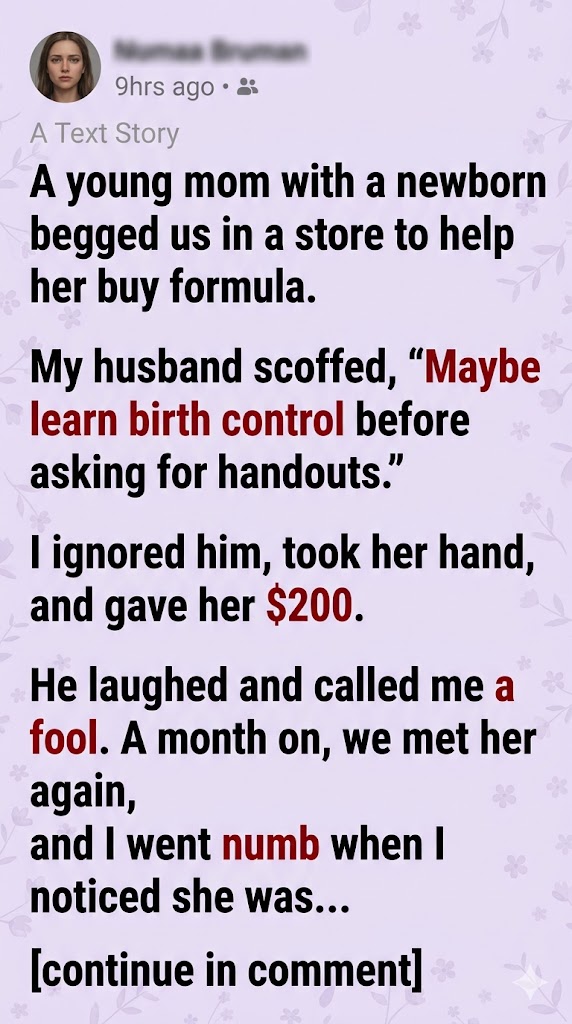
The supermarket felt colder than it should have been that evening, the kind of artificial chill that clings to your skin and makes everything seem harsher than it really is. The smell of floor cleaner mixed with baby powder hung in the air, and beside me, Julian walked with his usual composed confidence, the kind that always made people step aside without question.
We turned into the baby aisle, and that’s when we saw her.
She looked young, barely out of her teens, holding a crying infant tightly against her chest while struggling to open a worn-out wallet with trembling fingers. On the self-checkout counter in front of her sat two cans of formula and a small pack of wipes, nothing excessive, just the bare minimum someone would need to get through a few days.
The machine blinked red.
Declined.
For a moment, everything seemed to pause. Her face drained of color, her shoulders sinking as if something invisible had just pressed down on her. Coins slipped from her shaking hand and scattered across the floor, the sound sharp against the quiet.
Then Julian laughed.
It wasn’t loud, but it didn’t need to be. There was something sharp in it, something deliberate. “Pathetic,” he muttered, just enough for her to hear, his eyes briefly scanning her worn clothes. “If you can’t afford a child, you shouldn’t have one. People like this are a burden.”
I didn’t look at him.
I looked at her.
She didn’t react, not outwardly. She just stood there, staring down, her body folding inward as if trying to disappear from the moment entirely. And in that instant, something shifted inside me, not violently, not dramatically, but with a quiet finality that felt irreversible.
For years, I had learned how to stay silent beside Julian, how to smooth over his sharp edges, how to exist without drawing attention. It was easier that way. Safer. But watching her carry a shame that didn’t belong to her made that silence feel unbearable.
“Wait,” I said.
Julian turned immediately, his expression tightening. “Don’t,” he said under his breath. “Don’t start.”
I didn’t answer him. I stepped forward, reaching into my bag and pulling out the envelope I had been carrying all day, the one filled with money I had been saving for something he said I needed to look “presentable.”
When I placed it in her hand, she looked up, confused at first, then overwhelmed in a way that words couldn’t hold.
“You deserve this,” I said quietly. “And you’re doing better than you think.”
It wasn’t the money that mattered in that moment. It was the decision.
I chose her dignity over his approval.
For illustrative purposes only
The drive home was filled with his anger, but it sounded different this time, like noise instead of authority. He talked about respect, about embarrassment, about how I had crossed a line, but his words didn’t land the way they used to.
For the first time, I wasn’t shrinking.
I was listening from a distance, as if something inside me had stepped out of reach.
Two weeks later, I was called into my boss’s office, expecting a routine conversation about work, maybe a correction, maybe another reminder to keep my head down. Instead, he stood up, extended his hand, and told me I was being promoted.
He said I had something rare, something he hadn’t seen in years, a kind of quiet strength that didn’t demand attention but changed things anyway. As he spoke, I realized the moment in that supermarket hadn’t just been about helping someone else.
It had been about finally choosing who I was.
A month later, she found me again.
Not in the supermarket, but standing in the lobby of my office building, holding her child, looking steadier than before. There was a calm in her now, something grounded, something rebuilt.
She told me her name was Alyson.
She told me that night had been the point where everything almost collapsed, that she had been one step away from giving up, from believing what people like Julian said about her. The money helped, she said, but it wasn’t what stayed with her.
It was the words.
Beside her stood her brother, a man whose presence carried weight without effort. He introduced himself briefly, handed me his card, and said something simple but firm, that no one should have to live under the kind of shadow he had heard about.
I didn’t respond right away.
Because I already knew.
For illustrative purposes only
I didn’t go home and wait for things to improve. I didn’t try to negotiate, to explain, or to make it work the way I always had before. For the first time, I understood that staying wasn’t strength, and silence wasn’t peace.
Leaving wasn’t loud.
It wasn’t dramatic.
It was quiet, steady, and final.
That supermarket aisle stayed with me, not as a place of humiliation, but as the moment everything changed direction. It was where I stopped measuring myself through someone else’s standards and started recognizing my own.
Julian’s voice, his laughter, his judgment—they didn’t disappear overnight, but they lost their weight. They became distant, irrelevant, like something that no longer had permission to define me.
Because in the end, it wasn’t about the money, or the argument, or even the moment itself.
It was about a choice.
I chose humanity over habit.
And in return, I got something I didn’t even realize I had been losing all those years—myself.
