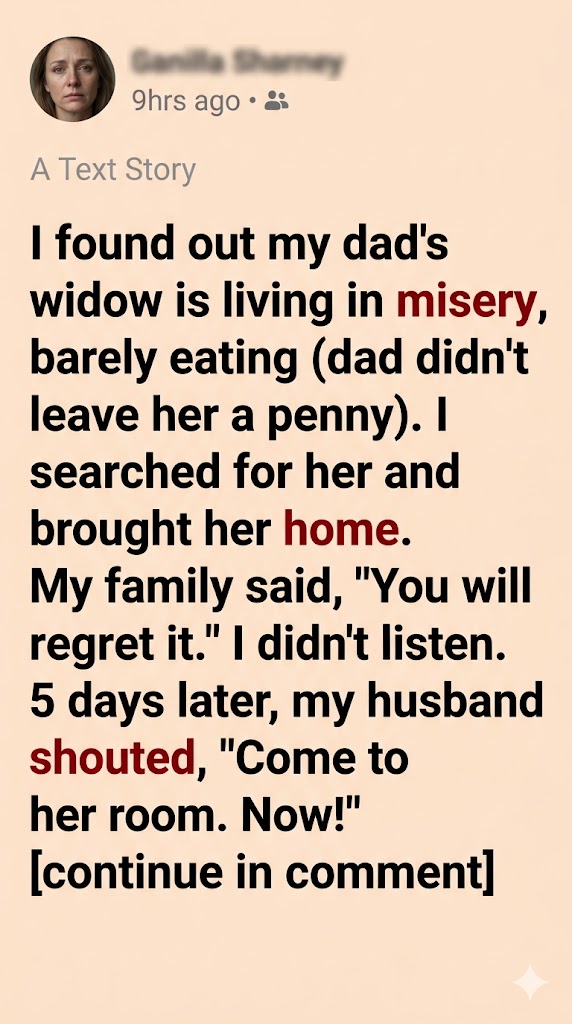
I didn’t expect the past to come back like that—quietly, painfully, and wrapped in guilt.
When I found out my dad’s widow was living alone in near-starvation, something inside me twisted. It had been three years since my father passed, and after the reading of the will, everyone assumed she’d be taken care of.
She wasn’t.
A distant acquaintance mentioned seeing her at a small market on the edge of town—thin, pale, counting coins before putting food back on the shelf. Dad hadn’t left her anything. Not a house. Not savings. Nothing.
I didn’t want to believe it. But I went anyway.
It took me two days to find her. When I finally did, she was living in a cramped, dim room above an old repair shop. The air smelled of dust and loneliness. She looked smaller than I remembered, her once-neat hair now streaked with gray, her hands trembling slightly as she opened the door.
For illustrative purposes only
“Anna?” she whispered, like she wasn’t sure I was real.
I didn’t hesitate. “Pack your things. You’re coming home with me.”
Her eyes widened. “No… I can’t. I don’t want to cause trouble.”
“You won’t,” I said firmly, even though I already knew what was waiting for me.
And I was right.
The moment we walked through the door, the tension was immediate. My sister didn’t even try to hide her disapproval. My aunt shook her head. And my husband… he stayed quiet, but I could see the worry in his eyes.
Later that night, the warnings came.
“You’ll regret this,” my sister said flatly.
“She’s not your responsibility,” my aunt added.
“She wasn’t even a good wife to Dad,” someone muttered.
But I didn’t listen.
Because when I looked at her sitting quietly at the edge of the guest bed, hands folded like she was afraid to touch anything, I didn’t see the woman my family resented.
I saw someone who had no one left.
The first few days were… fragile.
She moved carefully, spoke softly, ate very little. She kept thanking me for everything—even for a glass of water. My children didn’t understand the tension, but they sensed her sadness. My youngest offered her a cookie on the second day. She took it like it was something sacred.
Still, the house felt divided.
For illustrative purposes only
Then came the fifth day.
My husband’s voice cut through the silence like a knife.
“Anna! Come to her room. Now!”
Something in his tone made my stomach drop. I ran.
The bed was empty.
The closet door hung open. The few clothes she had were gone. The room looked untouched—like she had never been there.
Then I saw it.
A single folded note on the pillow.
My hands shook as I opened it.
“I didn’t want to be a burden. Thank you for your kindness.”
My heart slammed against my chest.
“No… no, no…”
I didn’t even grab my keys. I ran outside, barefoot, scanning the street like a madwoman. Every second felt like I was losing her all over again.
And then I saw her.
At the bus stop, sitting on the cold bench, clutching two worn bags like they were her whole world.
I ran to her and wrapped my coat around her shoulders.
“You’re family,” I whispered, my voice breaking. “This is your home. Please don’t leave.”
For a moment, she didn’t move.
Then her face crumpled.
And she cried.
Not quietly. Not politely. She cried like someone who had been holding it in for years.
That moment changed everything.
When we walked back into the house together, something felt different. Maybe it was the way I held her hand. Maybe it was the way she didn’t try to pull away.
Or maybe it was the way my children ran up to her, hugging her without hesitation.
My husband stood in the hallway, silent for a long moment. Then he stepped forward.
“I’m sorry,” he said, his voice low but steady.
It wasn’t perfect after that. Healing never is.
But it began.
For illustrative purposes only
Slowly, she started eating more. Then she started helping in the kitchen. One evening, the smell of her cooking filled the house—warm, rich, comforting. My kids laughed at her stories. My husband fixed a loose cabinet in her room. Even my sister softened over time.
And little by little… she came back to life.
She laughed again.
Eight months passed like that—quiet, beautiful, ordinary in the best way.
Then one evening, she called me into her room.
Her hands were weaker now, her voice softer.
She pressed something into my palm.
A small, worn key.
“It’s an apartment,” she said gently. “It belonged to my father. It’s not much… but I want you to have it.”
I shook my head immediately. “No, I can’t—”
“You can,” she interrupted, her eyes steady. “You’re my only family.”
Tears blurred my vision.
That was our last evening together.
She passed peacefully that night.
The apartment was exactly as she described—tiny, worn down, forgotten by time. But to us, it was something more.
A gift.
A memory.
My husband and I spent months restoring it. We painted the walls, fixed the floors, opened the windows to let the light in again.
Now, every corner holds a piece of her.
And every time I step inside, I remember that day at the bus stop… and the choice that changed everything.
Because sometimes, all it takes to restore faith in humanity…
is one person deciding not to walk away.
