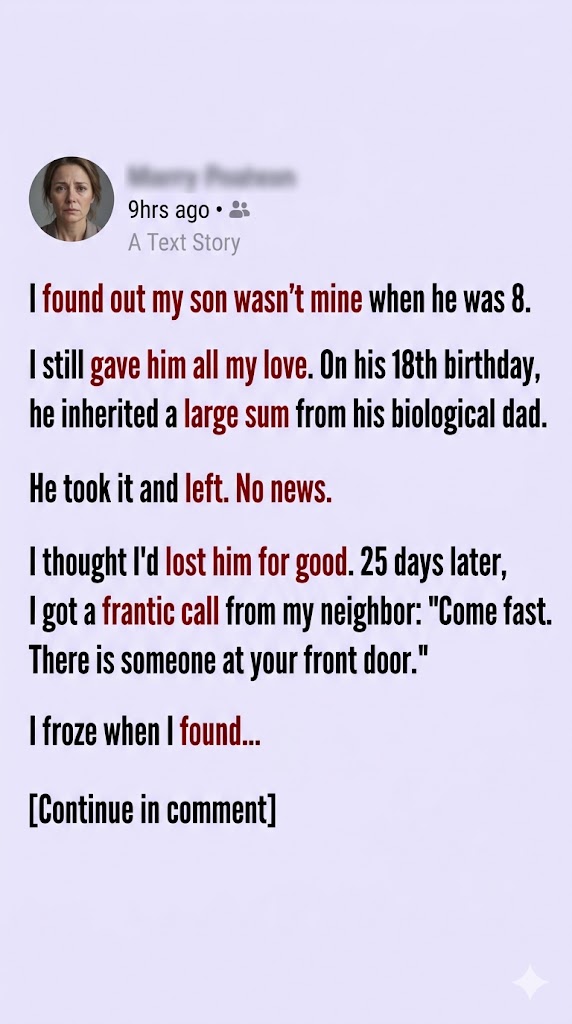
I found out my son wasn’t biologically mine when he was eight years old, and the strange part wasn’t the moment itself, but how quiet everything felt afterward, as if something enormous had shifted and the world was pretending nothing had changed.
It happened during a routine checkup, one of those appointments you don’t think twice about until the doctor pauses a little too long before speaking. I remember sitting there, watching my son swing his legs from the exam table, completely unaware, while the doctor cleared his throat and said carefully, “There’s… something that doesn’t quite match here.”
I frowned. “What do you mean?”
He hesitated, then looked directly at me. “Based on your blood types, it wouldn’t be possible for you to be his biological father.”
For a moment, I didn’t react, not because I understood, but because I didn’t, and my mind refused to process what I had just heard. I looked at my son, at the way his shoelaces were half undone like always, at the way he glanced at me and smiled without any reason, and something inside me said louder than anything else: that’s my boy.
Later, there were conversations I wish had never needed to happen. My ex-wife sat across from me, avoiding my eyes, her voice low when she finally admitted the truth.
“There was someone else,” she said. “I didn’t know how to tell you.”
I didn’t ask anything else after that, because the only thing that mattered wasn’t what had happened between us, it was what I was going to do next.
That night, my son came into the room, holding his favorite toy, and asked, “Dad, are you mad about something?”
I looked at him for a long second before answering.
“No,” I said. “Come here.”
He climbed onto my lap without hesitation, and in that moment, the decision felt simple.
He was still mine.
Not because of blood.
But because of everything that actually mattered.
For illustrative purposes only
I never told him.
Not when he fell off his bike and cried into my shirt.
Not when he struggled with math and stayed up late saying, “I don’t get it, Dad.”
Not when he stood on stage at his school play, scanning the crowd until his eyes found mine and his shoulders relaxed.
If anything, I loved him harder, because love, I learned, isn’t something that comes from biology, it’s something you build, day by day, in ways no one else sees.
Years passed, and he grew into someone I was proud of in ways I couldn’t always explain, taller than me, stronger, louder, but still the same kid who would occasionally lean against me without saying anything, just because he could.
Then, on his eighteenth birthday, everything changed.
A lawyer contacted him.
His biological father had died.
And left him millions.
He came to me that evening, standing in the doorway like he used to when he was younger, except now there was something heavier in his expression.
“I need to ask you something,” he said.
I nodded. “What is it?”
He swallowed. “Is it true?”
For a moment, I considered lying.
Then I didn’t.
“Yes,” I said.
Silence filled the room.
He didn’t shout, didn’t react the way I had feared, he just stood there, processing, then nodded slowly.
“I need some time,” he said.
The next morning, he was gone.
No argument.
No explanation.
Just a suitcase missing from his room and a silence that felt completely different from anything I had experienced before.
Days passed.
Then weeks.
I called.
No answer.
I texted.
Nothing.
At some point, I stopped trying, not because I didn’t care, but because I didn’t know how to keep reaching for someone who wasn’t there.
The house felt emptier than it ever had before, not just quiet, but hollow, as if something essential had been taken out of it.
On the twenty-fifth day, my phone rang.
It was my neighbor.
“Hey,” she said quickly. “You need to come home.”
My heart dropped. “Why? What happened?”
“There’s someone sitting on your porch,” she said. “He’s been there for hours.”
I didn’t ask anything else.
I just drove.
When I pulled into the driveway, I saw him immediately.
Sitting on the steps.
A suitcase beside him.
Head lowered.
Like he wasn’t sure he was allowed to be there.
For a moment, I didn’t move.
Then he looked up.
“Dad…” he said.
That was all it took.
I walked toward him slowly, afraid that if I moved too fast, the moment might break.
“I’m here,” I said quietly.
He stood up quickly, grabbing a thick folder from beside him, holding it out like it mattered more than anything else.
“I didn’t leave you,” he said, his voice shaking. “I swear I didn’t.”
I frowned, taking the folder.
“What is this?”
“Just… look,” he said.
Inside were documents.
Bank papers.
Receipts.
Statements.
At first, I didn’t understand.
Then I saw it.
My mortgage.
For illustrative purposes only
The one I had been struggling to pay for two years.
The one I had hidden from him.
The one I thought would eventually take this house away from me.
Paid.
Every single dollar.
I looked up at him, my chest tightening.
“You… did this?”
He nodded, his eyes already red.
“I found the letters,” he said. “From the bank. You kept them in that drawer. I wasn’t trying to snoop… I just… I needed to understand everything.”
His voice broke, but he kept going.
“You gave me everything,” he said. “When you didn’t have to. You chose me. Every day.”
I couldn’t speak.
“This was the least I could do,” he added.
I stepped forward and pulled him into my arms, holding him tighter than I ever had before, because in that moment, there was no doubt left, no distance, no question about what we were to each other.
“You didn’t have to do this,” I said.
“I know,” he whispered. “But I wanted to.”
We stood there on the porch, holding onto each other in a way that didn’t need explanation, because some things don’t need to be said out loud to be understood.
Because family isn’t built by blood.
It’s built by the choice to stay.
And sometimes… that choice comes back to you in ways you never expect.
