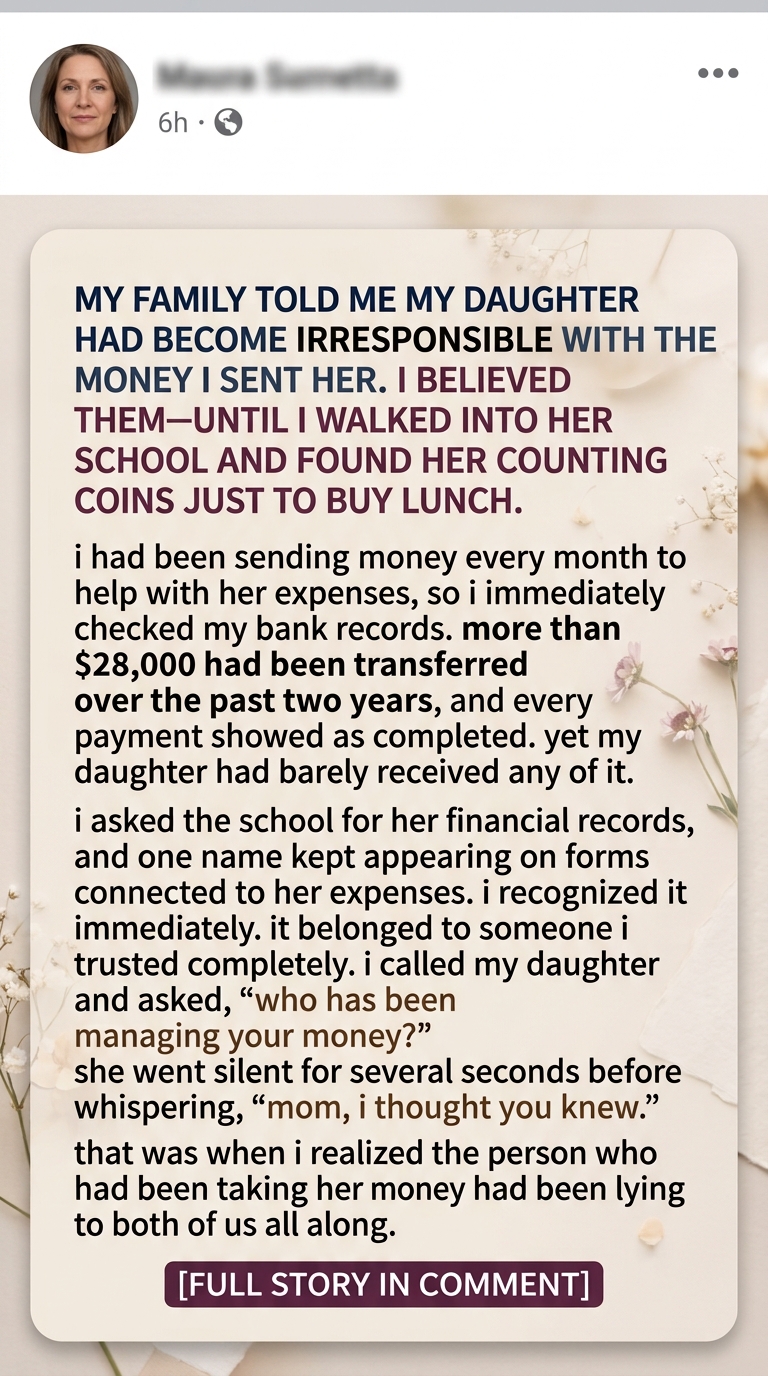
MY FAMILY TOLD ME MY DAUGHTER HAD BECOME IRRESPONSIBLE WITH THE MONEY I SENT HER. I BELIEVED THEM—UNTIL I WALKED INTO HER SCHOOL AND FOUND HER COUNTING COINS JUST TO BUY LUNCH. For two years, I had been sending my daughter money every month because I wanted her to focus on school instead of worrying about bills. She was twenty-one, attending a university several hours away from home, and trying to build a future for herself. I had always told her that as long as she was studying and working toward something, I would do whatever I reasonably could to help. Every month, I transferred money into the account that had been arranged for her expenses. Sometimes it was $800. Sometimes $1,200. When tuition payments or books were due, I sent more. I paid because I wanted her to have food, transportation, school supplies, and a safe place to live. But whenever I asked my family how she was doing financially, they always gave me the same answer. “She needs to learn responsibility.” “She spends too much.” “You’re enabling her.” “She has become careless with money.” The person who said it most often was my younger sister, Claire. Claire had always presented herself as the practical one in the family. She handled paperwork. She understood banking. She knew how to organize things. When my daughter first went away to school, Claire volunteered to help her manage the practical side of her finances because my daughter was overwhelmed with classes and a part-time job. I trusted Claire completely. That was my first mistake. One Sunday afternoon, Claire came over for coffee. We were sitting at my kitchen table when she shook her head and said, “You really need to stop sending Lily so much money.” I looked at her. “Why?” “She doesn’t manage it properly.” “How do you know?” Claire sighed as though I were being difficult. “She spends it almost immediately.” “On what?” “Clothes. Food delivery. Things young people buy.” I frowned. “That doesn’t sound like Lily.” “You’re her mother. Of course you think she’s perfect.” The words bothered me, but I didn’t argue. A few weeks later, my brother repeated the same thing. Then my mother. Then my aunt. It was as though the entire family had quietly agreed on a story about my daughter. Lily was irresponsible. Lily wasted money. Lily couldn’t manage herself. And because I loved her too much, I was supposedly making the problem worse. I believed them. I regret that more than I can explain. Then, one Tuesday morning, I happened to be near Lily’s university for work. I decided to surprise her. I drove to campus and walked toward the student center. I expected to find her sitting with friends, maybe drinking coffee between classes. Instead, I saw her standing near a vending machine. She was holding a small pile of coins in her palm. I stopped. At first, I didn’t recognize her. She looked thinner. Her hair was pulled into a messy ponytail, and her backpack looked worn out. She was staring at the vending machine as though she were trying to calculate whether she could afford lunch. Then she counted the coins again. One. Two. Three. Four. She sighed. I walked toward her. “Lily?” She froze. Her face changed immediately. “Mom?” I looked at the coins in her hand. “What are you doing?” She quickly closed her fingers around them. “Nothing.” “Are you buying lunch?” She didn’t answer. I looked at the vending machine. The cheapest meal available was $3.75. She had $2.85. Something inside me dropped. I reached into my purse. “Here.” “No.” “Lily.” “I’m fine.” “You’re not fine.” She looked away. “I said I’m fine.” I stared at my daughter, and suddenly every conversation with my family came rushing back. She’s irresponsible. She spends too much. She needs to learn. I asked quietly, “Where is the money I’ve been sending you?” Her eyes filled with tears. “What money?” “The money I’ve been sending every month.” She looked confused. “Mom, you haven’t been sending me money.” I felt as though someone had struck me. “What?” “You said Claire was handling it.” My heart started pounding. “Claire?” Lily nodded. “She told me you were sending money into an account she managed for my expenses.” I stared at her. “I’ve been sending money every month.” “I know.” “How much have you received?” She hesitated. “Sometimes she gives me cash.” “How much?” “Maybe two hundred dollars here and there.” My mouth went dry. “How much have you received altogether?” Lily looked down. “I don’t know. Maybe three thousand dollars.” I couldn’t speak. I had sent far more than that. Much more. I told Lily I needed to see her records. She looked frightened. “Mom, what’s wrong?” “I don’t know yet.” But I knew something was terribly wrong. That afternoon, I went home and opened my bank account. I searched every transfer. Month after month. Payment after payment. $900. $1,000. $1,200. $1,500. $800. The total stopped me cold. $28,640. More than twenty-eight thousand dollars. Every payment had been completed. Every transfer had gone somewhere. And almost none of it had reached my daughter. I printed everything. Then I called the bank. The representative confirmed what I already suspected. The account receiving the transfers was not in Lily’s name. It was a joint financial account. And the second name attached to it was Claire’s. I sat at my kitchen table staring at the papers. Claire. My sister. The woman I had trusted with my daughter. I called her. She answered casually. “Hey, what’s up?” I said, “I checked the transfers.” Silence. “What transfers?” “The money I’ve been sending Lily.” Another silence. Then she said, “Oh.” Just one word. Oh. I felt something inside me turn cold. “Why was my money going into an account you controlled?” Claire immediately became defensive. “I was managing it for her.” “Then why doesn’t she have it?” “She has everything she needs.” “She was counting coins to buy lunch.” Claire didn’t answer. “She has received around three thousand dollars from nearly twenty-nine thousand.” “That isn’t true.” “I have the bank records.” She started talking faster. “You don’t understand. Lily isn’t good with money.” “I don’t care whether she is good with money. It was her money.” “I was protecting her.” “From what?” “From herself.” I stood up from the table. “No. You were controlling her.” Claire’s voice changed. “You’re being dramatic.” “No. I’m finally paying attention.” She hung up. The next morning, I drove back to Lily’s university. We went together to the school’s financial services office. I showed them the bank records and asked whether they could help us understand where Lily’s school-related payments had gone. The administrator pulled up her file. Within minutes, we found something strange. Several forms listed Claire as an authorized financial contact. Some expenses had been marked as paid. Others had been delayed. There were also notes showing that Lily had requested assistance several times. I looked at my daughter. “You asked for help?” She nodded. “Many times.” “Why didn’t you tell me?” “Claire told me you were upset with me.” My stomach tightened. “She told me you thought I was wasting your money.” Lily wiped her eyes. “She said you were angry every time I asked for more.” “I never said that.” “I know that now.” Then she whispered, “Mom, I thought you knew.” That sentence broke something in me. Because my daughter hadn’t been hiding her struggle. She had been trying to survive inside a lie someone else had built around both of us. I asked the school for copies of every financial document that involved Claire. One name kept appearing. Claire. And then we found something else. A form had been submitted claiming that Lily had received a monthly living allowance. The signature looked like Lily’s. But Lily stared at it and immediately said, “That’s not my signature.” I looked closer. It was similar. But not identical. Someone had copied her signature. That was when I stopped thinking about family drama and started thinking about fraud. I contacted an attorney. We gathered every bank statement, every transfer confirmation, every school record, every message Claire had sent Lily, and every receipt showing where the money had actually gone. The attorney asked one question. “Did your sister have permission to use these funds for herself?” “No.” “Did your daughter authorize any withdrawals?” “No.” “Then we need to find out where the money went.” We did. Some of it had paid Lily’s expenses. A small portion. But thousands of dollars had been transferred to accounts belonging solely to Claire. Some had paid credit card bills. Some had paid household expenses. And some had been used for purchases completely unrelated to Lily. When I confronted Claire again, she finally admitted it. Not everything. But enough. She claimed she had borrowed the money. “I was going to pay it back.” “When?” “I don’t know.” “You stole from your niece.” “I was helping you.” “No. You were stealing from my daughter.” She cried. She told me she was ashamed. She told me she had gotten into debt and didn’t know how to get out. She told me she planned to repay everything eventually. But none of that changed what she had done. The hardest part was realizing how easily she had manipulated everyone. She had told my family that Lily was irresponsible. She had told Lily that I was disappointed in her. She had told me that Lily was wasting money. Three lies. One purpose. To keep us separated while she took the money meant for my daughter. We pursued the matter legally. Some of the money was recovered. Some wasn’t. Claire eventually signed an agreement acknowledging what she had taken and accepting responsibility for repayment. Our relationship never returned to what it had been. My family was divided. Some relatives said I should forgive her because she was struggling. Others said I was destroying the family over money. But every time someone said that, I remembered Lily counting coins beside that vending machine. Twenty-eight thousand dollars had never been the real loss. The real loss was trust. My daughter had spent two years believing her mother was disappointed in her. I had spent two years believing my daughter was irresponsible. And Claire had lived comfortably in the space between those two misunderstandings. After everything was settled, I opened a new account for Lily. This time, only Lily and I had access. I also stopped letting other people speak for my daughter. If I wanted to know how she was doing, I called her. If she needed help, I asked her directly. If something seemed wrong, I checked the facts myself. Months later, I visited her at school again. She was sitting at the same student center where I had found her counting coins. But this time, she wasn’t alone. She had two friends beside her, a notebook open on the table, and a full lunch in front of her. She looked up and smiled. “Mom.” I sat down. “How are you?” She smiled. “Actually good.” I looked at her for a moment. Then I said, “I’m sorry.” She shook her head. “You didn’t know.” “I should have asked.” She reached across the table and took my hand. “Now you do.” I smiled through my tears. She was right. Now I did. And from that day forward, I made myself one promise. I would never again let someone else’s voice become louder than my daughter’s truth. Because sometimes the person who looks irresponsible isn’t the one wasting the money. Sometimes they’re the person who has been robbed of it. And sometimes the biggest betrayal doesn’t come from a stranger. It comes from the person sitting beside you at the family table, smiling while everyone else is being taught to doubt the truth.
