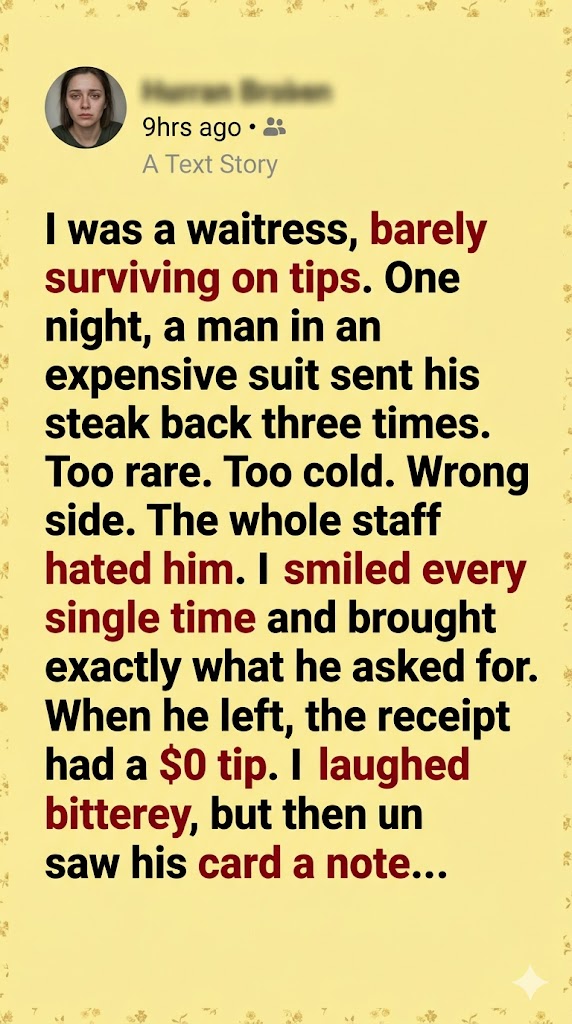
I still remember the exact weight of that tray in my hands—the way my fingers ached from balancing too many plates, the way my smile felt glued on after a twelve-hour shift that wasn’t even close to over.
Back then, I was barely surviving. Rent swallowed most of my paycheck, and whatever was left depended entirely on tips—and tips were never guaranteed. Some nights, I went home counting coins, wondering how long I could keep pretending everything was fine.
That night started like any other.
Busy. Loud. Exhausting.
Then he walked in.
You could tell immediately he wasn’t like the usual customers. Tailored suit. Expensive watch. The kind of presence that made people stand a little straighter without realizing why.
He sat alone.
Table 12.
My section.
“Good evening, sir,” I said, putting on my best professional smile. “Can I start you with something to drink?”
He barely looked up. “Water. No ice.”
No warmth. No small talk.
Fine. I’d had worse.
For illustrative purposes only
When I brought his steak—medium rare, exactly as ordered—he cut into it, paused, and frowned.
“This is too rare.”
I blinked. It looked perfect. But I nodded anyway. “I’m so sorry, sir. I’ll have that fixed right away.”
Back to the kitchen. Back through the heat, the noise, the eye rolls from the chef.
“It’s perfect,” the chef muttered.
“I know,” I whispered. “Just… please.”
We redid it.
Second time, I placed it gently in front of him. “Here you go, sir.”
He took another bite.
“This is too cold.”
Now I felt it—that flicker of frustration in my chest. Not enough to show, but enough to sting.
“I apologize. I’ll take care of it.”
Back again.
By now, the staff had noticed.
“Who’s that guy?” one of the other waitresses whispered.
“Table 12,” I said under my breath.
“Oh… him? Yeah, good luck. He’s already sent something back twice.”
“Three times,” I corrected quietly.
By the third trip to the kitchen, even the chef slammed the pan down.
“He’s messing with you,” he said. “No one’s this picky.”
Maybe he was right.
But I still took the plate back out.
This time, he didn’t complain about the temperature.
He frowned again. “The sides are wrong.”
I stared at the plate for half a second too long.
They weren’t wrong.
But I forced a calm breath.
“I’m very sorry. I’ll correct that immediately.”
And I did.
Every single time, I smiled. Not because I wanted to—but because I needed to. Because losing control, even for a second, could mean losing my job. And I couldn’t afford that.
For illustrative purposes only
By the time he finished his meal, I was running on pure exhaustion.
He didn’t say thank you.
Didn’t smile.
Didn’t even look at me when he asked for the check.
I dropped the receipt, already bracing myself for disappointment.
Still… a small part of me hoped.
Maybe he’d leave something decent.
Maybe all that effort would count for something.
A few minutes later, he stood, straightened his jacket, and walked out without a word.
I grabbed the receipt.
$0 tip.
I let out a short, bitter laugh.
Of course.
Of course he wouldn’t tip.
I felt something inside me crack—not dramatically, not loudly—just a quiet kind of disappointment I’d gotten used to.
I started clearing the table, stacking plates, wiping down the surface.
Then I noticed something.
A small card.
Tucked neatly under the edge of his plate.
I frowned and picked it up.
A business card.
Heavy. Clean. Expensive.
And on the back, written in neat, confident handwriting:
“You have more patience than half my executives. Call me Monday.”
I stared at it.
For a moment, I honestly thought it was a joke.
But it wasn’t.
The name printed on the front?
I recognized it.
He was the CEO of a well-known marketing firm—one I’d seen mentioned in business articles, the kind of company people dreamed of working for.
My heart started racing.
I almost didn’t call.
All weekend, I kept going back and forth.
What if it’s a prank?
What if I embarrass myself?
What if I’m not good enough?
For illustrative purposes only
But Monday morning came, and something in me refused to stay stuck where I was.
So I called.
His assistant answered first. Then, somehow, I was transferred directly to him.
“You called,” he said, his voice exactly as calm as I remembered.
“Yes, sir. About the card… from the restaurant.”
A pause.
“Good,” he said. “Come in this afternoon.”
No long interview.
No complicated process.
Just… an opportunity.
He offered me an entry-level position.
Nothing glamorous. Nothing easy.
But it was a door.
And I walked through it.
That was years ago.
Today, I sit in a corner office as an account director in that same company.
I lead teams.
I handle clients.
And sometimes—when I’m interviewing new hires—I think back to that night.
That impossible customer.
That terrible tip.
That moment I almost gave up.
Because the truth is… that steak wasn’t the problem.
It was a test.
And I didn’t even know I was taking it.
