The morning had that kind of cold that doesn’t just sit on your skin—it presses inward, slow and persistent, until it feels like it’s part of you. Fifth Avenue looked washed out, stripped of color by a sky that couldn’t decide whether it wanted to snow or just threaten it all day. People moved quickly, heads down, collars turned up, wrapped in their own urgency. I walked with them, just another figure in a long line of people trying to get somewhere warm, somewhere predictable, somewhere that made sense. My thoughts weren’t on anything large or meaningful. They rarely were those days. Instead, they hovered around small, manageable concerns—how thin my socks felt inside my shoes, whether I could stretch my paycheck long enough to finally buy a proper winter coat, whether I could keep pretending that the quiet exhaustion I carried was temporary. It was easier to focus on those things than to admit how close I felt to burning out completely.
That’s when I saw her. She was sitting near the edge of the building, not blocking anyone’s path, not asking loudly for attention. Just there. A worn sweater, too light for the weather, sleeves stretched thin at the cuffs. No coat. Not even something improvised. People passed her the way people pass street signs—acknowledging without really seeing. I did the same at first. It’s a practiced thing, that polite kind of ignoring. You tell yourself you can’t stop for everyone. You tell yourself you’ve got responsibilities, deadlines, a life that doesn’t leave room for interruption. And for a few steps, that logic worked. It always had. Until it didn’t.
“Do you have any spare change?” she asked.
Her voice wasn’t desperate. That’s what made it linger. It was calm, almost detached, like she already knew the answer and was asking anyway. I gave the response I had given a hundred times before. A quiet “Sorry,” paired with a small shake of the head. Routine. Practiced. Safe. Then I kept walking. Ten steps. Maybe fifteen. Enough distance to tell myself the moment was over.
But something didn’t settle.
I stopped.
Not dramatically. Just… stopped. The kind of pause that feels heavier than it should. I turned back, and this time I actually looked at her. Not through her. Not past her. At her. The cold hit me differently in that moment, sharper somehow. It reminded me that I would be inside soon, that I would warm up, that my discomfort had an endpoint. Hers didn’t. That realization didn’t arrive all at once—it unfolded quietly, piece by piece, until ignoring it felt harder than turning around.
I walked back.
For a second, I didn’t say anything. Neither did she. Then, without giving myself time to reconsider, I took off my coat. It wasn’t new. It wasn’t even particularly warm. But it was mine, and it was something.
“You should have this,” I said, holding it out.
She hesitated, as if the gesture didn’t fit into whatever expectations she had built from the world. Then she reached out and took it. Her hands brushed mine, and they were colder than I expected. Not just cold from the air—cold in a way that suggested it had been a long time since warmth had been an option.
“Thank you,” she said softly.
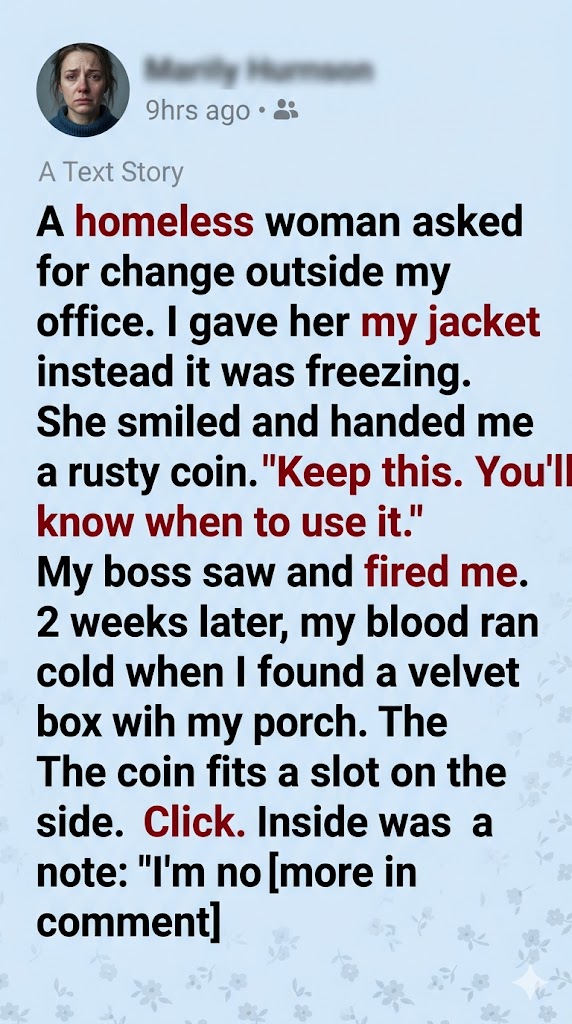
Then, almost as an afterthought, she reached into her pocket and pulled out a coin. Old. Worn. The kind of thing you don’t see in circulation anymore. She pressed it into my palm with a quiet certainty.
“This belongs to you now,” she said.
I almost laughed. Not out of mockery—out of confusion. But something about the way she said it stopped me. So I nodded, closed my fingers around it, and stepped back.
Then everything shifted.
“Excuse me,” a voice cut in sharply.
I turned to see Mr. Harlan standing near the entrance, his expression already set in disapproval. He had seen the whole thing.
“What exactly do you think you’re doing?” he asked.
“It’s just a coat,” I said.
“That coat has our company logo on it,” he snapped. “You represent this firm the moment you step onto this street. And what you just did—standing here, engaging like that—it reflects poorly on us.”
I stared at him, trying to process the logic.
“She needed it,” I said simply.
“That’s not your concern during work hours.”
The conversation didn’t last long after that. It didn’t need to. His decision had already been made before he spoke. Words just filled the space between judgment and consequence.
“You’re done here,” he said. “Effective immediately.”
Just like that.
No warning. No discussion. Just an ending.
I stood there for a moment, the coin still in my hand, the cold suddenly much more noticeable without the coat. Around us, the city kept moving, indifferent to what had just happened.
I didn’t argue.
There didn’t seem to be a point.
The next two weeks were quieter than I expected—and heavier.
Losing a job doesn’t just affect your income. It reshapes your sense of direction. Days that once had structure blur into something less defined. Mornings arrive without urgency. Evenings stretch longer than they should. I applied for positions, updated resumes, made calls that led nowhere. Each small rejection added weight to a growing sense of uncertainty.
The coin stayed in my pocket.
I didn’t think much of it at first. It was just there, something I carried without a clear reason. But every now and then, I’d take it out and turn it over in my hand, noticing details I hadn’t before—the worn edges, the faint markings, the way it felt heavier than it looked.
It became a quiet reminder of that morning.
Of the decision.
Of the cost.
Exactly two weeks later, a package arrived.
No return address. No explanation.
Just a plain box, sitting at my door like it had always been meant to be there.
I almost ignored it.
But something—curiosity, instinct, maybe just the need for something unexpected—made me pick it up and bring it inside.
The box had no visible latch.
No seam.
Just a small, circular indentation on the top.
I stared at it for a moment.
Then, almost without thinking, I reached into my pocket and took out the coin.
It fit perfectly.
The moment it clicked into place, the box opened.
Inside was a single envelope.
The letter was brief.
Direct.
It explained that the woman I had met was not who she appeared to be that morning. That the encounter had not been accidental. That what I had done—what I had chosen to do—had been observed, considered, and understood.
At the bottom of the letter was a name.
A company.
And an offer.
Not just a job—but one that changed everything.
A week later, I walked into a new office.
Not as someone trying to prove themselves—but as someone who had already been seen clearly.
She was there.
Not in a worn sweater this time, but in a tailored suit, standing at the center of a room that moved around her with quiet efficiency.
But her presence hadn’t changed.
Still calm.
Still steady.
Still the same.
“You kept the coin,” she said.
I nodded.
“You gave away something you needed,” she continued. “Without expecting anything in return.”
I thought about that morning. About the cold. About the decision that hadn’t felt like much at the time.
“It didn’t feel like a big thing,” I admitted.
She smiled slightly.
“It rarely does.”
Looking back, it would be easy to frame everything as a turning point. A moment where one decision led directly to a better outcome.
But that’s not quite true.
Because when I gave away that coat, I didn’t know what would happen next.
There was no guarantee. No promise. No safety net.
Just a choice.
A small one.
A quiet one.
The kind people make every day without realizing how much it reveals about who they are.
I still think about that morning sometimes.
About the cold.
About the pause.
About the moment where I could have kept walking and no one would have blamed me.
And I realize now that what changed my life wasn’t the job I gained afterward.
It was the decision I made before any of that existed.
Because in that moment, I didn’t choose comfort.
I didn’t choose convenience.
I chose something harder to explain—but easier to recognize once you’ve felt it.
I chose to remain human.
And somehow… that was enough.
