My Wife’s Sister Humiliated Me at Our 25th Anniversary Dinner—Until My Wife Revealed the Letter Their Father Had Hidden for Years
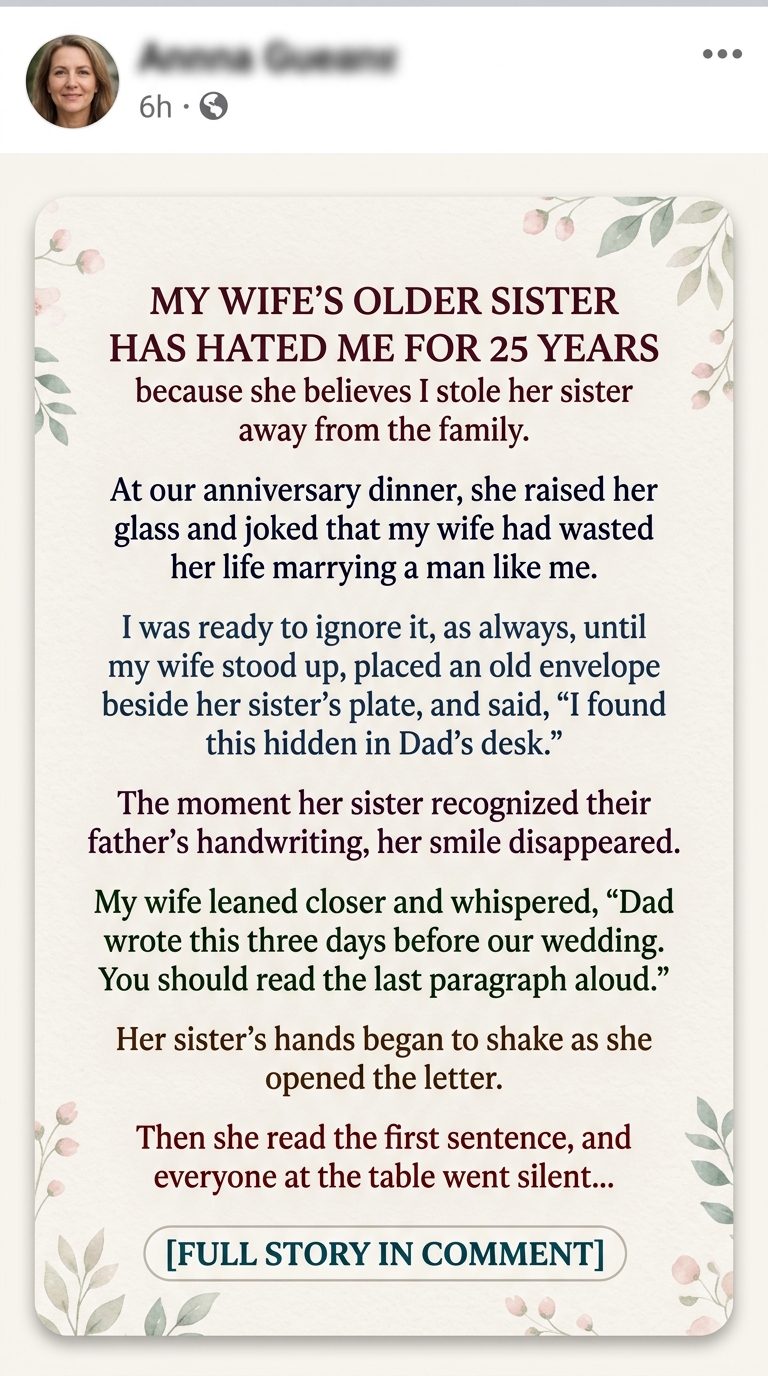
My wife’s older sister has hated me for 25 years because she believes I stole her sister away from the family. At our anniversary dinner, she raised her glass and joked that my wife had wasted her life marrying a man like me. I was ready to ignore it, as always, until my wife stood up, placed an old envelope beside her sister’s plate, and said, “I found this hidden in Dad’s desk.” The moment her sister recognized their father’s handwriting, her smile disappeared. My wife leaned closer and whispered, “Dad wrote this three days before our wedding. You should read the last paragraph aloud.” Her sister’s hands began to shake as she opened the letter. Then she read the first sentence, and everyone at the table went silent…
For a few seconds, nobody moved.
The restaurant’s soft music continued playing, silverware clinked at a nearby table, and a waiter walked past us carrying a tray of wine. But at our table, it felt as though the entire world had stopped.
My sister-in-law, Margaret, stared at the letter as if the paper itself had accused her of something unforgivable.
“What is this supposed to mean?” she finally whispered.
My wife, Claire, remained standing beside her chair. She wasn’t angry. That was what frightened me most. In 25 years of marriage, I had learned that Claire could endure almost anything without raising her voice. But when she became this quiet, it meant she had already made a decision.
“It means you should finish reading what Dad wrote,” Claire replied.
Margaret looked around the table, searching for someone who would defend her. Her husband suddenly became fascinated with his glass. Their two grown children exchanged nervous glances. My mother-in-law, Eleanor, sat perfectly still, her fingers pressed against her lips.
Then Margaret unfolded the final page.
Her eyes moved across the first few lines. Her face lost its color.
“No,” she whispered. “This can’t be right.”
“Keep reading,” Claire said.
Margaret swallowed hard and began reading aloud.
“Margaret, if you are reading this, then I have failed to tell you the truth while I was alive. I have watched you blame Daniel for something he never did, and I can no longer allow you to destroy another person’s life to protect your pride.”
My name was Daniel.
I felt my stomach tighten.
For 25 years, Margaret had treated me like an intruder. She had told relatives I was selfish, irresponsible, and unworthy of her sister. At family dinners, she made jokes about my modest job. Whenever Claire and I accomplished something, Margaret found a way to suggest that her sister could have done better with someone else.
I had spent decades believing her hatred came from the fact that Claire married me instead of staying close to her parents.
Now, for the first time, I wondered whether something else had happened before our wedding.
Margaret continued reading, but her voice grew weaker.
“You told me Daniel convinced Claire to leave this family. You told everyone he pressured her into marrying him. But you know the truth. You know what you did the night before their wedding, and you know why I refused to give you the money you demanded.”
She stopped.
My mother-in-law suddenly reached across the table.
“That’s enough, Margaret.”
Claire turned toward her mother.
“No, Mom. It isn’t enough. Not after 25 years.”
Eleanor slowly withdrew her hand.
I looked at my wife. “Claire, what money is he talking about?”
She took a long breath before answering.
“Twenty-five years ago, Dad discovered that Margaret had been taking money from the family business. When he confronted her, she blamed you.”
I stared at her.
“Me?”
Claire nodded.
“She told Dad you had asked her to lend you money to start your business. She claimed she had given you a large amount and that you refused to pay it back. Dad knew something was wrong because the dates didn’t match. You hadn’t even met him when the first withdrawals happened.”
I remembered those early years. I had been a young accountant working for a small construction company. Claire and I had been dating for almost two years, and we were saving every spare dollar for our wedding.
I had never borrowed money from Margaret.
Not once.
“Why would she accuse me of something like that?” I asked.
Claire looked at her sister.
“Because Dad had discovered where the money really went.”
Margaret pushed her chair backward.
“This is ridiculous. Dad was sick. He wasn’t thinking clearly when he wrote this.”
“He was perfectly clear,” Claire replied. “He had the bank records. He had the receipts. And he had the letter you sent him begging him not to tell anyone.”
Margaret’s husband finally looked up.
“What letter?”
She turned toward him so quickly that her earrings swung against her neck.
“Don’t listen to her.”
But her husband had already begun looking at the envelope.
For the first time that evening, I noticed that Margaret wasn’t merely embarrassed. She was terrified.
And I knew then that whatever was hidden in that letter was far worse than a family disagreement.
It was something she had spent 25 years trying to bury.
To understand why, I need to explain what happened before Claire and I got married.
I met Claire when I was 27 and she was 25. She worked as a primary school teacher, and I was an accountant at a construction company that barely paid enough to cover rent and groceries.
We met at a friend’s birthday party. Claire was sitting near the kitchen, laughing at a story someone had told. When I introduced myself, she asked what I did for a living.
I told her I worked with numbers.
She smiled and said, “Then you’ll be useful. I can never remember how much money I have until it’s already gone.”
That was how our first conversation began.
We dated quietly for several months before meeting each other’s families. Claire’s father, Robert, was a retired engineer who had spent most of his life building the family construction business. He was serious, observant, and difficult to impress.
Her mother, Eleanor, was warm when we were alone but unusually quiet whenever Margaret was present.
Margaret was five years older than Claire. She had grown up believing that she would inherit the family business, and everyone around her had reinforced that expectation. She dressed elegantly, spoke confidently, and seemed to know exactly how to make a room revolve around her.
When Claire introduced me, Margaret looked me over and asked, “So, what are your plans for the future?”
I explained that I wanted to save enough money to open my own accounting firm someday.
She laughed.
“An accounting firm? You mean you’ll spend your life helping other people count their money?”
Claire frowned.
“Margaret, that’s enough.”
But her sister only smiled.
“I’m just asking. Claire deserves someone who can provide her with a comfortable life.”
I could have answered her. I could have told her that I didn’t need to be wealthy to love her sister. But I knew how important her family was to Claire, so I swallowed my pride.
I thought Margaret would eventually accept me.
I was wrong.
Over the next year, she made her disapproval impossible to ignore. If I bought Claire inexpensive jewelry, Margaret would comment on how much better diamonds looked. If I drove an old car, she would ask whether I planned to replace it before Claire became embarrassed by it.
At family gatherings, she told stories about wealthy men she knew and the luxurious vacations they took.
Claire always defended me, but I could see how much the arguments hurt her.
One evening, after Margaret had spent an entire dinner mocking my salary, Claire sat beside me in my apartment and held my hand.
“You don’t have to prove anything to her,” she said.
“I know.”
“Do you?”
I looked at her.
She continued, “My sister has spent her whole life believing that money makes someone important. My father never taught her that. She learned it somewhere along the way, and now she doesn’t know how to stop.”
I kissed her forehead.
“I don’t care what she thinks of me.”
Claire studied my face.
“Then promise me something. Whatever happens with my family, don’t let Margaret become the reason we stop being happy.”
I promised.
And for the next 25 years, I tried to keep that promise.
When I proposed, Claire accepted before I had finished asking the question. We planned a modest wedding and agreed that we would build our life together slowly.
Robert surprised me during one of our meetings by asking about my career plans. He listened carefully as I described the accounting firm I hoped to open.
Then he asked, “Would you still pursue that dream if Claire had more money than you?”
I thought the question was strange.
“Of course,” I answered. “Her money is hers. My dream is mine. We would build our life together.”
He stared at me for a moment before nodding.
“Good answer.”
I didn’t know then that Robert had already begun investigating something suspicious inside his company.
Three days before our wedding, he called me to his office.
I arrived expecting to discuss wedding arrangements or perhaps hear another lecture about taking care of his daughter.
Instead, I found him standing near the window with a thick folder on his desk.
“Daniel,” he said, “I need to ask you something, and I need you to answer honestly.”
I sat down.
“Of course.”
“Have you ever borrowed money from Margaret?”
“No.”
“Has she ever offered you money?”
“She offered to introduce me to a banker once, but I declined. Why?”
He studied me for several seconds.
“Because someone has been using your name.”
He opened the folder.
Inside were copies of bank transfers, invoices, and handwritten notes. Several transactions had been made from the family business account over the previous year. Some were labeled as consulting payments. Others were listed as loans.
My name appeared on several documents.
But the signatures weren’t mine.
I felt a chill spread through my body.
“Mr. Robert, I’ve never seen these before.”
“I believe you.”
He said it so simply that I nearly forgot to breathe.
He explained that money had been disappearing from the company for months. At first, the amounts were small enough to escape notice. Then the withdrawals grew larger. When he began investigating, he discovered that several payments had supposedly gone to a business registered under my name.
The company didn’t exist.
Someone had created false documents using my personal information and had been moving money through an account connected to a shell business.
Robert had initially suspected me because my name appeared on the paperwork. But after checking the records, he realized that the signatures were forged and that the dates contradicted my actual employment history.
Then he discovered that Margaret had approved several of the payments.
“Why would she do this?” I asked.
Robert looked exhausted.
“I don’t know everything yet. But I know she is frightened. And frightened people sometimes do terrible things to protect themselves.”
He asked me not to confront Margaret until he had finished reviewing the evidence.
I agreed.
That evening, I told Claire that her father had uncovered a financial problem involving the family company. I didn’t give her every detail because Robert had asked me to keep the investigation confidential until he understood the full extent of the damage.
Claire trusted her father.
She also trusted me.
She told me we would deal with whatever came our way after the wedding.
But Margaret had already begun preparing her own version of the story.
The night before our wedding, she arrived at her father’s house and demanded that he transfer a substantial amount of money into her personal account.
Robert refused.
According to the letter we were now reading, Margaret had argued that she deserved the money because she had sacrificed years of her life helping the family business.
Robert reminded her that she had already received a generous salary, a company car, and several advances that had never been repaid.
Then he confronted her with the forged documents.
That was when everything changed.
Margaret realized that her father knew she had been taking money. Worse, he had enough evidence to report the matter to the authorities.
She begged him to give her time to repay it.
Robert agreed to consider a repayment arrangement, but he refused to conceal the truth indefinitely.
He also told her that she must stop blaming me.
Margaret responded by threatening to tell Claire that I had been involved in the missing money.
Robert warned her that he would show Claire the evidence if she did.
She stormed out of the house.
The following morning, Margaret arrived at our wedding looking perfectly composed. She smiled for photographs, greeted guests, and stood beside her mother as though nothing had happened.
I didn’t know about the argument.
I didn’t know she had already begun telling relatives that I had manipulated Claire into marrying me.
I only knew that Margaret refused to look me in the eye during the ceremony.
After the wedding, Claire and I moved into a small rented house. We worked hard, saved carefully, and slowly built the life we had imagined.
I eventually opened my own accounting firm. The first year was difficult. There were months when I worried about paying salaries, and evenings when I stayed in the office long after everyone else had gone home.
Claire never complained.
She packed my lunch, encouraged me when clients canceled contracts, and reminded me that success was not something we had to achieve overnight.
When our daughter, Sophie, was born, I began to understand what Robert had meant when he asked whether I would still pursue my dream if Claire had more money than I did.
Love wasn’t about competing with someone.
It was about building something together.
Over time, my firm grew. We hired more employees, moved into a larger office, and bought a comfortable house with a garden where Sophie could play.
But Margaret never changed.
At Christmas, she joked that my success had arrived too late to impress anyone.
When Claire bought herself a new dress, Margaret asked whether I had finally learned to earn enough money to keep my wife happy.
When our daughter graduated from university, Margaret congratulated Claire for raising a successful child despite having married beneath her station.
Each time, I looked at Claire and chose silence.
I thought I was protecting our peace.
I didn’t realize that my silence was allowing Margaret’s version of history to become the only one some members of the family knew.
Robert never publicly explained what had happened before our wedding. He said the matter was being handled privately and that he hoped Margaret would take responsibility for her actions.
He gave her time to repay the money and insisted that she step away from certain financial responsibilities within the company.
For a while, she did.
But she never apologized to me.
Instead, she told people that our wedding had caused a permanent rift between her and her father.
She claimed Robert had changed after I entered the family.
She suggested that I had manipulated him into favoring Claire.
The truth was far simpler.
Robert had discovered what Margaret had done, and he could not pretend otherwise.
Several years later, Robert died after a long illness.
His death devastated Claire. He had been a steady presence in her life, and losing him left a hole that none of us knew how to fill.
Before he died, he gave Claire a small box containing family photographs, old letters, and several personal documents.
She kept the box in a cabinet for years.
She never told me much about its contents.
Then, a few months before our 25th anniversary, Claire decided to help her mother clean out the garage at the old family house.
While sorting through a damaged wooden desk that had belonged to Robert, she discovered a false panel beneath one of the drawers.
Inside was an envelope bearing Margaret’s name.
It contained the letter we were now reading, along with copies of the financial records and a short handwritten note from Robert.
Claire told me later that she sat on the garage floor for nearly an hour after discovering it.
She had always known there was something unresolved between her father and sister. But she had never understood why Margaret’s resentment toward me seemed so personal.
The letter finally explained it.
And it revealed something even more painful.
Robert had not written the letter to punish Margaret.
He had written it because he feared that, after his death, she would continue telling the same lie until everyone believed it.
He wanted Claire to know that I had never stolen money from the family business, never manipulated him, and never forced her to choose between her husband and her relatives.
He had wanted to protect both of us.
But he had also wanted to give Margaret one final opportunity to tell the truth herself.
That was why he had addressed the letter to her.
For years, she had known it existed.
She had simply believed it would never be found.
Now, at our anniversary dinner, the truth was sitting in front of everyone.
Margaret finally lowered the letter.
“I was young,” she said. “I made mistakes.”
Claire’s expression didn’t change.
“You were thirty-two years old when Dad confronted you.”
“I was under pressure!”
“From whom?” Claire asked. “Who forced you to take the money? Who forced you to forge Daniel’s signature? Who forced you to spend 25 years telling people that he was the reason Dad stopped trusting you?”
Margaret looked toward her husband.
He was staring at her with an expression I had never seen on his face before.
“Is it true?” he asked quietly.
She opened her mouth, then closed it again.
“Margaret, look at me,” he said. “Did you steal that money?”
She began to cry.
“I never intended for things to go this far.”
Her husband leaned back in his chair.
“That’s not what I asked.”
For a long moment, Margaret said nothing.
Then she nodded.
“Yes.”
The word was barely audible.
But everyone heard it.
Her husband removed his glasses and rubbed his eyes. Her children stared at the table. Eleanor began crying silently.
I sat motionless, trying to process what I had just heard.
I had spent 25 years wondering whether there was something about me that Margaret genuinely despised. I had questioned whether I should have tried harder to win her approval, whether I should have confronted her earlier, whether my silence had made me appear weak.
Now I understood.
Her hatred had never really been about me.
I was simply the person she had chosen to blame because I was standing closest to the truth.
Claire picked up the final page.
“There’s more,” she said.
Margaret shook her head desperately.
“Please, Claire. Don’t.”
“You had 25 years to tell the truth. I’m not going to protect you from the consequences anymore.”
My wife read the next paragraph aloud.
“To my daughter Margaret: I know you believe that if Daniel had never married Claire, I might have continued to overlook your mistakes. Perhaps you are right. I might have delayed confronting you. I might have given you more time. But I would never have allowed you to destroy an innocent man’s reputation simply because you were afraid of losing your place in this family.”
Claire paused.
Then she continued.
“I want you to understand something. Daniel did not take your sister away from you. Claire chose him because he treats her with kindness, respects her independence, and loves her without asking her to become someone else. You resent him because he possesses something you have spent your life trying to buy: the trust of the people who love you.”
Margaret covered her face.
I felt Claire’s hand find mine beneath the table.
Her father had understood us better than I realized.
He had seen what Margaret refused to see.
The letter ended with a final request.
“If you still have any love for your sister, stop making her choose between her marriage and her family. Tell the truth. Apologize to Daniel. And remember that a family’s honor is not preserved by hiding its mistakes. It is preserved by having the courage to admit them.”
Nobody spoke for several seconds.
Then Margaret looked at me.
For the first time in 25 years, she seemed unable to find a clever remark.
“Daniel,” she said, her voice trembling. “I’m sorry.”
I studied her face.
I had imagined hearing those words many times. Sometimes I pictured myself responding with anger. Other times, I imagined telling her exactly how much damage she had caused.
But now that the apology had finally arrived, I felt strangely calm.
“What are you sorry for?” I asked.
She blinked.
“What?”
“I want to understand. Are you sorry you accused me of stealing? Are you sorry you told the family I manipulated Claire? Are you sorry you humiliated me at every gathering? Or are you sorry because your father left behind evidence that proves you were lying?”
Her face crumpled.
“I know I hurt you.”
“Yes,” I said. “You did.”
She looked down.
“I was afraid Dad would disown me. I thought if people believed you were responsible, he might reconsider. I thought I could fix everything before anyone found out.”
“Did you ever intend to tell the truth?”
She didn’t answer.
I nodded slowly.
“That’s what I thought.”
Margaret began crying harder.
“I was jealous of Claire,” she admitted. “She never had to fight for Dad’s approval. He trusted her. He listened to her. And then she married you, and he trusted you too. I felt like I was losing everything.”
Claire stared at her sister.
“You weren’t losing everything, Margaret. You were losing the right to do whatever you wanted without consequences.”
Margaret shook her head.
“You don’t understand what it was like being the oldest. Everyone expected me to take over the business. I was supposed to be successful. I was supposed to make Dad proud.”
Claire’s voice softened, but her words remained firm.
“And instead of telling him you were struggling, you stole from him and blamed my husband.”
Margaret covered her mouth.
“I know.”
“No,” Claire said. “I don’t think you do. Because if you understood, you would have apologized years ago. You would have stopped treating Daniel like he was responsible for your choices.”
Our mother-in-law finally spoke.
“Margaret, your father gave you so many opportunities to make this right.”
Margaret turned toward her.
“You knew?”
Eleanor closed her eyes.
“I knew he had discovered the missing money. I knew he had confronted you. But I didn’t know everything he had found until after he died.”
“Why didn’t you tell everyone?”
“Because your father begged me to give you time to come forward yourself. He believed you would eventually do the right thing.”
Eleanor looked at her eldest daughter with tears in her eyes.
“I waited too long. And while I was waiting, you hurt your sister and her husband over and over again.”
Margaret’s husband stood.
“I need some air.”
He walked away from the table without looking at her.
Her children remained seated, visibly shaken.
The anniversary dinner we had planned as a celebration had become a reckoning.
I glanced at Claire.
“Do you want to leave?” I asked quietly.
She looked at the letter, then at her sister.
“Not yet.”
She turned back to Margaret.
“There’s one more thing you need to know.”
Margaret wiped her face.
“What?”
“Dad didn’t leave that letter because he wanted to ruin your life. He left it because he knew you might never tell the truth unless you had no other choice.”
Claire reached into her handbag and removed a second envelope.
“This one was addressed to me.”
Margaret stared at it.
Claire opened the envelope and took out a single sheet of paper.
Her voice shook slightly as she read.
“Claire, if you are reading this, I hope it means you have found the courage to face what happened in our family. I am sorry I did not tell you everything while I was alive. I wanted to protect you from your sister’s mistakes, but I realize now that silence can sometimes become another form of harm.”
Claire paused to steady herself.
“Please do not spend your life trying to repair a relationship that requires you to accept disrespect as the price of belonging. You can love your sister without believing her lies. You can forgive her without pretending she never hurt you. And you can choose your husband without feeling that you have betrayed your family.”
Claire lowered the letter.
For the first time that evening, tears rolled down her cheeks.
I reached for her hand.
She squeezed mine tightly.
Then she looked at Margaret and said, “I have spent years trying to keep peace between us. I told myself that if I stayed quiet, eventually you would stop. I made excuses for you because you were my sister. But every time you insulted Daniel, you were also insulting my choices, my marriage, and the life we built together.”
Margaret nodded through her tears.
“I know.”
“No, listen to me. I love you. You’re my sister, and I don’t want to spend the rest of my life hating you. But I won’t keep pretending this never happened.”
She placed the letter back inside its envelope.
“If you want a relationship with me, it has to begin with the truth. Not another excuse. Not another story about how everyone misunderstood you. The truth.”
Margaret whispered, “I’ll tell them.”
“Tell whom?”
“Everyone. The family. Our relatives. Anyone who heard what I said about Daniel. I’ll tell them that he never took the money and that I lied.”
Claire studied her sister for a long moment.
“Then do it because it’s the right thing to do, not because you’re afraid of losing us.”
Margaret nodded.
For once, she didn’t argue.
We left the restaurant shortly afterward.
Outside, the night air was cool, and the streets were quiet. Claire stood beside our car for a moment, looking up at the sky.
I wrapped my arms around her.
“Are you all right?”
She shook her head.
“Not really.”
I kissed the top of her head.
“You don’t have to be.”
She leaned against me.
“I should have asked Dad more questions. I should have understood why Margaret treated you that way.”
I gently turned her toward me.
“Claire, you didn’t create her choices. You spent 25 years trying to keep your family together. You gave her more chances than most people would have.”
“But I let her hurt you.”
“You didn’t make her do it.”
Claire looked at me for a long time.
“Do you hate her?”
I considered the question.
For years, I had carried resentment toward Margaret. I hated the way she made Claire uncomfortable, the way she turned family celebrations into competitions, and the way she could ruin an entire evening with a single remark.
But standing there, I realized that I no longer wanted to spend another 25 years carrying her anger inside me.
“No,” I finally said. “But I don’t trust her.”
Claire nodded.
“Neither do I.”
We drove home in silence.
When we arrived, we sat together in the living room, still dressed for the anniversary dinner. The cake we had ordered was sitting untouched in a box on the kitchen counter.
Claire eventually laughed softly.
“Twenty-five years of marriage, and our anniversary ends with a family scandal.”
I smiled.
“At least nobody can accuse us of having a boring evening.”
She laughed again, then rested her head against my shoulder.
For the first time in years, we didn’t discuss Margaret, defend ourselves, or wonder what the next family gathering might bring.
We simply sat together.
And that was enough.
The following morning, Margaret sent Claire a message asking to meet.
Claire didn’t answer immediately.
She spent the next two days thinking about what she wanted to say. She wasn’t ready to forgive her sister, but she was willing to hear her out.
A week later, Margaret arrived at our house alone.
She looked different without her usual confidence. She wore a simple blouse and carried a folder under her arm.
Claire invited her inside.
I joined them at the dining table.
Margaret placed the folder between us.
“These are copies of the records Dad kept,” she said. “I found the originals among his business files years ago. I kept them because I was afraid someone would discover them.”
I looked at the documents.
They confirmed what Robert had written. Money had been transferred through false accounts, and my name had been used without my knowledge.
Margaret had also included a signed statement acknowledging that I had never been involved in the scheme.
“I’ve already contacted several relatives,” she continued. “I told them the truth. Some of them were angry. Others said they had suspected something for years.”
She turned toward me.
“I know this doesn’t undo what I did. But I wanted you to have these documents in case you ever need to clear your name.”
I looked at the folder, then at her.
“Why now?”
She took a shaky breath.
“Because when I saw that letter, I realized Dad had known exactly what I was doing. He knew I was lying, and he still gave me the chance to make things right. Instead, I spent years blaming you because I couldn’t face what I had done.”
She looked down at her hands.
“I was cruel to you, Daniel. I wanted you to feel small because I was terrified that everyone would discover how small I had made myself.”
For the first time, her apology sounded like an admission rather than a request for comfort.
I didn’t reach across the table to reassure her. I didn’t tell her everything was fine.
Because it wasn’t.
“Thank you for telling the truth,” I said. “But I need you to understand something. You don’t get to decide how quickly other people forgive you.”
She nodded.
“I understand.”
“Trust takes time. If you want to rebuild your relationship with Claire, you’ll have to show her that your behavior has changed. And if you want a relationship with me, you need to stop treating every disagreement as a competition.”
“I will.”
Claire folded her hands on the table.
“I want to believe you, Margaret. But I need more than promises.”
Margaret looked at her younger sister.
“I know.”
Then she did something I hadn’t expected.
She stood, walked around the table, and hugged Claire.
For a moment, Claire remained stiff. Then she slowly returned the embrace.
Neither of them spoke.
When Margaret left, Claire watched her car disappear down the street.
“Do you think she’ll change?” she asked.
“I think she has a chance to.”
“And if she doesn’t?”
I took her hand.
“Then we’ll deal with that when it happens.”
Over the next several months, Margaret made a genuine effort to repair the damage she had caused. She apologized to relatives she had misled and corrected the false stories she had told about me. She also stepped away from the family business and began working to repay the money she had taken, following the arrangement established with the family’s advisers.
Not everyone forgave her.
Her husband needed time to process what he had learned. Her children struggled with the realization that their mother had blamed an innocent man for her own actions. Eleanor, who had spent years hoping her daughters would reconcile, finally stopped pressuring Claire to pretend everything was normal.
Some family gatherings remained uncomfortable.
But Margaret no longer made jokes about my career or questioned whether Claire had married the right man. When she disagreed with us, she learned to speak without trying to humiliate anyone.
It wasn’t an overnight transformation.
There were setbacks, difficult conversations, and moments when old habits resurfaced.
But there was also something new: accountability.
A year after our anniversary, Margaret invited Claire and me to dinner at her home.
Before anyone sat down, she raised a glass of water.
“I want to say something before we eat,” she announced.
Claire glanced at me.
Margaret looked directly at us.
“For years, I told myself that Daniel had taken something away from me by marrying my sister. The truth is that I blamed him because I was ashamed of my own choices. He didn’t destroy my relationship with Dad. He didn’t make me steal money. And he didn’t force Claire to choose him over her family.”
She swallowed.
“I did those things to myself. I’m sorry for the years I made both of you suffer.”
The room remained quiet.
Then Margaret turned toward me.
“Daniel, I know you may never trust me the way you trust other people. I understand that. I’m not asking you to forget what happened. I just want the chance to prove that I can be better.”
I looked at Claire.
She gave me a small nod.
I turned back toward Margaret.
“Then keep proving it.”
She nodded, and for the first time, there was no argument, no excuse, and no attempt to make herself the victim.
We sat down to dinner.
It wasn’t perfect. Healing rarely is.
But it was honest.
And honesty was something our family had needed for a very long time.
On our 26th wedding anniversary, Claire and I celebrated at home. We cooked dinner together, opened a bottle of wine, and sat in the garden after sunset.
She brought out the letter her father had written to her.
“I’ve been thinking about Dad,” she said.
“Me too.”
“I used to think that protecting my family meant keeping everyone together, no matter what. I thought that if I loved people enough, I could eventually make them stop hurting each other.”
I reached for her hand.
“And now?”
She smiled sadly.
“Now I think love means telling the truth, even when the truth changes everything.”
I looked at the woman who had stood beside me through every difficult year, every insult, and every uncertain beginning.
“You know something?” I said.
“What?”
“If I could go back to the day we met, knowing everything that would happen, I’d still ask you to marry me.”
Her eyes filled with tears.
“Even knowing my sister would spend 25 years insulting you?”
I laughed softly.
“Especially knowing I’d have you standing beside me at the end of it.”
She leaned forward and kissed me.
Later that evening, we placed Robert’s letters in a small wooden box and put them on the bookshelf in our study. We didn’t keep them as reminders of Margaret’s mistakes.
We kept them because they reminded us of something more important.
A person’s character isn’t measured by how much money they have, how impressive their career looks, or how loudly they demand respect.
It’s measured by what they do when telling the truth becomes difficult.
For 25 years, I had believed that staying silent was the best way to protect my marriage. I thought that if I endured Margaret’s insults without responding, I was preserving peace for the woman I loved.
But I eventually learned that peace built on someone else’s lies is not peace at all.
It is simply silence waiting for the truth to arrive.
And when the truth finally came, it didn’t destroy our family.
It revealed which parts of our family were worth saving.
I never received the perfect apology I once imagined. Some wounds remained, and some memories never became pleasant simply because someone finally admitted what had happened.
But I no longer needed Margaret to approve of me.
I had my wife, our daughter, the life we had built, and the quiet satisfaction of knowing that I had never needed to step on someone else to stand tall.
Sometimes, the greatest victory isn’t watching the person who hurt you suffer.
Sometimes, it’s reaching a point where their opinion no longer has the power to hurt you.
And sometimes, the most powerful thing a person can leave behind isn’t money, property, or a family business.
It’s the truth.
Because a lie can survive for 25 years, but it only takes one honest sentence to bring it to its knees.
Tighten the middle backstoryClarify the hidden letter timeline
