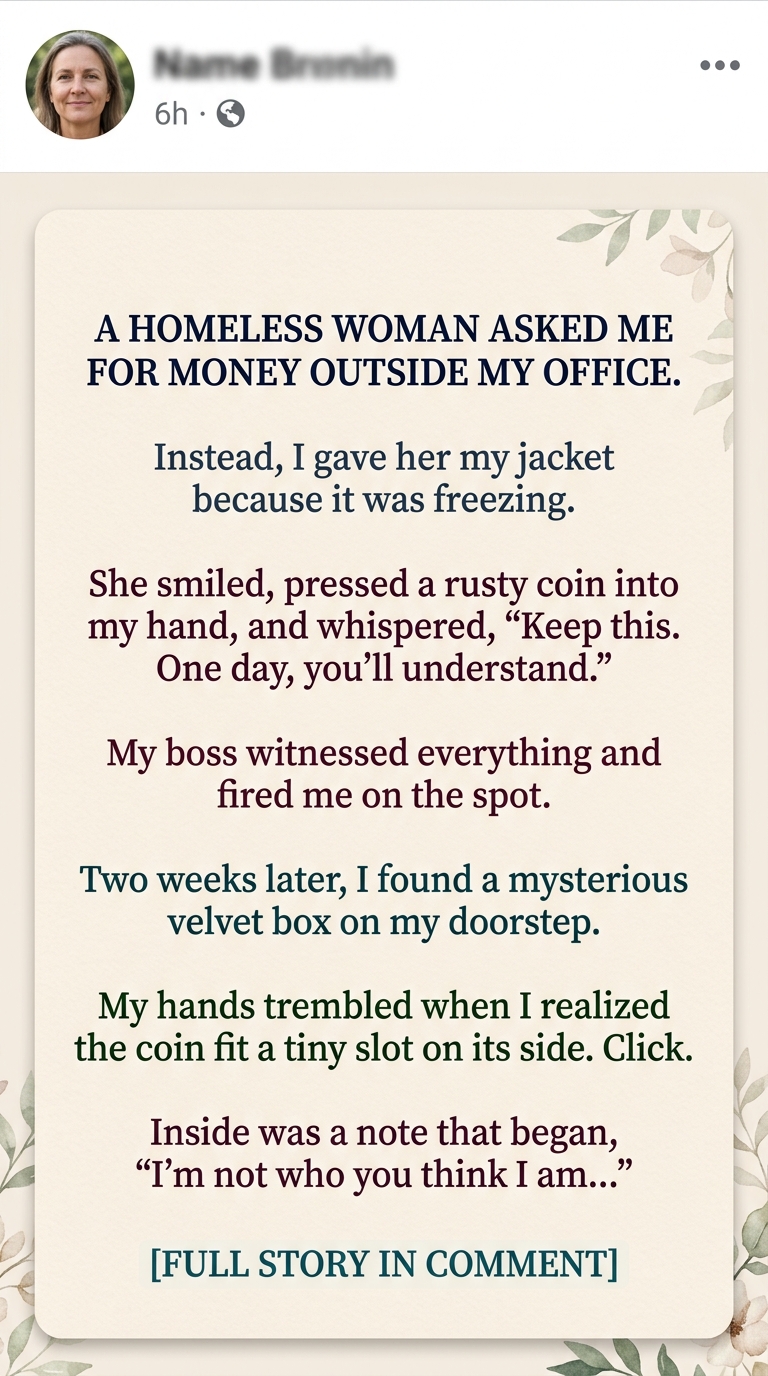
I Gave My Jacket to a Homeless Woman—and Lost My Job. Two Weeks Later, a Mysterious Box Arrived.
The homeless woman was shivering so violently that she could barely hold out her hand. I was already late for an important meeting, my phone was buzzing nonstop, and my boss had sent me three messages demanding to know where I was. But when I looked at the woman sitting outside my office building in downtown Denver, Colorado, I couldn’t bring myself to walk past her. The temperature had dropped below freezing, and she was wearing a thin, torn sweater that looked as though it had been pulled from a garbage bin. Her lips were pale, her fingers were red, and her eyes carried the kind of exhaustion that comes from spending too many nights wondering where you will sleep. “Please, sir,” she whispered. “Anything would help. I haven’t eaten today.” I reached into my pocket, but all I had was a few coins and a company access card. I had forgotten my wallet at home. I glanced at my expensive wool jacket, then back at the woman. Without thinking twice, I took it off and placed it around her shoulders. “Here,” I said. “At least keep warm.” She stared at me as if I had just handed her something far more valuable than a jacket. “But you’ll freeze,” she protested. I smiled faintly. “I’ll survive. I work inside.” For the first time, she smiled back. It was a strange smile—gentle, almost familiar, and touched with a sadness I couldn’t explain. Then she reached into the pocket of her sweater and pulled out a rusty old coin. It was dark with age, its edges worn smooth, and a strange symbol had been engraved on one side. She pressed it into my palm and curled my fingers around it. “Keep this,” she whispered. “One day, you’ll understand.” I tried to hand it back. “I can’t take your money.” “It’s not money,” she replied. Her eyes suddenly became serious. “And when the time comes, don’t let anyone convince you that kindness was a mistake.” Before I could ask what she meant, the revolving doors of my office building spun open behind me. My boss, Richard Hale, stepped outside, his polished shoes clicking against the pavement. He was a tall man in his early fifties who wore expensive suits, spoke in a permanently irritated tone, and believed that an employee’s value could be measured by how much profit they generated. His gaze moved from the homeless woman to my jacket wrapped around her shoulders, then settled on me. “What exactly are you doing?” he demanded. “Helping someone who needs it,” I answered. Richard looked at the woman with open disgust. “This is a business building, not a shelter. And you have a client meeting in ten minutes.” “I know. I’ll be upstairs in a moment.” His expression hardened. “You gave your company jacket to a stranger?” “It’s my personal jacket.” “That isn’t the point.” He stepped closer, lowering his voice but making no effort to hide his anger. “You represent this company, Michael. Do you have any idea how unprofessional this looks?” I stared at him in disbelief. “She’s freezing, Richard. I couldn’t just leave her here.” “Then you should have called a shelter. Instead, you’ve created a spectacle.” I felt my jaw tighten. “With respect, sir, giving someone a jacket isn’t a spectacle.” For a moment, neither of us spoke. Then Richard smiled—a thin, unpleasant smile that told me the conversation was already over. “Go upstairs. Clear your desk. You’re finished here.” I thought I had misheard him. “What?” “You’re fired, Michael. Effective immediately.” He turned and walked back through the revolving doors without another word. I stood on the pavement, holding a rusty coin while the woman beside me clutched my jacket. People passed us without looking. Somewhere behind the glass, my colleagues were probably watching. I had worked at Hale Financial Group for six years. I had stayed late, worked weekends, and taken on responsibilities that belonged to people earning twice my salary. I had believed that being loyal and dependable would eventually earn me respect. Instead, I had lost my job because I refused to ignore a freezing woman. The strangest part was that, as I stood there in the cold, I didn’t regret giving her my jacket. I regretted only how long it had taken me to understand the kind of man I had been working for. I looked down at the coin. “Who are you?” I asked the woman. She pulled the jacket tighter around herself. “Someone who knows what it’s like to lose everything.” Then she turned and disappeared into the crowd. I never saw her again that day. For the next two weeks, my life fell apart in ways I hadn’t expected. My savings were modest, my rent was due, and the job market was less forgiving than I had hoped. I sent out applications, contacted old colleagues, and tried to convince myself that losing my position might eventually turn out to be a blessing. But at night, when the apartment grew quiet, I found myself thinking about the woman and her strange words. One day, you’ll understand. Understand what? The coin sat on my kitchen table beside my keys. I examined it under a lamp, searching for a date or a country of origin, but there were no recognizable markings. The symbol on its face looked like a circle surrounding a small tree, with three narrow lines extending from its roots. On the reverse was a single letter: E. I searched online for similar coins, but nothing matched. Eventually, I slipped it into my pocket and tried to forget about it. Then, exactly fourteen days after I lost my job, someone knocked on my apartment door. When I opened it, the hallway was empty. On the floor sat a small velvet box, dark blue and tied with a silver ribbon. My name was written on a white card attached to the lid. No return address. No delivery receipt. No indication of who had left it. I brought the box inside and locked the door. For several minutes, I simply stared at it. Something about its weight and the careful way it had been wrapped made it feel less like a package and more like a message. I untied the ribbon and lifted the lid. Inside was a fitted velvet cushion with a narrow metal slot cut into one side. Beside it lay a folded piece of paper. My heart began beating faster. I reached into my pocket and took out the rusty coin. The symbol on the coin matched a small engraving on the box. My fingers trembled as I pushed the coin into the slot. It fit perfectly. There was a soft click. A hidden compartment opened beneath the velvet lining, revealing a brass key, a photograph, and a sealed letter. I picked up the photograph first. It showed a younger man standing beside a woman outside an old brick building. The man wore a simple dark coat and had a serious face. The woman looked remarkably like the homeless stranger who had given me the coin. I turned the photograph over. Written in faded ink were six words: “For the man who chose kindness.” My throat tightened. I unfolded the letter. The first sentence made my blood run cold. **”My name is Eleanor Whitmore, and I am not who you think I am.”** I read the line again, then continued. “If this letter has reached you, it means you gave away something you valued to help someone you believed had nothing. I need you to understand that I did not choose you because you were wealthy, powerful, or connected to the right people. I chose you because, when no one was watching, you did something that revealed who you truly were.” I sat down slowly. The letter explained that Eleanor had once been the founder and majority owner of a respected investment company called Whitmore Capital. Decades earlier, she had built it with her husband, Thomas, after they started with little more than a borrowed office and a determination to create a business that treated people fairly. They had promised each other that their company would never measure a person’s worth by their bank balance, clothing, or social standing. But after Thomas died, Eleanor discovered that the people she had trusted to manage the company were more interested in protecting their own positions than preserving the values on which it had been built. A bitter legal dispute followed. Several senior executives tried to force her out, and a network of false reports and manipulated documents made it appear that she was no longer capable of managing her affairs. Rather than fight a public battle while she was grieving, Eleanor stepped away from the company and allowed her lawyers to handle the dispute. She began living quietly, spending much of her time volunteering at shelters and community kitchens. She wanted to discover whether the world still contained people who would treat someone with dignity without expecting anything in return. “I have spent years watching people behave differently when they believe someone is important,” the letter continued. “They become polite when they see expensive clothes, respectful when they hear a prestigious name, and helpful when they expect a reward. I wanted to know whether anyone would still be kind if they believed I had nothing to offer.” I thought of the woman outside my office. The thin sweater. The trembling hands. The quiet smile. The coin. Eleanor explained that the old coin was not valuable in itself. It was a key to a small personal archive she had kept separate from her company’s records. The box contained documents that could identify the people who had tried to take control of her business, as well as a letter from Thomas describing the principles they had agreed would guide their company. The brass key opened a safety deposit box containing the original records. But there was another reason she had chosen me. Years earlier, Eleanor had helped fund a community scholarship program. One of its earliest recipients had been my mother. My mother had never told me much about the scholarship beyond saying that someone had given her a chance when she was young and struggling to raise me alone. The letter explained that Eleanor had quietly followed the lives of several scholarship recipients over the years, not to control them, but to see whether the opportunities she had helped create had made a difference. My mother had passed away five years earlier, but she had left behind a letter thanking the anonymous benefactor who had paid for her final year of nursing school. Eleanor had kept a copy. My eyes blurred as I read the final lines of the page. “Your mother once wrote that the greatest gift I gave her was not money. It was the feeling that someone believed she was worth helping. She raised you to understand that kindness is not a transaction. When I saw you outside that building, I recognized something of her in you. I did not know whether you would give me anything. I only hoped that you might see a human being instead of a problem to be removed from your path.” I put the letter down and covered my face with my hands. My mother had worked double shifts to support us. She had packed lunches when we had very little, smiled when she was exhausted, and taught me that a person’s character was revealed by how they treated those who could do nothing for them. I had spent years believing those lessons were simply things good people said. Now I was beginning to understand that someone had helped my mother live them. But the letter wasn’t finished. Eleanor wrote that she had recently learned that Hale Financial Group, the company that had fired me, had been quietly pursuing a merger with a firm connected to the former executives who had tried to seize her company. She had been reviewing the proposed transaction through her legal advisers when my name appeared in a set of employment records. A former employee had mentioned that I had raised concerns about irregularities in a client account months earlier. I remembered that investigation clearly. I had found discrepancies between the transactions reported to clients and the records held internally. When I raised the issue with Richard, he told me the differences were harmless accounting adjustments and instructed me to stop asking questions. I had complied with the formal review process but refused to sign a statement saying I had personally verified records I had never been allowed to examine. Shortly afterward, I was moved away from the account. At the time, I had assumed Richard simply disliked being challenged. Now Eleanor’s letter suggested that the irregularities might be connected to the merger she was investigating. “I cannot tell you what to believe,” she wrote. “And I will not ask you to accuse anyone without evidence. But if you choose to use the key, you will find documents that may help independent investigators understand what happened. I have also arranged for my legal team to contact you. They can help you protect yourself and decide whether you wish to provide a statement about the concerns you raised at work.” I stared at the letter for a long time. The woman I had helped had not promised me a fortune. She had not offered to buy me a new life or destroy the man who had fired me. Instead, she had given me something much more complicated: the chance to do the right thing when doing so might cost me again. The next morning, I called the number printed at the bottom of the letter. A woman named Margaret answered. She introduced herself as Eleanor’s attorney and explained that Eleanor was safe, but had deliberately kept her whereabouts private while her legal team worked through several sensitive matters. Margaret confirmed that the box was genuine and that the key opened a safety deposit box containing original correspondence, financial records, and a signed statement from Thomas Whitmore. She also made one thing very clear. “You are under no obligation to become involved,” she told me. “These documents belong to Mrs. Whitmore. She has authorized us to share relevant material with the appropriate authorities, but you should not make accusations or release confidential information publicly. If you have evidence relating to your former employer, we can discuss the proper legal process.” I thanked her and hung up. For the rest of the day, I walked around my apartment thinking about the decision ahead of me. I could leave the box untouched, accept that I had lost my job, and focus on rebuilding my life. Nobody could blame me for wanting peace. I had already paid a price for refusing to look away when someone needed help. But I kept remembering the letter my mother had written. Someone believed I was worth helping. I had spent years working in an industry where people talked about integrity in meetings and measured success in quarterly results. If the documents revealed wrongdoing, staying silent would mean allowing the same kind of people who had pushed Eleanor aside to keep making decisions that affected others. I called Margaret back and agreed to meet her. Two days later, I sat in a quiet conference room with Eleanor’s legal team and reviewed the documents under their supervision. Some of the records were decades old. Others were recent correspondence related to the proposed merger. Together, they suggested that individuals associated with the former Whitmore executives had been using layered companies to conceal financial interests in transactions involving Hale Financial Group. My own records from the client account were not proof of a crime, but they provided a reason for investigators to examine the transactions more closely. I gave a formal statement describing what I had observed, the questions I had raised, and the instructions Richard had given me. I was careful not to claim anything I could not support. For the first time in months, I felt that I was doing something useful with the experience that had cost me my livelihood. Several weeks passed. I found temporary work with a small accounting firm, where the owner cared more about accuracy than appearances. I rented a less expensive apartment, learned to live with uncertainty, and stopped checking my phone every few minutes in the hope that my old company might offer me my job back. Then, one rainy Thursday morning, Margaret called. “The independent review has been completed,” she said. “I wanted you to hear this from us before you read it elsewhere. The investigators found evidence of serious irregularities in the proposed merger and in several accounts connected to it. Your statement helped them understand where to look, but the findings rest on the records and testimony they independently verified.” She paused before continuing. “Mr. Hale has been removed from his position pending further proceedings. The company has also agreed to cooperate with the investigation.” I felt no urge to celebrate. Richard had humiliated me, but I knew that the consequences now facing him were not something I needed to enjoy. What mattered was that the concerns I had raised had finally been taken seriously. “And Eleanor?” I asked. Margaret’s voice softened. “She would like to meet you, if you’re willing.” We arranged to meet at a small community garden on the edge of the city. When I arrived, Eleanor was standing beside a wooden bench, wearing a simple coat and holding a paper cup of coffee. She looked different from the woman I had seen outside my office. Her hair was neatly combed, her face rested, and her eyes were bright. But the gentle smile was exactly the same. I stopped a few feet away. “You could have told me who you were,” I said. “Yes,” she replied. “I could have.” “You let me believe you were homeless.” Eleanor lowered her eyes. “I did. And I understand why that troubles you. I cannot pretend that my choice was perfect. I wanted to learn whether people could still show kindness without expecting a reward, but I should have considered what it meant to ask someone else to participate in a test they never agreed to take.” Her honesty caught me off guard. “Why me?” I asked. “Because you were the only person who stopped that morning,” she said. “Several people looked at me. Some offered advice. Some told me to move. You were the only one who gave me something you were actually using.” She glanced at my coat. “I know a jacket is not a fortune, Michael. But it was cold, you were on your way to work, and you had no reason to believe helping me would benefit you. You simply saw that I was suffering and responded.” I sat beside her. “I lost my job because of it.” “I know,” she said quietly. “And I am sorry. I never wanted you to suffer for helping me. I did not ask Richard to fire you, and I did not arrange it. When I learned what happened, I was angry—not because you had been punished, but because a man who claimed to value professionalism had apparently forgotten the most basic responsibility of leadership.” She took a breath. “I cannot give you back those two weeks of fear. I cannot undo the humiliation you experienced. But I can make sure that your kindness is not used as a reason to question your competence. My legal team has documented your professional record, and I would like to recommend you for a position with an organization I support. The choice will be yours, and the interview process will be independent. You will not owe me anything if you decline.” I looked at her, unsure how to respond. “I didn’t give you my jacket because I expected anything.” “I know,” she said. “That is why I want you to choose freely.” She handed me a second envelope. Inside was a copy of my mother’s old scholarship letter, along with a note she had written shortly before her death. My mother had thanked Eleanor for helping her finish nursing school and promised that she would pass the kindness forward whenever she could. At the bottom, she had added a sentence that made my eyes fill with tears: “I hope my son grows up knowing that being a good man is not about what he owns, but what he is willing to give when someone else has less.” I pressed the paper against my chest. For years, I had carried my mother’s lessons like a small light through difficult days. I had never realized that someone else had been carrying a memory of her, too. Eleanor watched me quietly. “She was a remarkable woman,” she said. “I wish I had told her how much her letter meant to me.” We sat in silence for a while, listening to the wind move through the trees. Before I left, Eleanor asked whether I would consider helping her establish a small emergency fund for workers who lost their jobs after reporting serious workplace concerns. She wanted it to provide temporary financial support and access to independent legal advice, without requiring recipients to prove that they were heroes or perfect employees. “People should not have to choose between their conscience and their ability to pay rent,” she said. I told her I would think about it. In the months that followed, I accepted a position at an independent financial oversight organization. The work was demanding, but it allowed me to use my experience to help make financial practices more transparent. I also volunteered one evening a week at a community kitchen. I never became wealthy because I gave away a jacket, and my life did not transform overnight into a fairy tale. I still worried about bills. I still had difficult mornings. I still remembered the humiliation of standing outside my former office while my boss dismissed me as though my compassion had made me incompetent. But I no longer believed that the day I was fired had been the day I failed. Sometimes I took the rusty coin from the velvet box and held it in my palm. It was not worth much in money. Its edges remained rough, and its strange symbol was still difficult to explain. Yet it reminded me of the moment I had made a simple choice without knowing what it would cost or what it might bring. One afternoon, nearly a year after our first meeting, I asked Eleanor why she had kept the coin for so long. She smiled. “My husband carried it when we had almost nothing,” she said. “He gave it to me the day we opened our first office. He told me that money could open doors, but character determined what we did after walking through them. After he died, I kept the coin as a reminder of the promise we had made.” “And you gave it to me?” I asked. “I gave it to someone who reminded me that the promise was still worth keeping.” I looked down at the coin and thought about how easily I might have walked past her that freezing morning. I could have told myself I was too busy, that someone else would help, or that kindness was a luxury I could not afford. My boss might still have fired me for another reason. The investigation might still have happened. My life might have followed an entirely different path. I would never know. But I knew this: the most important thing about that morning was not the box that arrived two weeks later, the documents that exposed wrongdoing, or the opportunities that eventually followed. It was the fact that, for one brief moment, I had seen another human being in need and chosen not to look away. The world often teaches us to measure success by the titles we hold, the money we earn, and the approval we receive from people in power. Yet none of those things can tell us whether we have lived with integrity. A person can lose a job and still keep their dignity. A person can have almost nothing and still offer someone else warmth. And an act of kindness can matter even when it brings no reward at all. I once believed that giving away my jacket had cost me everything. Now I understand that it had cost me a job I was afraid to lose, while revealing a life I had been too afraid to change. The coin did not make me a better person. It simply reminded me of the person I wanted to be. And if there is one thing I hope y
