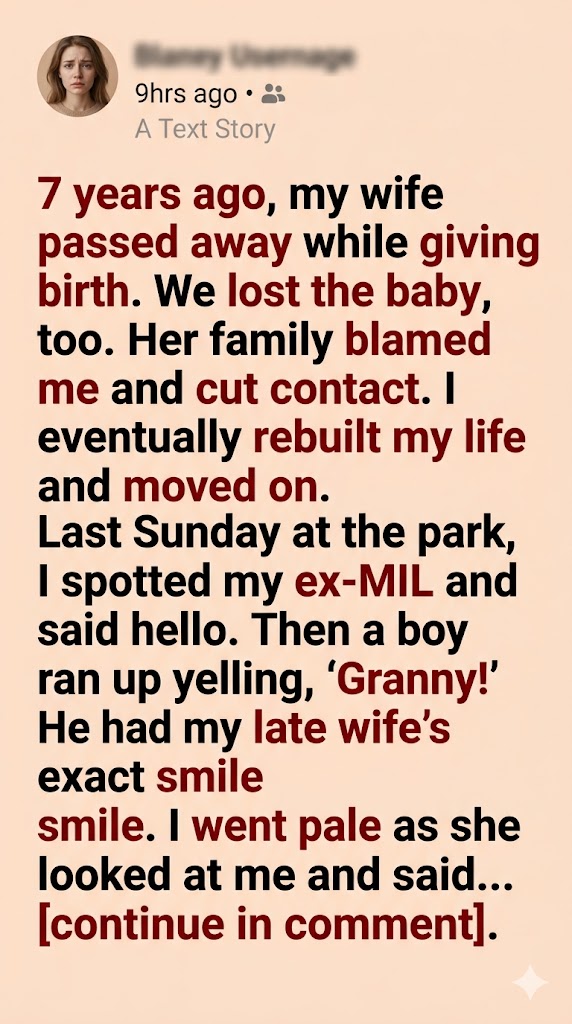
I thought grief had an ending.
Not a happy one—just a quiet place where the pain softened enough to live around. Seven years ago, my wife, Emily, died in childbirth. Our son didn’t make it either. One moment I was holding her hand, promising we’d be okay. The next, I was standing in a hospital hallway that felt too bright, too clean, too empty.
Her parents blamed me.
For illustrative purposes only
They never said it outright at first—but it lived in every look, every silence. Eventually, it turned into words. I was the one who had “pushed” for a natural birth. The one who hadn’t “noticed something was wrong soon enough.” Grief needed somewhere to go, and I was the nearest target.
I didn’t fight back.
I didn’t have the strength. I buried my wife. I buried my son. And then, slowly, I buried that entire part of my life.
It took years to breathe normally again.
Years before I could walk past a playground without feeling like I’d been punched in the chest. Years before I could hear a child laugh and not immediately think of what I’d lost.
Eventually, I rebuilt something that looked like a life.
And then came last Sunday.
It was an ordinary afternoon. My girlfriend, Claire, and I were walking through the park, talking about nothing important—what to cook for dinner, whether we should take a short trip somewhere. The sun was out, kids were playing, dogs were chasing frisbees.
And then I saw her.
My former mother-in-law.
She was sitting alone on a bench, a little more hunched than I remembered, her hair now completely gray. For a second, I thought about walking past. Pretending I hadn’t seen her.
But something in me—maybe habit, maybe something unfinished—pulled me over.
“Hi,” I said.
She looked up.
For a moment, there was confusion. Then recognition hit, and her face changed in a way I couldn’t quite read.
We made small talk.
Painful, stiff, unnatural small talk. The kind where every sentence feels like it’s walking on glass. She asked how I’d been. I said I was okay. I asked about her health. She said she managed.
Claire stood quietly beside me, sensing the weight of something she didn’t fully understand.
And then—
“Granny!”
A small voice cut across the park.
I turned instinctively.
For illustrative purposes only
A little boy—maybe six or seven—was sprinting across the grass toward us, his face lit up with pure, unfiltered joy.
And I froze.
Because I knew that smile.
Not similar. Not close.
Exact.
It was Emily’s smile.
The same tilt of the lips. The same brightness in the eyes. The same way his whole face seemed to glow when he laughed.
Seven years hadn’t erased that from me. It couldn’t.
I felt the blood drain from my face.
My chest tightened like the past had reached out and grabbed me.
He ran straight into her arms, laughing, breathless, holding onto her like she was his whole world.
I must have looked like I’d seen a ghost, because she quickly said, almost too quickly:
“We fostered him three years ago. I’m sorry… I should have told you.”
I blinked, trying to process her words.
“After… after Emily,” she continued, her voice softer now, “we were drowning. The house was too quiet. The days were too long. We needed… something. Someone.”
She looked down at the boy, brushing his hair back gently.
“When he came, it was like…” She paused, searching for the words. “Like a light we didn’t expect. His laugh, his expressions… it felt like a sign. Something we couldn’t explain.”
My throat tightened.
“We named him Mike,” she said. “After the grandson we lost.”
For a moment, none of us spoke.
The boy—Mike—looked up at me curiously.
“Who’s he?” he asked.
Her voice trembled slightly. “An old friend.”
That word hit harder than I expected.
An old friend.
Not family. Not anymore.
But not nothing, either.
Then something shifted.
Maybe it was the way I was looking at the boy. Maybe it was the years of silence finally breaking under their own weight.
For illustrative purposes only
She turned back to me, and her composure cracked.
“I’m sorry,” she said.
Not the polite kind. Not the distant kind.
A real apology.
“We were wrong,” she whispered. “We were hurting, and we took it out on you. You didn’t deserve that. None of it was your fault.”
I didn’t realize how much I needed to hear those words until they were finally said.
Seven years of quiet guilt, of questions I never voiced, of blame I never fully shook—
And in one moment, something loosened.
Not fixed. Not erased.
But loosened.
Mike tugged at her sleeve, impatient with the seriousness.
“Granny, look!” he said, pulling out a small stack of football cards from his pocket.
He turned to me, holding them up proudly.
“Do you collect these?” he asked.
I managed a small smile.
“I used to,” I said.
And just like that, he launched into an excited explanation—players, stats, trades—his words tumbling over each other.
We started walking toward the parking lot together.
Claire stayed close, quietly supportive. My former mother-in-law walked beside me, not speaking much, but not pulling away either.
And Mike… he walked between us, completely at ease, as if none of the past existed.
As if we were just three people sharing a simple afternoon.
Before we parted, she hesitated.
“Would you… would you like to come for dinner next Saturday?” she asked.
I looked at Mike, who was now carefully reorganizing his cards.
Then I looked at her.
At the years behind us. And the small, unexpected bridge forming in front of us.
“Yeah,” I said quietly. “I’d like that.”
For the first time in a long time, the past didn’t feel like something I had to run from.
Maybe… it was something I could finally face.
One dinner at a time.
