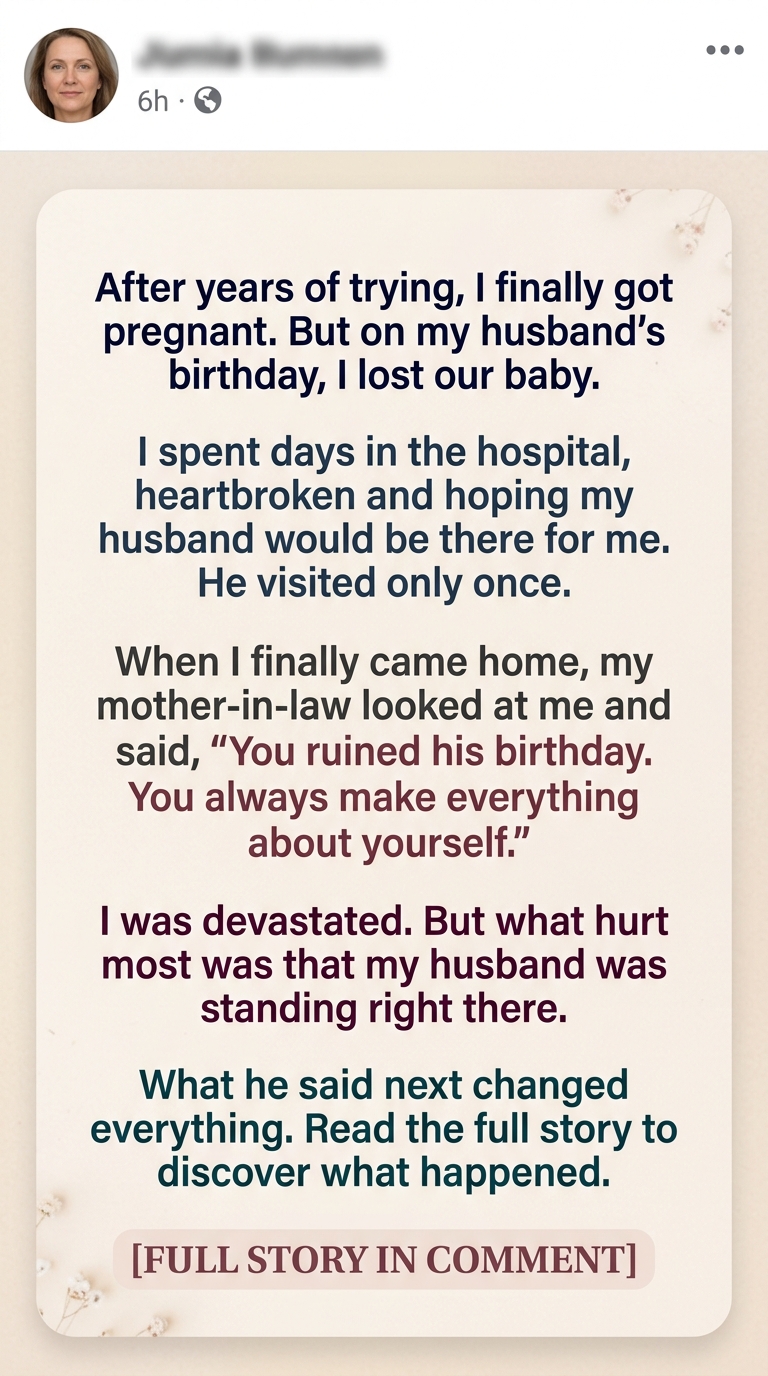
After years of trying to have a baby, I finally got pregnant. But on my husband’s birthday, I lost our baby. When I came home from the hospital, his mother looked me in the eyes and said, “You ruined his birthday. You always make everything about yourself.”
I wish I could say that was the worst thing that happened that day.
My name is Emily, and for five years, my husband, Daniel, and I dreamed of becoming parents.
Every month, I watched the calendar, hoping this would finally be our month. Every negative pregnancy test broke my heart a little more. I cried in bathrooms, pretended to be fine at family gatherings, and smiled whenever someone asked when we planned to have children.
Daniel always told me, “One day, sweetheart. We’ll have our little family. I promise.”
Those words kept me going.
Then, one quiet morning, I saw two pink lines on a pregnancy test.
I stared at them for almost a full minute before bursting into tears. When Daniel came home, I placed the test in a tiny gift box and handed it to him.
He opened it, looked at the test, and froze.
“Are you serious?” he whispered.
I nodded, crying and laughing at the same time.
He lifted me into his arms and spun me around the living room. That night, we lay in bed with his hand resting gently on my stomach, talking about baby names and imagining what our child would look like.
For the first time in years, I felt like all our pain had finally led us somewhere beautiful.
My pregnancy wasn’t easy. I struggled with exhaustion and nausea, but I didn’t care. Every doctor’s appointment felt like a miracle. Every time I heard our baby’s heartbeat, I thanked God for giving us this chance.
Daniel was excited, too, at least at first.
But as the weeks passed, something began to change.
His mother, Margaret, had never liked me very much. She often complained that I wasn’t the kind of wife she had imagined for her son. When she learned I was pregnant, she suddenly became interested in everything I did.
She criticized the food I ate, the clothes I wore, and how much I rested.
“Women have been having babies for thousands of years,” she told me once. “You’re acting as if you’re the first woman ever to get pregnant.”
Daniel rarely defended me. He would simply tell me to ignore her because she was old-fashioned.
I tried.
I wanted peace in our home, especially now that we were going to have a baby.
Then came Daniel’s birthday.
He had planned a big family dinner, and his mother had spent days talking about how perfect the celebration needed to be. I wanted to help, but I had been experiencing severe abdominal pain since that morning.
I told Daniel I wasn’t feeling well.
“Can you just rest for a little while?” he asked. “My mom has already done so much for tonight.”
I nodded and went to lie down.
But the pain became unbearable.
I remember gripping the edge of the bed, trying to breathe through the cramps. When I finally noticed the blood, my entire body went cold.
“Daniel!” I screamed.
He rushed into the bedroom, and the moment he saw me, his face changed.
Within minutes, we were on our way to the hospital.
I held his hand tightly in the car, repeating the same words over and over.
“Please, let our baby be okay. Please.”
Daniel didn’t answer.
At the hospital, nurses hurried me into a room while doctors examined me. I remember staring at the ceiling, listening to the distant sounds of footsteps and medical equipment, desperately searching the faces around me for some sign of hope.
Finally, the doctor came in.
He sat beside my bed, his expression gentle.
“I’m so sorry,” he said quietly.
I didn’t need him to explain.
I knew.
Our baby was gone.
A sound escaped my throat that I didn’t recognize. I covered my face with both hands and cried until my chest hurt.
Five years of waiting. Five years of hoping. And now, in a matter of hours, the future I’d imagined had disappeared.
Daniel stood beside the bed, silent.
I reached for his hand.
“Please don’t leave me,” I whispered.
He squeezed my fingers briefly.
“I need to make a phone call,” he said.
Then he walked out.
I spent the next three days in the hospital, recovering physically while trying to understand how I was supposed to live with the emptiness inside me.
Daniel visited once.
He stayed for less than twenty minutes. He asked whether the doctor had said when I could come home, checked his phone several times, and told me his mother was upset about the birthday dinner.
I stared at him, wondering whether he understood what had happened to us.
“Daniel, we lost our baby,” I whispered.
His jaw tightened.
“I know, Emily. But I can’t just stop everything. My family has been calling me all day.”
I turned my face toward the window.
I didn’t have the strength to argue with him.
I had imagined that losing our baby would bring us closer, that we would hold each other through the pain and somehow find a way forward together.
Instead, I felt more alone than I had ever felt in my life.
On the fourth day, the doctor discharged me.
I took a taxi home, carrying a small hospital bag and a heart that felt too heavy for my body.
When I opened the front door, I heard voices coming from the living room.
Margaret was sitting on the sofa with Daniel. There were birthday decorations still hanging on the walls, and a half-empty box of cake sat on the coffee table.
They were talking as if nothing had happened.
When Margaret noticed me, she looked me up and down.
“Oh, you’re finally home,” she said.
I forced a small nod.
I was exhausted. All I wanted was to lie down in my own bed and cry somewhere no one could see me.
But before I could walk away, Margaret stood up.
“Honestly, Emily, I hope you’re satisfied.”
I stopped.
“What?”
She crossed her arms.
“You ruined Daniel’s birthday. Everyone was waiting for you, and instead, the entire evening became a disaster. You always make everything about yourself.”
For a moment, I couldn’t understand the words coming out of her mouth.
I had just spent days in a hospital grieving the loss of my child.
And she was angry about a birthday party.
My eyes filled with tears.
“Margaret, I didn’t choose this. I wanted that baby more than anything.”
She shook her head impatiently.
“There’s always some drama with you. Daniel deserves to be happy, too.”
I looked at my husband.
He was standing near the sofa, staring at the floor.
“Daniel,” I whispered. “Please tell her she can’t speak to me like that.”
He finally looked up.
And then he said the words that broke something inside me.
“Mom has a point, Emily. You need to stop acting like you’re the only person who’s hurting. It was my birthday, too.”
I felt as though the room had tilted beneath my feet.
I looked at him, waiting for him to take it back. Waiting for him to realize how cruel those words were.
But he didn’t.
Instead, he picked up his phone and walked into the kitchen.
I stood there for several seconds, unable to move.
Then I went upstairs, closed our bedroom door, and sat on the edge of the bed.
My eyes landed on the small white box on my nightstand.
Inside it were the baby clothes I’d bought weeks earlier. A tiny yellow onesie. A pair of white socks. A little knitted hat I had imagined placing on our newborn’s head.
I held the onesie against my chest and finally let myself cry.
That night, Daniel came into the bedroom around eleven.
He changed his clothes, plugged in his phone, and climbed into bed without saying a word.
“Do you still love me?” I asked quietly.
He sighed.
“Emily, not tonight. I’m tired.”
I turned away from him.
That was the moment I understood something I had been too afraid to admit.
I wasn’t asking him to fix my grief. I wasn’t asking him to find the perfect words or somehow make our loss disappear.
I was asking my husband to care that I was hurting.
And he couldn’t even do that.
The following morning, I woke up early and began packing a suitcase.
Daniel watched me from the doorway.
“What are you doing?”
“I’m going to my sister’s house for a while.”
He frowned.
“You’re leaving because of what Mom said?”
I zipped the suitcase.
“No, Daniel. I’m leaving because of what you said.”
He rolled his eyes.
“You’re making this into something bigger than it needs to be.”
I looked at him for a long moment.
“You know what the saddest part is? When I was in that hospital bed, I kept making excuses for you. I told myself you were grieving. I told myself you didn’t know how to handle the pain. I kept telling myself that once I came home, you’d hold me and tell me we’d get through this together.”
My voice cracked.
“But you never asked me how I was feeling. You never held me while I cried. And when your mother blamed me for losing our baby, you agreed with her.”
Daniel said nothing.
I picked up my suitcase.
“Maybe I can’t control what happened to our baby. But I can decide whether I spend the rest of my life begging my own husband to treat me like someone he loves.”
Then I walked out.
For the first time in years, I didn’t look back to see whether he was following me.
At my sister’s house, I barely spoke for days. She never pressured me to explain anything. She simply made me tea, sat beside me when I cried, and reminded me to eat when grief made food feel impossible.
Slowly, I began to feel human again.
I started seeing a counselor to help me process the loss. I learned that I didn’t have to apologize for grieving, and I didn’t have to make my pain smaller to keep other people comfortable.
Daniel called several times.
At first, he told me I was overreacting.
Then he said his mother hadn’t meant to hurt me.
Finally, after two weeks, he sent a message that read:
“Come home. We need to talk.”
I stared at those words for a long time.
Not once had he said he was sorry.
Not once had he asked whether I was sleeping, whether I was eating, or whether I was managing to get through the days.
Still, a part of me hoped he might finally understand.
So I agreed to meet him.
We sat across from each other at a small café near our house. Daniel looked tired, but he didn’t reach for my hand.
“My mom thinks you owe her an apology,” he began.
I blinked.
“For what?”
“For embarrassing her. For leaving like that. She thinks you’re trying to punish the whole family.”
I felt a strange calm settle over me.
For weeks, I had imagined this conversation. I had imagined him crying, apologizing, and telling me how much he regretted abandoning me when I needed him most.
Instead, he had brought me back to the same place.
His mother’s feelings came first. His birthday came first. His comfort came first.
And somehow, I was still expected to apologize.
I took a slow breath.
“Daniel, do you remember what you promised me when I showed you that positive pregnancy test?”
He looked down.
“You told me we’d have our little family. You promised me we’d face everything together.”
His eyes became wet.
“I know.”
“No, I don’t think you do. Because when the worst thing that has ever happened to me happened, you left me alone. And when I came home, you made me feel guilty for it.”
He reached across the table.
“Emily, I was hurting, too.”
“I know,” I replied. “But I never asked you not to hurt. I only asked you not to abandon me while we were hurting.”
He began to cry.
For the first time, I saw the grief he had been hiding. But seeing his pain didn’t erase mine, and it didn’t change what he had done.
“I made a mistake,” he whispered. “Please come home. I’ll talk to my mother. I’ll make things right.”
I wanted so badly to believe him.
I wanted the man who had spun me around the living room when he learned we were having a baby. I wanted the husband who had once promised to hold my hand through every difficult moment.
But love wasn’t just the beautiful things someone said when life was easy.
It was what they did when everything fell apart.
“I need time,” I told him.
He nodded, wiping his face.
Before we left, he asked one final question.
“Is there any chance we can still save our marriage?”
I looked at the man I had loved for seven years.
“I don’t know,” I said honestly. “But if we ever have a chance, it won’t be because I learned to tolerate being hurt. It’ll be because you finally understand why you hurt me.”
I walked away without making any promises.
Over the following months, Daniel began attending counseling. He also started setting boundaries with his mother, something he had refused to do for years.
He apologized for the hospital visits, for his silence, and for the cruel words he had spoken when I needed compassion most.
Some apologies came too late to undo the damage, but I listened.
I didn’t make a decision about our marriage immediately. I focused on healing and learning who I was outside the role of a wife who constantly tried to keep everyone happy.
I also learned something important about grief: there is no correct timeline, no perfect way to mourn, and no reason to feel ashamed for struggling after losing someone you never got the chance to hold.
Our baby would always be part of my story.
And no birthday, family gathering, or angry accusation could ever change that.
I still don’t know exactly what the future holds for Daniel and me. Trust takes time to rebuild, and love alone cannot repair everything.
But I know this now:
**I did not ruin my husband’s birthday by losing our baby. I did not ruin his happiness by grieving. And I did not owe anyone an apology for the pain I never chose.**
The day I left that house, I wasn’t trying to punish my husband or destroy his family.
I was simply choosing not to abandon myself anymore.
And for the first time in a very long time, that felt like the beginning of something new.
