# My Dad Abandoned Me at 3—28 Years Later, I Took Him In, and What I Found in His Coat Changed Everything
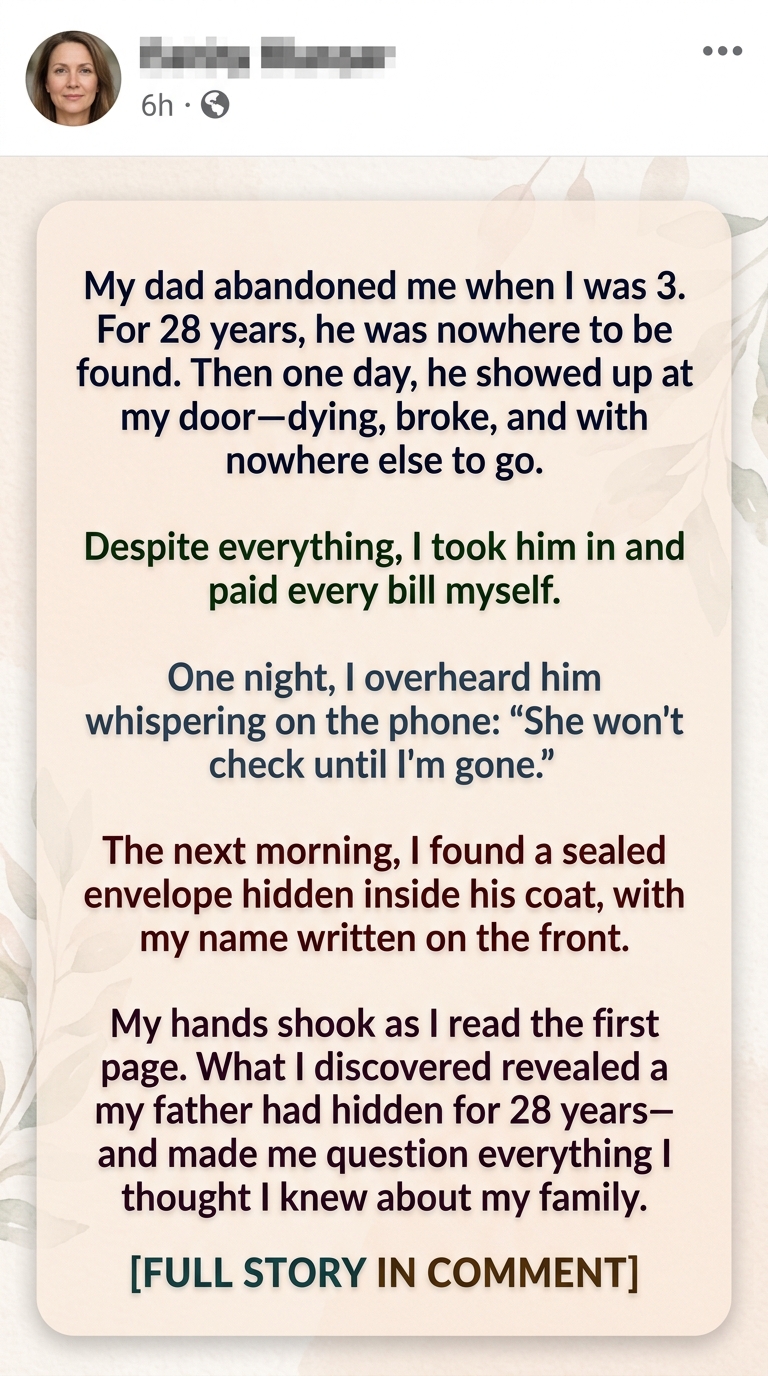
My father abandoned me when I was three years old.
For twenty-eight years, I believed he had simply decided that being a father was too much trouble.
He never called on my birthdays. He never sent Christmas cards. He never showed up when I graduated from high school or when I received my first promotion at work.
When I was a little girl, I used to stand beside the front window and ask my mother when Daddy was coming home.
At first, she would kneel beside me, brush the hair from my forehead, and whisper, “Soon, sweetheart.”
Eventually, she stopped promising.
By the time I turned ten, I had learned not to ask.
My mother raised me alone, working long shifts at a grocery store and taking cleaning jobs on weekends. She never remarried. She never spoke badly about my father, even when I was old enough to understand how difficult life had been for her.
Whenever I asked why he had left, she gave me the same answer.
“Sometimes, people make choices they can never undo.”
I hated that answer.
I wanted something more straightforward. I wanted to know whether he had stopped loving me, whether he had another family, or whether I had done something wrong.
But my mother never explained.
Then, when I was twenty-four, she died unexpectedly after a short illness.
At her funeral, I stood beside her grave and realized that the one person who knew the whole story had taken her secrets with her.
I thought I would never see my father again.
I was wrong.
## The Man Who Appeared at My Door
I was thirty-one when someone knocked on my front door on a rainy Thursday evening.
I had just finished dinner and was preparing to watch television when I heard the knock.
When I opened the door, I barely recognized the man standing on my porch.
He was thinner than I remembered from the few photographs my mother had kept. His hair had turned almost completely white, his cheeks were hollow, and one hand gripped the railing as though standing upright required all his remaining strength.
But his eyes were unmistakable.
They were the same blue eyes I saw whenever I looked in the mirror.
“Daddy?” I whispered.
He lowered his head.
“I know I have no right to be here.”
For several seconds, neither of us moved.
Twenty-eight years of anger, unanswered questions, and childhood loneliness seemed to rise between us.
I wanted to slam the door.
I wanted to ask him where he had been when I cried myself to sleep because the other children at school had fathers who came to pick them up.
I wanted to know why he had left my mother to struggle alone.
Instead, I noticed the way his fingers trembled against the railing.
“Dad, are you sick?”
He nodded slowly.
“The doctors say I don’t have much time.”
Those words silenced every angry question I had prepared.
He explained that he had been diagnosed with an advanced illness. He had little money left, no stable home, and no close family willing to help him.
“I don’t expect you to forgive me,” he said. “I just didn’t know where else to go.”
I should have told him to leave.
My friends certainly thought I should have.
When I called my best friend, Melissa, that evening, she couldn’t believe what I was telling her.
“Are you serious? He abandoned you for almost three decades, and now he expects you to take care of him?”
“He isn’t asking for forgiveness,” I replied.
“He’s asking for a place to stay. Don’t confuse that with being sorry.”
Her words hurt because part of me knew she might be right.
But when I looked at my father sitting alone on my porch, struggling to catch his breath, I couldn’t bring myself to turn him away.
I opened the door wider.
“You can stay here for now,” I told him. “We’ll figure out what happens next.”
He looked at me with an expression I couldn’t quite understand.
Relief, perhaps.
Or guilt.
“Thank you,” he whispered.
Then he stepped inside the house he had never helped me build.
And I made the first of several decisions that would change my life forever.
## The Father I Never Knew
The first few weeks were difficult.
My father slept in the spare bedroom at the end of the hallway. I took him to medical appointments, picked up his prescriptions, prepared his meals, and paid his bills.
His savings were almost nonexistent.
Whatever money he had received from his last job had disappeared into rent, medical expenses, and years of living without anyone to help him.
I covered everything.
I never told him how much it cost because I didn’t want him to feel humiliated.
But I also didn’t pretend that his return had erased the past.
We were strangers sharing a house, connected by blood but separated by nearly three decades of silence.
Sometimes, I would find him standing in the kitchen, staring at an old photograph of me that he had somehow managed to bring with him.
It was a picture taken on my third birthday.
I was wearing a yellow dress, sitting in front of a small cake with three candles.
My mother stood behind me, smiling at the camera.
My father was beside us, his arm around her shoulders.
It was one of the last photographs taken before he left.
“Why do you still have that?” I asked him one afternoon.
He looked startled.
“Because it’s the last picture I have of you as a little girl.”
I crossed my arms.
“You missed everything after that.”
His eyes filled with tears.
“I know.”
“No, Dad. You don’t know. You weren’t there.”
He lowered the photograph.
For a moment, I thought he might finally explain himself.
Instead, he said, “You’re right.”
And that was all.
I hated how much I wanted him to fight for his place in my life.
I wanted him to tell me there had been a reason. A good reason. Something that would make the years of waiting feel less meaningless.
But he never offered an explanation.
He spent most of his days quietly reading in the living room or sitting beside the window.
Occasionally, he asked about my job or whether I was seeing anyone.
Sometimes, I caught him looking at me as if he wanted to say something important.
Every time, he changed his mind.
Then, one night, everything changed.
## “She Won’t Check Until I’m Gone”
It happened a little after midnight.
I had gone downstairs for a glass of water when I heard my father’s voice coming from the spare bedroom.
His door was almost closed, leaving only a narrow gap.
I wasn’t trying to listen.
But then I heard him say my name.
“No, she doesn’t know anything about it.”
I froze.
There was a long silence.
Then he spoke again, his voice lower than before.
“She won’t check until I’m gone.”
My fingers tightened around the glass.
Who was he talking to?
And what wouldn’t I check?
I moved closer to the door, trying to hear the other person’s response, but my father suddenly whispered something I couldn’t make out.
Then he said, “I told you I’d take care of it. Just give me a little more time.”
A moment later, the call ended.
I hurried back upstairs before he could discover me standing in the hallway.
I barely slept that night.
His words kept repeating in my mind.
*She won’t check until I’m gone.*
Was he hiding money?
Had he committed a crime?
Was someone threatening him?
Or had he returned to my life because he needed something from me?
The following morning, I watched him carefully over breakfast.
He seemed unusually nervous.
He barely touched his toast, and when his phone vibrated on the table, he turned it facedown without looking at the screen.
“Everything okay?” I asked.
He glanced at me.
“Of course.”
“Who were you talking to last night?”
His fork stopped halfway to his mouth.
For one brief second, fear crossed his face.
Then he forced a smile.
“An old friend.”
“What friend?”
“Someone from my past.”
He returned to his breakfast, making it clear that the conversation was over.
But I knew what I had heard.
And I knew my father was hiding something.
## The Envelope Inside His Coat
Two days later, I decided to wash some of his clothes.
My father had been sleeping more than usual, and I didn’t want to disturb him by asking which things needed cleaning.
His old brown coat was hanging beside the back door.
When I picked it up, I noticed something strange.
The lining near the inside pocket felt unusually thick.
At first, I thought someone had sewn the pocket incorrectly.
Then I felt a hard rectangular object hidden beneath the fabric.
I hesitated.
I knew I shouldn’t go searching through his belongings.
But I couldn’t forget the phone call.
And I couldn’t ignore the growing suspicion that whatever he was hiding had something to do with me.
I carefully examined the inside of the coat and found a small section of stitching that looked newer than the rest.
Using a pair of scissors, I loosened a few threads.
A yellowed envelope slipped into my hand.
My name was written across the front.
Not my nickname.
Not simply my first name.
My full legal name, written in my father’s unmistakable handwriting.
Beneath it were four words that made my stomach tighten.
**”For my daughter, when ready.”**
I sat down at the kitchen table.
The envelope had been sealed for a long time. Its edges were worn, and the paper smelled faintly of dust.
For several minutes, I simply stared at it.
Then I opened it.
Inside were three folded pages, a photograph, and a smaller envelope marked with a date.
The first page began with a sentence that made my hands tremble.
*My darling girl, if you’re reading this, then I’ve finally run out of time to tell you the truth.*
I stopped breathing for a moment.
He had written this letter before arriving at my house.
Perhaps long before.
I continued reading.
*I know you believe I abandoned you because I didn’t love you enough to stay. I have allowed you to believe that for twenty-eight years, and that is the greatest shame of my life.*
My eyes burned.
*But your mother and I did not separate for the reason you were told.*
I read that sentence again.
Then a third time.
My mother had never told me they were separating.
She had always said he had left.
What did he mean?
I turned the page.
*Before you decide whether you can forgive me, there is something you need to understand about the months before I disappeared.*
The letter continued, describing arguments I had never known about, financial problems I had never heard mentioned, and a decision he claimed he had made to protect me.
But the more I read, the more questions I had.
His explanation involved a person my mother had trusted.
Someone who had remained in our lives long after my father was gone.
Someone whose name I recognized immediately.
I dropped the letter onto the table.
It couldn’t be true.
Not that person.
Not someone who had attended my school events, comforted me after my mother’s death, and told me for years that I deserved better than the father who abandoned me.
I picked up the letter again, hoping I had misunderstood.
But the name was still there.
And underneath it was a sentence that made my entire body go cold.
*Your mother knew what happened. She tried to tell you once, but I begged her not to.*
I felt as though the room had tilted around me.
My mother had known?
All those years when I asked why my father left, she had known the real story?
I pressed a hand against my mouth, struggling to breathe.
Then I noticed the photograph.
It showed my father standing outside a building I didn’t recognize, holding a document in one hand.
Beside him stood the same person named in the letter.
On the back of the photograph, someone had written a date.
It was dated just three months before my father disappeared.
I turned the picture over again.
This time, I noticed something I had missed.
A second person stood in the background.
Someone whose face had been partially obscured by a shadow.
Someone who looked remarkably like me.
But the photograph had been taken when I was only three years old.
How could that be?
I returned to the letter, searching for an explanation.
Instead, I found the smaller envelope.
It had been carefully sealed and marked:
**”Open only after you learn what really happened.”**
I stared at it for a long time.
Then I heard footsteps behind me.
I turned.
My father was standing in the kitchen doorway.
His face had gone completely pale.
For several seconds, he didn’t speak.
His eyes moved from the opened envelope to the photograph in my hand.
Then he whispered the words I would never forget.
“You weren’t supposed to find that yet.”
## The Question He Couldn’t Avoid
I stood so quickly that my chair scraped against the floor.
“What is this?”
My father closed his eyes.
“Please, let me explain.”
“Explain what? That you lied to me? That Mom lied to me? That someone else knew the truth while I spent my entire childhood believing you didn’t want me?”
His shoulders sagged.
“I never stopped loving you.”
“Then why did you leave?”
He looked at the photograph.
For the first time since arriving at my house, he seemed less like a dying stranger and more like the frightened man who had once walked away from his own family.
“Because I thought leaving was the only way to protect you.”
“Protect me from whom?”
He didn’t answer immediately.
Instead, he pulled out a chair and sat down slowly.
“I made a terrible mistake when I was young,” he said. “I trusted the wrong person. I believed I could fix everything myself, and when I realized how badly things had gone, I thought the best thing I could do was disappear.”
“That doesn’t explain twenty-eight years.”
“No,” he whispered. “It doesn’t.”
He rubbed his face with both hands.
“I should have come back. I should have fought harder. I should have told you the truth when you were old enough to understand.”
“But you didn’t.”
“No.”
His voice broke.
“I was ashamed. And every year I stayed away made it harder to return.”
I wanted to hate him.
Part of me still did.
But another part of me wanted to understand why a man would carry a letter like this for decades, hide it inside his coat, and return to the daughter he had abandoned only when he was dying.
I placed the photograph on the table.
“Who is the person you named in this letter?”
He looked up at me.
Then he said the name.
I felt the blood drain from my face.
It was someone I had trusted for most of my life.
Someone who had helped me after my mother died.
Someone who had repeatedly told me that my father had never deserved another chance.
“That’s impossible,” I whispered.
“I wish it were.”
I stared at him.
“What did this person do?”
My father reached toward the letter, but I pulled it away.
“No more secrets. Not today. Tell me everything.”
He swallowed hard.
Then he began to speak.
And with every sentence, the story of my childhood started to unravel.
## The Truth My Mother Took to Her Grave
My father explained that, shortly before he left, he had discovered that someone close to our family had been hiding a serious financial problem.
Money had disappeared.
Documents had been altered.
And when my father tried to confront the person responsible, he was warned that exposing the truth could destroy more than his marriage.
He claimed he had been pressured into leaving town.
At first, he believed he would be gone only a few weeks.
Then the situation became more complicated.
He said he had tried to contact my mother, but every attempt ended in silence or fear. He convinced himself that staying away would keep the conflict from reaching me.
Years passed.
His courage never caught up with his guilt.
“I told myself I would come back when I could make everything right,” he said. “But there was always another reason to wait.”
I stared at him in disbelief.
“Did Mom know where you were?”
“Eventually, yes.”
“Then why didn’t she tell me?”
His eyes filled with tears.
“Because by then, she believed telling you the truth would hurt you more than protecting the secret.”
I thought about my mother.
The woman who had worked herself to exhaustion to give me a decent life.
The woman who had sat beside my bed whenever I was sick.
The woman who had listened to me cry about my father and never once told me the whole truth.
I didn’t know whether to feel betrayed or heartbroken.
Perhaps both.
“Did she forgive you?” I asked.
He looked down at his hands.
“She never told me.”
That answer hurt more than I expected.
For twenty-eight years, I had imagined my father living happily somewhere else, free from the responsibilities he had abandoned.
Now I was learning that there had been a darker story.
But I also understood something else.
Whatever had happened, it did not erase the years he had chosen not to return.
He could explain his fear.
He could describe his shame.
He could tell me about the threats and the secrets.
But he couldn’t give me back my childhood.
And he knew it.
“I don’t expect you to forgive me,” he said. “I only wanted you to know that you were never the reason I left.”
I looked at the man sitting across from me.
For the first time, I saw how old he had become.
His hands trembled. His breathing was shallow. His eyes carried the exhaustion of someone who had spent far too long running from the past.
I wanted to ask him a hundred more questions.
But before I could speak, he reached into his pocket and placed a small brass key on the table.
“There is one more thing,” he said.
My stomach tightened.
“What now?”
“The rest of the truth isn’t in that letter.”
He pushed the key toward me.
“It’s in a box at the bank. I kept it there because I was afraid someone would find it in my apartment.”
“What kind of box?”
“A safety deposit box.”
“What is inside?”
He looked directly into my eyes.
“Proof.”
“Proof of what?”
His answer came so quietly that I almost didn’t hear it.
“Proof that the person who helped raise you has been lying to you for almost thirty years.”
## The Safety Deposit Box
The following morning, I drove my father to the bank.
He insisted on coming with me, even though the short walk from the parking lot left him exhausted.
The bank manager checked the key and verified his identification before escorting us to a private room.
My father opened the box himself.
Inside were several folders, a stack of old bank statements, two sealed envelopes, and a small recording device.
I stared at the contents.
“How long have you kept all this?”
“Twenty-eight years.”
He lifted one of the folders and placed it in front of me.
“Start with that.”
The first document was a financial statement dated the year he disappeared.
The second was a letter bearing a signature I recognized.
The third was a photocopy of a report filed shortly before he left.
As I read, the pieces began to fit together.
There had been money taken from an account that belonged to my parents.
There had been accusations.
There had been an attempt to make my father appear responsible for something he claimed he hadn’t done.
But the most disturbing document was the last one.
It was a letter written by my mother.
I recognized her handwriting immediately.
The date at the top was from several years after my father had disappeared.
My hands began to shake as I read.
*I cannot keep pretending that you made the right choice by staying away.*
I stopped.
My father turned his face toward the wall.
I continued.
*Our daughter asks about you less often now. I think she has started to believe that she wasn’t worth coming back for. I don’t know how to explain your absence anymore.*
Tears blurred the words.
*If you ever decide to return, please do it before she grows up believing that everyone she loves will eventually leave.*
I lowered the page.
My father was crying silently.
“I received that letter,” he whispered. “And I still didn’t come back.”
For the first time, I understood that the person who had suffered most from his absence wasn’t the only one who had paid a price.
My mother had spent years carrying the burden of his decision.
And I had grown up believing that his silence was proof that I wasn’t worth loving.
I turned to the final folder.
Inside was a document I didn’t recognize.
It contained a list of names, dates, and financial transactions.
At the bottom was a signature.
The same signature appeared on the letter that had been hidden in my father’s coat.
I looked at him.
“What does this mean?”
He took a long breath.
“It means the person who betrayed us didn’t just take money.”
He paused.
“They made sure you would grow up believing I had abandoned you because I didn’t care.”
I felt a chill move through me.
“Why would anyone do that?”
My father stared at the documents.
“Because if you ever learned the truth, you might discover what happened to the money.”
I looked down at the final page.
There was an account number.
A date.
And a balance that made me read the figure twice.
The money hadn’t simply disappeared.
It had been transferred.
And the account was connected to someone I knew.
Someone who had been there for every birthday, every graduation, every family gathering.
Someone who had comforted me when I cried about my father.
I whispered the name.
My father nodded.
“That’s why I came back.”
I felt sick.
“Did you come back because you wanted to see me, or because you needed me to find this?”
He didn’t answer quickly enough.
And in that moment, I realized that even now, after everything, I still didn’t know whether I could trust him.
## The Last Promise
Over the following days, I made copies of the documents and sought independent legal advice.
I didn’t want to accuse anyone without evidence.
I also refused to let my father’s version of the past become the only version I believed.
The records raised serious questions, but they needed to be examined properly. Some of the transactions were decades old, and I didn’t yet know what could be verified or what legal options remained.
My father understood.
He never asked me to confront anyone on his behalf.
He never demanded forgiveness.
Instead, he began telling me small things about my childhood.
He remembered the stuffed rabbit I carried everywhere.
He remembered the way I used to pronounce certain words.
He remembered that I hated peas and loved the rain.
Those details hurt in a way I couldn’t explain.
They reminded me that he had once known me.
That somewhere beneath the anger and silence, there had been a father who remembered his little girl.
One afternoon, I found him sitting by the window with my childhood photograph in his hands.
“Can I ask you something?” I said.
He nodded.
“If you could go back to the day you left, what would you do differently?”
He looked at the photograph for a long time.
“I would stay.”
His voice cracked.
“I would stand in front of every person who tried to frighten me. I would tell your mother the truth. I would ask for help. I would do anything except leave you wondering why your own father didn’t want you.”
I sat beside him.
For the first time, I didn’t feel the urge to argue.
I simply asked, “Why didn’t you do that the first time?”
He lowered his head.
“Because I was a coward.”
There was no excuse in his answer.
No attempt to blame my mother.
No attempt to make himself the hero of a story in which I had been the one left behind.
Just an admission.
And strangely, it was the first thing he had said that felt completely honest.
That evening, I brought him a blanket and helped him settle into bed.
Before I left the room, he reached for my hand.
“I know I don’t deserve another chance,” he whispered. “But thank you for giving me somewhere to spend whatever time I have left.”
I squeezed his fingers.
“I haven’t forgiven you yet.”
“I know.”
“And I may never understand why you stayed away so long.”
“I know that, too.”
I stood in the doorway.
“But I don’t want you to die believing that I never wanted to know you.”
His eyes filled with tears.
For a moment, neither of us spoke.
Then he said, “That is more than I ever expected.”
I turned off the light.
For the first time in twenty-eight years, I didn’t close the door on my father.
## What Was Hidden in the Second Envelope
Three days later, my father became too weak to get out of bed.
I called his doctor and arranged for additional care.
That evening, while he slept, I returned to the documents from the safety deposit box.
I had read everything except the second sealed envelope.
It was smaller than the first, and my father’s handwriting appeared across the front.
**”For my daughter, if she still wants the truth.”**
I sat at the kitchen table and carefully opened it.
Inside was a single sheet of paper.
It wasn’t a financial document.
It wasn’t another accusation.
It was a letter addressed to me, written in my father’s hand only a few months before he arrived at my door.
*My darling girl,*
*If you are reading this, I have finally told you enough to begin asking the right questions.*
*But there is something I need you to understand.*
*The person who hurt our family was not the only person who made a choice.*
*I made one, too.*
*I chose silence. I chose fear. I chose to believe that staying away would somehow protect you.*
*And every year I stayed away, I made that choice again.*
*You owe me nothing. Not forgiveness, not love, and certainly not the responsibility of making my final days easier.*
*If you decide you never want to see me again, I will understand.*
*But if there is one thing I hope you carry with you, it is this: you were never unwanted. You were never the mistake. And you were never the reason I left.*
*I am sorry it took me almost my entire life to tell you.*
*Dad.*
I folded the letter and held it against my chest.
For years, I had imagined what I would say if I ever saw my father again.
I had rehearsed angry speeches in my head. I had imagined demanding answers and walking away without looking back.
I had never imagined sitting in my own kitchen, crying over a letter written by a man I barely knew.
I didn’t know whether I could forgive him.
I didn’t know whether the evidence he had uncovered would lead to justice.
And I still didn’t know the full truth about the person who had helped shape my childhood.
But I knew one thing.
I was no longer the three-year-old girl waiting beside the window.
I was an adult who could ask questions, examine evidence, and decide for herself what kind of relationship she wanted with the man who had abandoned her.
And I intended to find out everything.
The following morning, I carried the documents into my father’s bedroom.
He was awake, staring at the ceiling.
“I read the second letter,” I told him.
He turned his head toward me.
“I’m sorry.”
“I know.”
I placed the papers on the bedside table.
“We’re going to finish this. But we’re going to do it properly. No more secrets, no more half-truths.”
He nodded weakly.
“Agreed.”
I sat beside him and took his hand.
Outside, rain tapped softly against the window.
For the first time since he arrived, the silence between us didn’t feel like a wall.
It felt like a beginning.
My father had returned to my life carrying a secret he had hidden for twenty-eight years.
I had taken him in because I couldn’t bear to turn away a dying man.
But I had discovered that the truth about his disappearance was only the beginning of a much larger story.
And somewhere in the documents he had kept hidden, there was still one question I hadn’t answered.
**Why had the person who betrayed our family spent nearly three decades making sure I believed my father never loved me?**
I intended to find out.
Even if the truth destroyed the only memories I had left of the family I thought I knew.
**THE END**
