When my mother died, the house didn’t feel peaceful or still in a comforting way. It felt hollow, like something essential had been pulled out of it and never replaced. Every room echoed differently, as if the walls themselves were unsure what to do without her voice in them. Even the smallest sounds—the fridge clicking, the floor creaking—felt louder than they should have been.
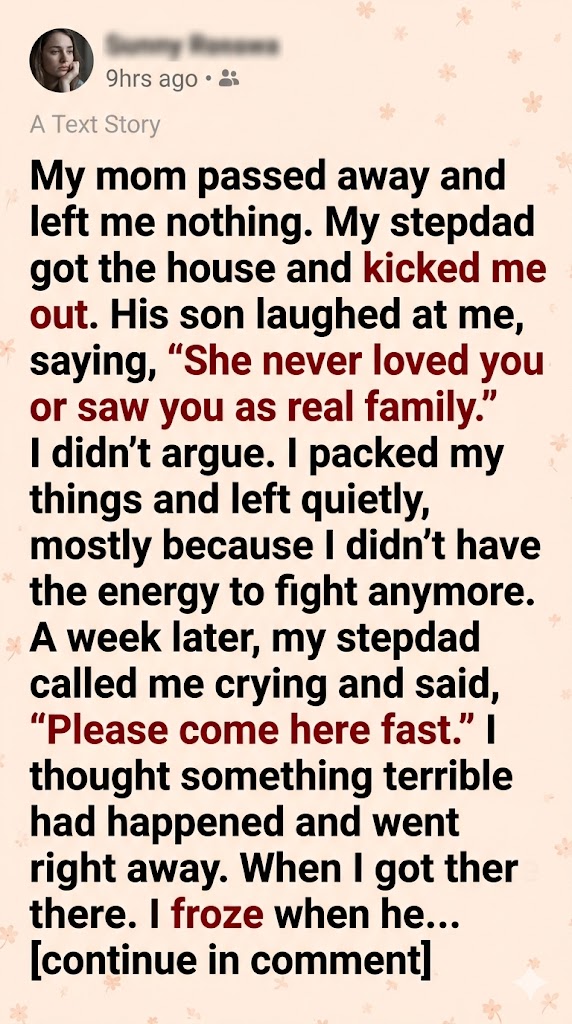
At the reading of the will, I sat quietly at the edge of the table, hands folded, trying not to expect anything. I told myself I wasn’t there for money or possessions. I just wanted something that said I still belonged. But when the lawyer finished reading, everything went to my stepfather. Every asset, every account, every piece of the home she had built. There was nothing left for me. Before I could even ask a question, my stepfather stood up and told me I had a week to leave. His son didn’t bother hiding his satisfaction, leaning back in his chair and saying I had never really been family anyway. I didn’t argue. I didn’t even cry in front of them. I just nodded, as if I understood something I didn’t, and went back to pack my things.
Packing felt like erasing myself. Each box I filled was a reminder that my life there could be reduced to objects—clothes, books, a few photographs I wasn’t even sure I had the right to take. No one helped me. No one asked if I was okay. Grief had already taken my mother, and now it felt like it was taking my place in the house too. I left without looking back, carrying only a small bag and more questions than I could count. On the bus ride away, I kept replaying everything I remembered about her, trying to figure out where I had gone wrong. Had I misunderstood her love? Had I imagined the bond I thought we shared?
The days that followed were the hardest. I stayed on a friend’s couch, sleeping lightly, waking up in the middle of the night with the same thoughts circling in my head. I started questioning every memory—birthdays, dinners, quiet conversations in the kitchen. I needed proof that I mattered to her, but the more I searched my mind, the more uncertain I became. Then, a week later, my phone rang. It was my stepfather. His voice was different—no arrogance, no confidence. It was unstable, almost panicked. He told me to come back to the house immediately. No explanation. Just urgency.
When I arrived, the atmosphere felt different again. He was sitting on the edge of my mother’s bed, shoulders slumped, looking like a man who had lost something far deeper than control. Without speaking, he handed me a small metal box. It was old, scratched, and locked. He said he had found it hidden behind the dresser while going through her things again. My hands shook as I opened it, not because of what I expected, but because I didn’t know what I was about to face.
Inside were letters. Dozens of them. All addressed to me. All in my mother’s handwriting. Beneath them were small personal items she had clearly set aside, along with an envelope of money I barely registered at first. I picked up the top letter, opened it, and began to read. And just like that, the room around me disappeared.
Her words were not rushed or dramatic. They were calm, deliberate, and deeply certain. She wrote about watching me grow, about moments she thought I hadn’t noticed—times I stayed kind when it would have been easier not to, times I stayed close when others drifted away. She wrote that she had known this moment might come, that grief sometimes changes people in ways they don’t expect, and that she had been afraid I might be pushed out of the life she wanted me to remain part of. So she had prepared for it in silence.
Letter after letter, she spoke to me as if she were still sitting beside me. She told me I was seen. That I had always been seen. That family, to her, was not defined by documents, inheritance, or approval from others, but by presence, care, and truth. In one letter, she wrote something I read more than once because I couldn’t believe how simple and absolute it was: “You are my child. Nothing can change that. Not time. Not death. Not them.”
By the time I reached the final letter, I was crying so hard I had to pause between lines. But it wasn’t the same kind of grief I had felt before. It wasn’t emptiness. It wasn’t confusion. It was recognition. For the first time since she died, I wasn’t trying to earn a place in her life—I was being reminded that I already had one that could not be taken away.
My stepfather spoke quietly afterward. He didn’t try to justify what he had done. He only admitted that he had acted out of anger and confusion, and that he had not looked closely enough at what she had left behind. His apology didn’t fix anything, and I didn’t know if it ever would. But in that moment, it didn’t matter as much as the letters still in my hands.
When I left the house again, I didn’t feel like I was being erased anymore. I felt like I was carrying something permanent. Not property. Not money. Something far more difficult to lose. Her words stayed with me long after the ink faded from the paper, becoming something I returned to whenever doubt crept in again. Because what she left behind wasn’t just a hidden truth in a metal box.
It was proof that I had never been forgotten.
