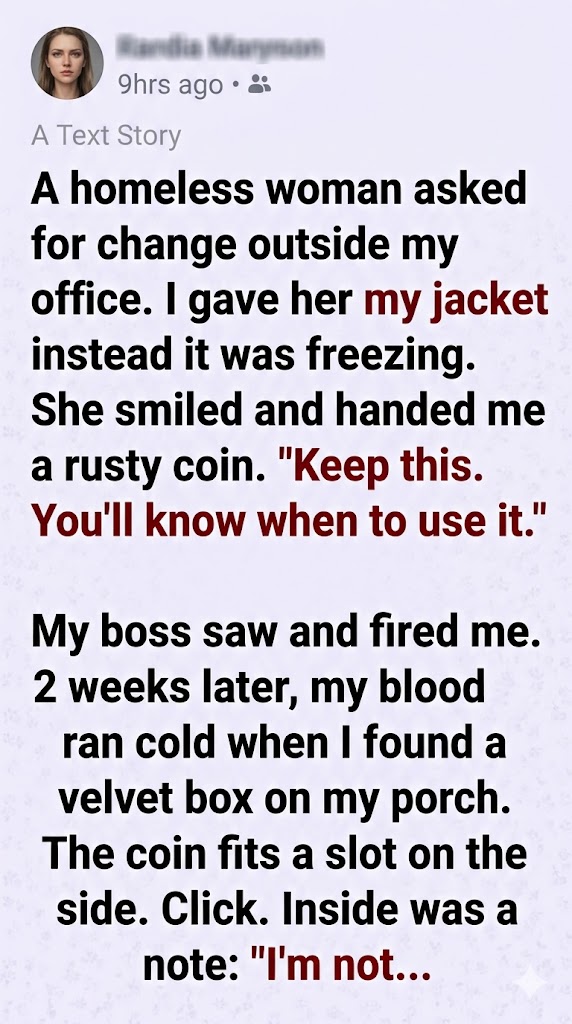
The morning I gave away my jacket didn’t feel important at the time. It wasn’t a decision I weighed carefully or something I expected to remember beyond the day itself. It was just cold—one of those sharp, unforgiving mornings where the wind doesn’t just pass by you but cuts through you, settling into your bones. The kind of cold that makes even a short walk feel like a test of endurance. I had left my apartment in a rush, like always, thinking more about deadlines than the weather. By the time I reached the glass entrance of our office building, my fingers were already stiff despite being tucked into my sleeves. That’s when I saw her. She was sitting just to the side of the revolving doors, pressed against the polished marble wall as if it might hold onto some leftover warmth from the building behind it. People passed her constantly—some glancing briefly, most not looking at all. I slowed down without meaning to. It wasn’t unusual to see someone there, but something about her made it harder to walk past. Maybe it was the way she wasn’t asking loudly or drawing attention. When she spoke, her voice was quiet, almost careful. “Spare some change?” she asked. It didn’t sound like a demand. It sounded like a routine she had repeated too many times to expect much from anymore.
I instinctively reached into my coat pocket, expecting to find a few coins or a bill folded somewhere. But my fingers came up empty. I checked again, slower this time, as if something might appear if I gave it another second. Nothing. “I’m sorry,” I said, already shifting my weight as if to continue walking. That should have been the end of it. That’s how those moments usually go—brief, forgettable, filed away without much thought. But I didn’t move. Something held me there. I noticed her hands next. They were trembling slightly, not dramatically, but enough to catch my attention. No gloves. Just bare skin exposed to the cold. Then I noticed her sweater—thin, worn, clearly not meant for that kind of weather. And then her eyes. They weren’t pleading or desperate. They were steady, almost observant, like she was watching everything without expecting anything. That’s what made it harder to leave. I looked down at my jacket, then back at her. I knew I’d be waiting outside for the bus anyway. Ten minutes, maybe fifteen. It wouldn’t kill me. Before I could overthink it, I slipped the jacket off my shoulders and held it out to her. “You should take this,” I said. “At least until it warms up.” She hesitated, clearly unsure. “I couldn’t,” she said softly. “You can,” I replied. “I’ll be fine.” Slowly, she reached out and took it. Her fingers brushed mine—cold enough to make me flinch slightly. Then she smiled. Not exaggerated. Not overly grateful. Just genuine.
From her hand, she placed something into mine. A coin. Old, worn, rusted around the edges. I looked down at it, confused. “Keep this,” she said. “You’ll know when to use it.” I frowned, turning it between my fingers. “I think you need it more than I do,” I said. She shook her head once, firmly. “No,” she replied. “It’s yours now.” Before I could ask anything else, the office doors behind me opened sharply. The sudden warmth from inside spilled out, along with a voice I recognized immediately. “Are you serious?” I turned to see my boss, Mr. Harlan, standing there. His coat was immaculate, his expression anything but. He looked from me to the woman, then back again with visible irritation. “We work in finance,” he said, his tone clipped and cold. “Not a charity.” I tried to explain, but he didn’t give me the chance. “Clients don’t want to see this,” he continued. “It reflects poorly.” “I was just—” “Don’t,” he cut in. “Clear your desk. Effective immediately.” For a second, I thought I had misheard him. The words didn’t make sense in the moment. Fired. Just like that. Over a jacket. Over a decision that had taken less than a minute. The woman looked up at him, her expression unreadable, but he didn’t acknowledge her at all. He turned and walked back inside without another word. I stood there, still holding the coin, trying to process what had just happened. My job—gone. My jacket—gone. My routine—gone. “I’m sorry,” the woman said quietly. I shook my head, though I wasn’t sure what I was responding to. “It’s not your fault,” I said. “I guess I should’ve known better.” She looked at me steadily. “No,” she said. “You knew exactly what you were doing.”
The next two weeks felt longer than the previous two years of my life. Losing a job unexpectedly does something to your sense of stability that’s hard to describe until it happens. It’s not just the income—it’s the structure, the routine, the quiet reassurance that tomorrow will look somewhat like today. Without it, everything feels uncertain. I spent hours each day applying for positions, rewriting my resume, sending emails that felt like they disappeared into nothing. Responses were rare, and when they came, they were brief and impersonal. My savings started to shrink faster than I expected. Each day carried a quiet pressure that built slowly but steadily. I replayed that morning more times than I could count. Not with regret exactly, but with questions. Had it been worth it? Would I do it again? The answer never came clearly. It wasn’t simple anymore. Then, one morning, something changed. I opened my apartment door to collect the mail, expecting the usual stack of bills and advertisements. Instead, there was a small box sitting just outside the door. Velvet. Dark, clean, deliberate. No shipping label. No return address. No note. Just placed there as if it had been waiting for me specifically.
I brought it inside carefully, my mind already racing through possibilities that didn’t make much sense. The box felt heavier than it looked. Not heavy in a physical way, but in a way that suggested importance. On the side, there was a narrow slot—unusual, almost out of place. I stared at it for a long moment before something clicked in my mind. The coin. I went to the drawer where I had left it, unsure why I had kept it in the first place. It felt strange in my hand again—cold, worn, oddly significant now. I returned to the box and held the coin over the slot. For a second, I hesitated. Then I slid it in. A soft click followed. The lid opened. Inside was a folded card and a sealed envelope. I picked up the card first, unfolding it slowly. The message was simple, direct. I’m not homeless. I’m a CEO. I test people. My heart started to race, the words settling in slowly. You gave a stranger warmth when you had nothing to gain. Most people look away. Some offer money. Very few give something that costs them. I stared at the sentence for longer than I expected, reading it again to be sure I understood. Then I opened the envelope. Inside was a formal letter—an offer. A position I had never imagined applying for. A salary that felt unreal compared to what I had been earning before. For a moment, I thought it had to be a mistake. But everything about it was precise, official, intentional. At the bottom, one line stood out. Welcome to your new life. You start Monday.
When Monday came, I stood in front of a building that made my old office look small by comparison. Glass, steel, and height that seemed designed to impress before you even stepped inside. The receptionist greeted me as if she had been expecting me all along. “She’s waiting for you,” she said with a knowing smile. I followed the directions she gave, my thoughts still catching up with reality. When I entered the boardroom, she was already there. The same woman. But different. Not in her face or her expression, but in everything around her. A tailored suit. Confidence that filled the room without effort. She turned toward me and smiled—the same calm, steady smile I remembered from that morning outside my old office. “You kept the coin,” she said. I nodded. “I almost didn’t,” I admitted. She seemed unsurprised. “Most people wouldn’t,” she replied. “That’s how I knew.” I thought about everything that had happened—the cold, the decision, the job I lost, the uncertainty that followed. “You didn’t just change my job,” I said slowly. “You changed how I see people.” She held my gaze for a moment, then nodded slightly. “Good,” she said. “Then the test worked.” And in that moment, standing in a place I had never imagined being, I understood something I hadn’t before. The value of a decision isn’t always clear when you make it. Sometimes it takes time, loss, and uncertainty before it reveals what it truly meant. But when it does, it changes more than just your circumstances. It changes how you see everything that comes after.
