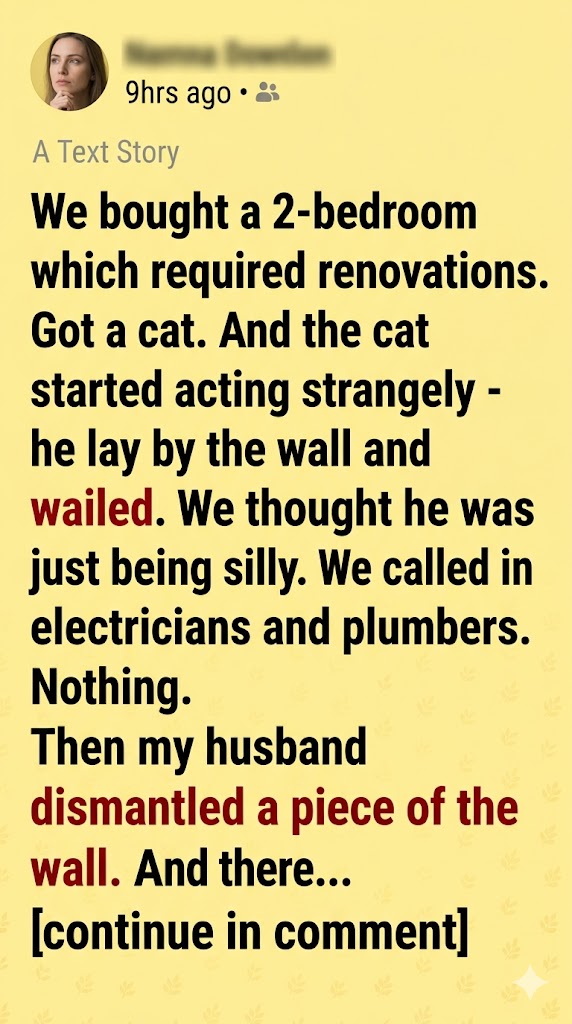
We bought a 2-bedroom which required renovations. It was a charming, slightly crooked terrace house in a quiet corner of Bristol, the kind of place that had “character” written all over its peeling wallpaper and creaky floorboards, but also a strange stillness—as if it had been waiting far too long for someone to notice it properly. My husband, Callum, and I had spent every penny of our savings on the deposit, knowing we’d have to do most of the work ourselves. We weren’t afraid of a bit of dust and sweat; we were young, optimistic, and ready to turn this tired old house into a home.
To make the transition easier, we decided it was finally time to get a pet. We adopted an orange tabby from a local shelter and named him Marmalade. He was a sweet, chunky thing who usually spent his days chasing sunbeams or sleeping on top of the radiator, completely unbothered by the world. But after we moved into the new place, something in him shifted almost immediately—like the house had spoken to him in a language we couldn’t hear. The cat started acting strangely—he lay by the wall in the hallway and wailed.
It wasn’t a normal meow for food or attention. It was a low, mournful sound that seemed to vibrate through the very floorboards, as though it was coming from deeper than his throat—maybe even deeper than the house itself. He would sit perfectly still, staring at a specific patch of drywall near the pantry, and let out these long, haunting cries at three in the morning, when the house felt most alive in its silence. We thought he was just being silly, or perhaps he was still adjusting to the new smells and sounds of an old building that had settled its own rhythms long before we arrived.
We called in electricians and plumbers, thinking there might be a buzzing wire or a dripping pipe that Marmalade could hear and we couldn’t. The electrician checked the sockets and the fuse box, but he found absolutely nothing out of the ordinary—no faults, no hidden currents, nothing that explained the cat’s obsession. The plumber crawled into the crawlspace and poked around the pipes, declaring everything bone-dry and silent, almost eerily so for a house this old. “Maybe he just likes the acoustics in that spot,” the plumber joked as he packed up his tools, but neither of us laughed.
But Marmalade didn’t stop. In fact, his behavior grew more intense, as though something behind that wall was calling to him more urgently each night. He started refusing to eat in the kitchen, preferring to drag his bowl into the hallway so he could keep his eyes locked on that exact section of plaster. His fur would stand on end for no reason, and he’d hiss at the air itself, as if something invisible had brushed past him. Callum and I were exhausted from the lack of sleep and the growing sense of unease that seemed to settle over the house like a heavy fog that refused to lift.
Read Also: The Quiet Kindness That Changed Everything
Finally, last Saturday, Callum reached his breaking point. He grabbed his crowbar and a hammer, looking at the wall with a mixture of frustration and something closer to dread than anger. “If the cat won’t shut up, I’m going to find out exactly what’s behind there,” he muttered, mostly to himself, though I could hear the tension in his voice. He carefully began to pry away the skirting board, expecting to find a dead mouse or maybe a nest of squirrels that the previous owners had somehow missed—but part of me already knew it wasn’t going to be anything ordinary.
Then my husband dismantled a piece of the wall. And there, tucked into a narrow, hollow space between the studs that shouldn’t have existed at all, was something that made both of us stop breathing at the same time. It wasn’t a pest or a broken pipe. It was a meticulously wrapped bundle of old, oilcloth-wrapped packages, hidden deep within the structure of the house as if it had been placed there with deliberate secrecy—and forgotten on purpose.
My heart was hammering against my ribs as Callum reached in and pulled the first package out. It was heavier than it looked, and the scent of old paper, dust, and something faintly metallic drifted up as if it had been sealed away from another century entirely. We sat on the dusty floor of the hallway, the cat finally silent now—watching us with unsettling calm—as we unwrapped the history of our home layer by layer, feeling like we were crossing a line we couldn’t uncross. Inside the first package was a collection of letters and a small, leather-bound diary dated back to the 1940s.
The second package contained something even more startling: a collection of high-quality silver coins and several pieces of antique jewelry, carefully wrapped as though they were meant to survive something far worse than time. But it wasn’t a “treasure” in the way people usually think. As I started reading the diary, the true story of the house began to unfold in fragments that felt strangely alive in my hands. The entries were written by a woman named Elspeth, who had lived in the house during the Blitz.
Read Also: “When My Mother-in-Law Controlled Everything—And My Husband Didn’t Stop Her”
She had hidden these items not because she was a thief, but because she was terrified of losing everything she loved during the air raids that turned nights into chaos. She wrote about her husband, a man named Arthur, who was away at sea, and how she wanted to keep their family heirlooms safe in case the house was hit or burned beyond recognition. The diary entries were full of hope and fear, sometimes within the same sentence, a window into a life that felt disturbingly close to our own—like we were only separated by time, not experience.
As I reached the final pages of the diary, I realised Elspeth didn’t die in a bombing; she had survived the war, but she had moved away suddenly in 1946, almost as if she had been chased by something unseen. She mentioned a “secret trust” she had left for the “future keepers of the hearth,” as though she knew someone would one day break into the silence she had built. She wrote that she had left a specific clue for those who had the “ears to hear the silence.” I looked at Marmalade, who was now purring softly, rubbing his head against the open cavity in the wall as if he recognised it.
I realized that the cat hadn’t been wailing at a ghost or a sound. He had been reacting to a small, hidden mechanism—a tiny, wind-driven chime that Elspeth had rigged behind the wall with almost obsessive precision. When the draft from the old vents hit it just right, it emitted a frequency that was nearly inaudible to humans but clearly drove Marmalade to distraction, as if it were calling something in him awake. It was a literal alarm bell designed not for danger—but for discovery, waiting for someone who lived in the house long enough to notice what others would ignore.
But the rewarding conclusion wasn’t just the silver or the jewelry. As we dug deeper into the hollow space, our hands shaking now with anticipation rather than fear, we found a third, smaller package tucked into the furthest corner like it had been meant to remain unseen forever. Inside was a legal deed to a small plot of land on the coast of Cornwall that had been tied to the property for decades but quietly forgotten by the modern land registry. Elspeth had ensured that whoever found her hidden cache would also find a way to escape the city, just as she had once dreamed of doing with Arthur.
We spent the rest of the weekend researching the lineage of the house. It turned out Elspeth had no living heirs, and the “secret trust” she had mentioned was a legitimate legal clause buried in the original title deeds, waiting like a dormant secret. Because we had “dismantled the wall of silence,” as the old legal jargon put it, the land in Cornwall was officially ours. It was a small piece of wild, beautiful coastline that we could never have afforded in a thousand years, as if the house had decided to reward curiosity itself.
Read Also: When The World Feels Cold, These Quiet Acts Of Kindness Prove Humanity Still Burns Bright
We didn’t sell the jewelry or the silver; we kept them as a reminder of the woman who had cared so much for the future of her home that she turned it into a time capsule of trust. We used the land in Cornwall to build a small eco-cabin, a place where we could go to escape the stress of our renovations and the strange echoes of the past. Marmalade loves the cabin; there are plenty of actual birds to watch and no hidden chimes to make him wail in the middle of the night.
I realized then that houses aren’t just bricks and mortar; they are containers for the lives that came before us, quietly holding onto stories we don’t immediately understand. Sometimes, the “problems” we find during a renovation—the creaks, the groans, and the strange behavior of our pets—are actually invitations to look a little closer at the history we are stepping into before we cover it up forever. Elspeth hadn’t just left us a treasure; she had left us a connection to a past that was filled with the same dreams and anxieties we have today, just waiting beneath the surface.
The most important thing I learned is that you should never ignore your intuition, even if it comes in the form of a cat crying at a wall in the dead of night. We often dismiss the things we don’t understand as “silly” or “annoying,” but there is usually a reason behind the chaos that only reveals itself when you finally pay attention. If we hadn’t listened to Marmalade, we would have plastered over that wall and never known that our lives were about to change forever.
Trust the signs, even the ones that keep you awake at three in the morning. Life has a way of hiding its best gifts in the places we least expect to find them, and sometimes you have to break down a few walls to see the beauty that’s been waiting for you all along. Our house isn’t just a 2-bedroom fixer-upper anymore; it’s a sanctuary of secrets and second chances.
