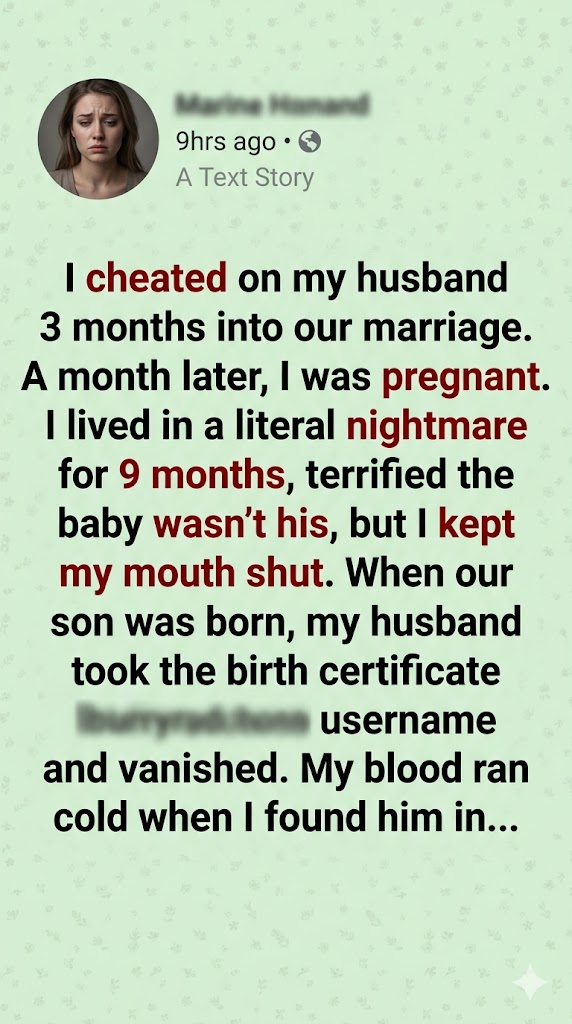
I betrayed my husband just three months into our marriage.
Even now, writing those words makes my chest tighten.
It wasn’t some grand love story or emotional escape. It was a mistake—impulsive, selfish, and over before it even meant anything. The kind of mistake you convince yourself you can bury deep enough that it never sees the light of day again.
So I buried it.
Or at least, I tried.
A month later, I found out I was pregnant.
I remember staring at the test in the bathroom, my hands trembling so badly I nearly dropped it. My first instinct should have been joy. We had talked about having kids someday. We had imagined it together—laughed about baby names, argued over whose eyes our child would inherit.
But all I felt was terror.
Because I didn’t know whose baby I was carrying.
From that moment on, my life became a silent, suffocating nightmare.
For illustrative purposes only
For nine months, I lived in constant fear. Every doctor’s appointment, every ultrasound, every gentle touch from my husband felt like a blade of guilt cutting deeper into me. He was so happy. So proud. He would rest his hand on my growing belly and smile in a way that made my stomach twist with shame.
“You’re going to be such a great mom,” he’d say.
And I would smile back, pretending I deserved those words.
At night, when he slept peacefully beside me, I would lie awake, staring at the ceiling, imagining the future crashing down around us. I rehearsed confessions in my head a thousand times—but I never said them out loud.
I told myself I was protecting him.
The truth? I was protecting myself.
Then the day came.
Our son was born on a quiet morning, after hours of labor that felt both endless and fleeting. When I finally held him in my arms, everything else disappeared. He was perfect. Tiny, warm, breathing softly against my chest.
For one brief moment, the fear vanished.
Maybe it didn’t matter, I thought. Maybe love would be enough.
My husband stood beside me, tears in his eyes as he looked down at our child.
“He’s beautiful,” he whispered.
I watched him carefully—too carefully. Searching for something. Doubt. Suspicion. Anything.
But there was nothing.
Just love.
For illustrative purposes only
Later that day, he offered to handle the paperwork.
“I’ll take care of the birth certificate,” he said with a reassuring smile. “You just rest.”
I nodded, grateful for the chance to avoid thinking any further.
But then he disappeared.
At first, I didn’t think much of it. Hospitals are busy places. Time blurs. But as the hours passed, a quiet unease began to creep in.
By the next morning, that unease had turned into dread.
I found him in the hallway outside the maternity ward.
He was standing by the window, completely still, as if the world had paused around him. In his hands was a small envelope, already opened.
Something inside me shattered.
My legs felt weak as I walked toward him.
“Where have you been?” I asked, my voice barely steady.
He didn’t answer right away.
Instead, he slowly turned to face me.
I saw it then—the truth. Not in the paper, but in his eyes. A quiet, aching understanding that made my heart stop.
“You… you did a test?” I whispered.
He nodded once.
My blood ran cold.
The hallway suddenly felt too narrow, too bright. I couldn’t breathe.
“I can explain,” I rushed out, panic rising in my chest. “It was a mistake—I didn’t mean for—”
He raised his hand gently, stopping me.
Then he looked down at the paper.
And without reading a single word, he began to tear it.
Slowly.
Deliberately.
The sound of paper ripping echoed louder than it should have in that empty hallway. Piece by piece, he reduced it to nothing, letting the fragments fall to the floor like snow.
I stared at him, completely frozen.
“What are you doing?” I whispered.
For illustrative purposes only
He looked back at me—his expression calm, but his eyes filled with something I couldn’t quite name. Pain, yes. But also something stronger.
Something steadier.
“I know,” he said quietly.
The words hit me harder than any accusation ever could.
“I know you cheated.”
My throat closed. Tears blurred my vision instantly.
“I’m so sorry,” I choked. “I was going to tell you, I just—I was scared—”
“I know,” he repeated.
Then he took a step closer.
His voice softened, but it didn’t lose its strength.
“But I forgive you.”
I shook my head, unable to understand. Unable to accept what I was hearing.
“You don’t even know what the result says,” I whispered.
He looked down briefly at the torn pieces on the floor, then back at me.
“I don’t need to.”
There was a long pause.
And then he said the words that changed everything:
“He’s mine… because I say he is.”
I broke then.
Completely.
Not because I was relieved.
But because I realized the weight of what he was giving me.
Not ignorance.
Not denial.
But a choice.
A choice to love. To stay. To claim a child without certainty—because, to him, being a father wasn’t about biology.
It was about commitment.
And in that moment, standing in a quiet hospital hallway surrounded by the pieces of a truth he refused to let define us, I understood something I never had before:
Forgiveness isn’t weakness.
Sometimes, it’s the strongest, most heartbreaking kind of love there is.
