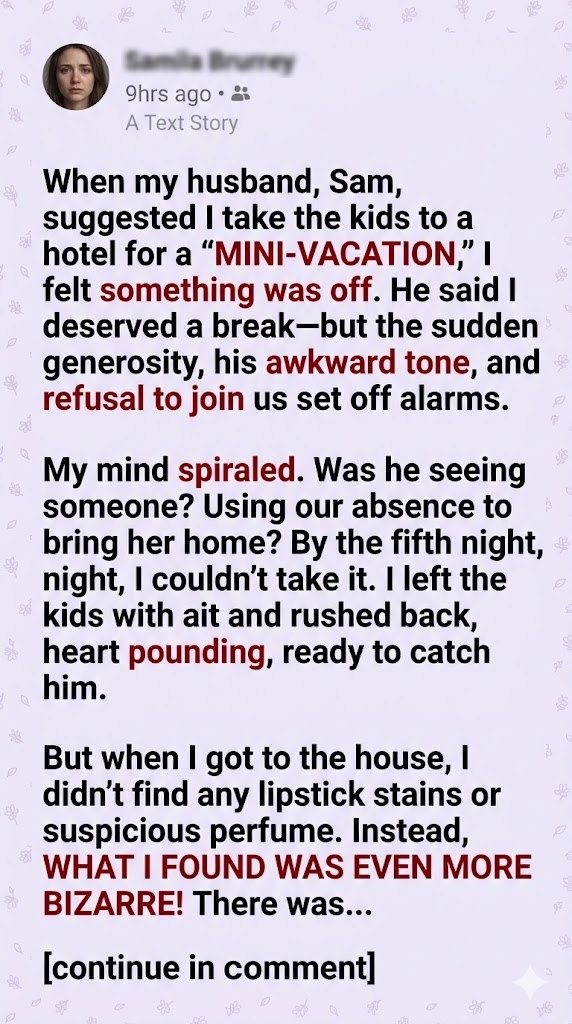
At first, I thought the story was simple. A husband acting distant. A sudden “gift” of a hotel stay for me and the kids. A gut feeling that something didn’t add up. I assumed the usual worst-case scenario—another woman, a secret life, a betrayal hiding in plain sight. I was ready to catch him, ready to confront him, ready to have my world collapse in a way I at least understood. But what I walked into was something far more corrosive than infidelity. It was control. It was lifelong conditioning. And it was a man who had already chosen who he belonged to—and it wasn’t me or our children.
The first few days at the hotel felt like borrowed peace. The kids treated it like an adventure—ice cream before dinner, swimming until their fingers wrinkled, cartoons on demand. I tried to smile through it, but every night, when the room went quiet, my thoughts grew louder. Sam didn’t call often. When he did, his voice was distracted, clipped, like he was speaking from another life I wasn’t part of.
By the fourth night, I couldn’t ignore it anymore. The excuses, the distance, the carefully avoided video calls. It all pointed in one direction in my mind: someone else.
I told myself I was just going home to confirm it. To end the guessing. To take control of whatever came next.
But I wasn’t prepared for what control actually looked like in my house.
The moment I stepped inside, the air felt wrong. Too clean. Too staged. Then I saw her—my mother-in-law, Helen—sitting in my living room like she had been waiting for me her entire life. My home had been rearranged around her presence. Bags lined the walls. Her perfume clung to the furniture like ownership.
And Sam… he wasn’t surprised enough. That was the worst part.
He stood there like a child caught between two punishments, unable to choose a side, already knowing which one he would obey.
Helen didn’t even acknowledge me as a disruption.
“You’re back early,” she said calmly, as if I had interrupted her routine.
That was the moment something in me shifted. Not exploded. Not collapsed. Shifted. Quietly. Permanently.
Because I finally understood—I hadn’t been sent away for a vacation. I had been removed so someone else could move in.
That night, I didn’t sleep. I listened instead.
The house had always felt like mine—our first home, built with shared decisions and small sacrifices. But now I heard footsteps that didn’t belong to me. I heard a kitchen that wasn’t being used the way I taught it to be used. And I heard Helen’s voice weaving through everything like she had rewired the walls.
“You let her think she has authority here,” she said sharply at one point.
Sam’s voice followed, smaller than I had ever heard it. “Mom, it’s not like that.”
But it was like that. And he knew it.
Then came the words that ended whatever illusion I still had left.
“I raised you,” Helen said. “Not her. Remember that.”
And Sam answered, almost obediently, “I know.”
No argument. No defense. No hesitation.
Just surrender.
That was the moment I stopped being a wife in my own mind.
The next morning, I became something else entirely.
I smiled at breakfast. I kissed Sam’s cheek. I told Helen I might extend the hotel stay because “the kids were enjoying it so much.” She looked pleased in a way that made my stomach turn—like I had finally become manageable.
Sam looked relieved.
Neither of them noticed I was already gone inside.
Because while they assumed I was retreating again, I was actually planning an exit.
Not emotional. Not dramatic.
Final.
What followed wasn’t chaos. It was precision.
I met a lawyer before lunch. I didn’t cry—I took notes. I asked questions about custody, financial separation, documentation. I learned what I needed to protect my children from being raised in a home where one parent had already surrendered to another authority.
Then I went to the bank. Then I transferred what I needed to transfer. Then I secured what needed securing.
By the time I returned to the hotel that evening, I wasn’t a woman reacting anymore.
I was a woman executing a decision.
Three days later, I moved out.
Quietly. Efficiently. While Sam was at work and Helen was rearranging my kitchen for what she clearly believed would be permanent residence.
There was no dramatic confrontation. No shouting match. No begging.
Just a note left on the counter.
“You chose your mother’s voice over ours. I am choosing peace over both.”
And I meant it.
By the time Sam returned home, the house was already hollowed out of everything that belonged to me and the children.
He called me immediately.
His voice cracked in disbelief. “Cindy, what did you do?”
For the first time in years, I didn’t soften my tone.
“I left.”
The days that followed were a strange kind of silence.
Sam called repeatedly. First angry, then confused, then desperate. Helen, I learned through neighbors, acted as if nothing had changed. She unpacked groceries. She organized drawers. She treated my absence like a temporary inconvenience.
But what she didn’t understand was simple.
I didn’t leave because of one argument.
I left because I finally saw the pattern.
And patterns don’t change just because people panic.
The truth came fully into focus in small moments.
The neighbor mentioning Helen “settling in.”
The way Sam never once told her to leave.
The way every boundary I ever tried to set had been quietly overwritten by her influence.
This wasn’t a surprise visit.
It was a takeover that had been building slowly for years.
And I had just been the last person to accept it.
Two weeks later, Sam showed up at my new apartment.
He looked different. Tired. Smaller somehow.
“I kicked her out,” he said immediately. “I told her she can’t interfere anymore. Please, Cindy. Come back.”
I almost believed him.
Almost.
But then I remembered something important: he only acted when he lost control of both sides.
And I wasn’t a side anymore.
I was gone.
Still, I didn’t slam the door. I didn’t shout. I simply looked at him and said, “You didn’t choose us when it mattered. You only chose us when you were afraid of losing us.”
He had no answer for that.
Life didn’t suddenly become easy after that.
There were hard days. Confusing ones. Nights when the kids asked questions I didn’t have perfect answers for.
But something unexpected happened too.
Peace returned in small pieces.
No tension in the kitchen.
No walking on eggshells.
No silent approval I had to earn.
Just space.
Real space.
Months later, I ran into Helen’s presence again—indirectly.
A neighbor mentioned she was still living in the house, as if nothing had changed. Still treating it like hers. Still operating under the belief that influence was ownership.
But I didn’t feel anger anymore when I heard it.
Just clarity.
Some people don’t leave control because they never learned to question it.
And some people leave because they finally do.
One evening, my daughter asked me something simple while brushing her hair.
“Mom, are we okay now?”
I thought about the question carefully before answering.
“We’re safe now,” I said. “That’s better than okay.”
And for the first time in a long time, I meant it without hesitation.
Because leaving wasn’t the end of our family.
It was the moment I finally started protecting it.
