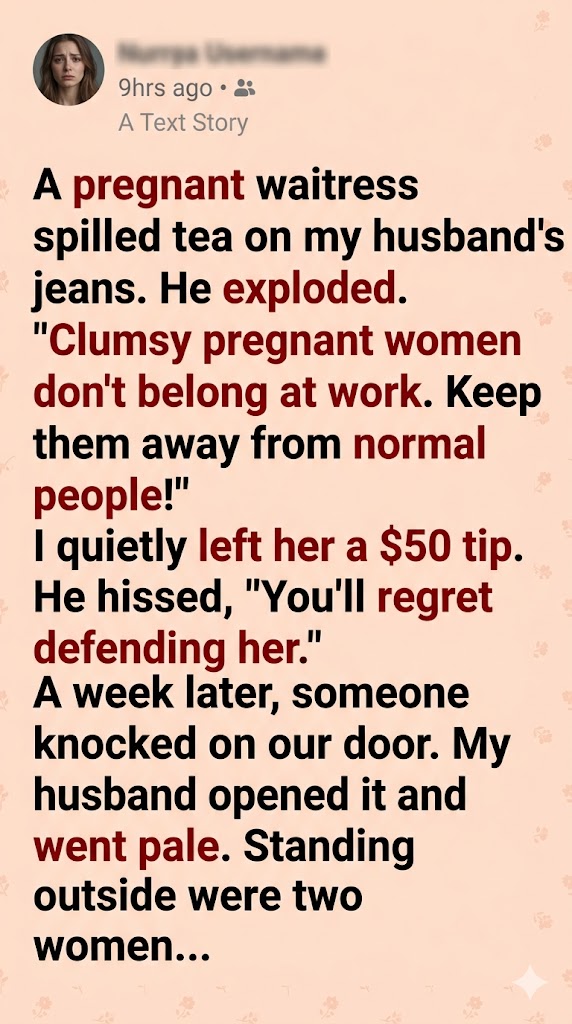
The restaurant had been warm and softly lit, the kind of place where conversations drifted gently over the clinking of glasses and the low hum of background music. It was supposed to be an ordinary evening—just dinner, a break from routine, a moment to reconnect after a long week. My husband sat across from me, scrolling briefly through his phone before setting it aside, his expression already carrying the tension he often brought with him from work. I had learned to read those small signs over the years, the tightening of his jaw, the impatience in his movements. Still, I tried to keep things light, asking about his day, sharing small details about mine. When the waitress approached, she carried herself carefully, one hand resting protectively against her stomach. She was visibly pregnant, her movements slower but deliberate, her smile polite despite what looked like exhaustion behind her eyes. She greeted us warmly, took our order, and left with a quiet efficiency that suggested she had done this countless times before. Nothing about the moment seemed unusual—until she returned with our drinks.
It happened in an instant. As she reached to place the teacup down, her hand slipped slightly, and the liquid spilled forward, splashing onto my husband’s jeans. It wasn’t a large amount, not enough to cause real harm, but enough to leave a visible stain. The waitress froze, her face draining of color as she immediately began apologizing. “I’m so sorry,” she said, her voice trembling slightly as she reached for napkins. But before she could say anything more, my husband stood up abruptly, his chair scraping loudly against the floor. His reaction was immediate and explosive, far out of proportion to the situation. “Clumsy pregnant women don’t belong at work,” he snapped, his voice cutting through the room and drawing the attention of nearby tables. “Keep them away from normal people!” The words hung in the air, heavy and sharp, and for a moment, everything else seemed to fall silent. The waitress looked stunned, her hands shaking as she tried to clean the spill, her eyes fixed downward as if avoiding the weight of his anger. I felt something twist inside me—not just embarrassment, but something deeper, something closer to disbelief.
I reached into my purse quietly, pulling out a folded bill and placing it gently on the table near her. “It’s okay,” I said softly, meeting her eyes just long enough to offer reassurance. She nodded slightly, though it was clear the moment had already left its mark. My husband leaned closer to me then, his voice low but laced with irritation. “You’ll regret defending her,” he hissed, as if my small act of kindness had somehow betrayed him. I didn’t respond. There are moments when words feel unnecessary, when silence carries more weight than any argument could. We left shortly after, the atmosphere too strained to continue the evening as planned. The drive home was quiet, the kind of silence that isn’t peaceful but tense, filled with things left unsaid. I stared out the window, replaying the scene in my mind—not the spill, but the reaction. It lingered with me long after we walked through the front door, settling into a space I couldn’t quite ignore.
The days that followed moved forward as they always did, filled with routine and responsibilities, but something had shifted. I found myself thinking about the waitress more often than I expected—about the look on her face, the way she had tried to remain composed despite the humiliation. I wondered what her life was like beyond that brief interaction. Whether she had support, whether she had a choice in working while pregnant, whether she had gone home that night carrying more than just physical exhaustion. Meanwhile, my husband seemed unaffected, as though the incident had been insignificant, already forgotten. That contrast unsettled me more than anything else. It revealed a difference in perspective that I hadn’t fully acknowledged before. A week passed, and though life continued outwardly unchanged, that moment lingered quietly beneath the surface, waiting.
Then, exactly one week later, there was a knock at our door.
It was late afternoon, the light outside beginning to soften as the day edged toward evening. My husband was the one who answered it, walking over casually, expecting nothing out of the ordinary. But the moment he opened the door, everything changed. I watched from a distance as his posture stiffened, his expression draining of color almost instantly. Something about the sight in front of him had caught him completely off guard. I stepped closer, curiosity pulling me forward, and that’s when I saw them—two women standing side by side. One of them was the waitress. Her presence was unmistakable, though now she looked more composed, more certain. Beside her stood another woman, older, dressed neatly, holding a folder in her hands. There was a quiet authority in the way she carried herself, a calm confidence that suggested she hadn’t come unprepared.
The older woman spoke first, her tone measured and professional. She introduced herself as the restaurant’s manager—and also the owner. Her connection to the waitress became clear quickly; she was her mother. The reason for their visit unfolded with careful clarity. The incident at the restaurant had not been dismissed or forgotten. Multiple customers had witnessed what had happened, and one of them had recorded the exchange on their phone. The video had been shared, spreading further than anyone might have anticipated. It wasn’t just about a spilled drink anymore—it had become something larger, something that reflected not just on a single moment, but on behavior, on values, on how people choose to treat others in vulnerable situations. The manager explained that while they had no intention of escalating things unnecessarily, they believed it was important to address what had happened directly. Not out of anger, but out of a desire for accountability.
My husband tried to respond, but his words lacked the certainty they usually carried. The confidence that had fueled his reaction that night was gone, replaced by something closer to discomfort. He attempted to minimize the situation, to frame it as a misunderstanding, but the presence of evidence—and the quiet strength of the two women standing before him—made that difficult to sustain. The waitress spoke then, her voice steady despite the emotion behind it. She explained how that moment had affected her, not just as an employee, but as a person. How words, once spoken, don’t simply disappear. How they stay, shaping the way someone feels long after the moment has passed. There was no accusation in her tone, only honesty. And somehow, that made it more powerful.
What followed wasn’t dramatic or confrontational in the way one might expect. There were no raised voices, no arguments that spiraled out of control. Instead, there was a conversation—uncomfortable, necessary, and deeply revealing. My husband listened in a way I hadn’t seen before, not because he wanted to, but because he had to. The situation left no room for dismissal, no space to retreat into denial. And in that space, something began to shift. Not instantly, not completely, but enough to be noticed. He apologized—not in the hurried, dismissive way people sometimes do to move past discomfort, but more slowly, more deliberately. Whether it was enough, whether it came too late, was something only time could answer.
After they left, the house felt different. Quieter, but not in the same way as before. There was a weight to that silence, but also a clarity. Moments like that don’t just pass—they linger, they reshape, they reveal things that might otherwise remain hidden. For me, it became a turning point, not just in how I saw that evening, but in how I saw the person I had built my life with. It forced questions I hadn’t fully asked before, about empathy, about respect, about the kind of behavior that defines someone when they think no one is watching. The unexpected visit had brought consequences, yes—but it had also brought truth. And sometimes, truth arrives not to punish, but to give us a chance to change, to reflect, and to decide who we want to be moving forward.
