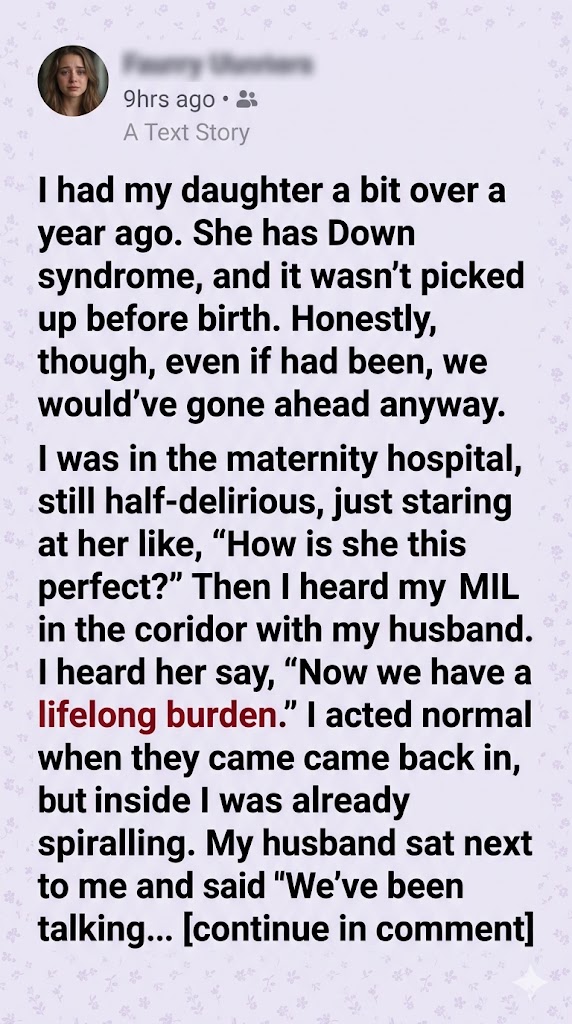
The day my daughter was born should have been the happiest day of my life. In many ways, it was. But it was also the day I learned how powerful fear can be—especially when mixed with exhaustion, hormones, and the desperate instinct to protect your child from the world.
My labor had lasted nearly twenty hours. By the time they finally placed my daughter in my arms, I was barely conscious. I remember the bright hospital lights, the steady beeping of machines, and the overwhelming feeling that nothing in my life had ever mattered before that moment.
She was tiny. Warm. Perfect.
The nurses moved quietly around the room while I stared at her little face. I remember tracing her fingers with mine and thinking, How can someone so small completely change the meaning of my life?
A doctor had already gently explained that she had Down syndrome.
The words should have shocked me more than they did. During the pregnancy, every scan had looked normal. Nothing had prepared us for this news. But as I looked at her sleeping against my chest, none of it changed what I felt.
She was still my daughter.
She was still everything.
My husband, Daniel, looked emotional too. He kissed my forehead and told me she was beautiful. For a little while, the room felt safe.
Then he stepped outside with his mother to make a few phone calls.
At first, I wasn’t even paying attention. I was drifting in and out, exhausted beyond words. But through the cracked hospital door, I heard my mother-in-law’s voice.
Soft. Serious.
“Now we have a lifelong burden.”
My entire body went cold.
I froze.
It felt like someone had poured ice water straight into my chest.
I stared down at my daughter, suddenly unable to breathe properly. My thoughts spiraled instantly.
Burden.
That was the first thing she thought when she looked at my baby?
Not beautiful. Not precious. Not loved.
A burden.
I felt tears sting my eyes, but I refused to cry. I just held my daughter tighter.
When they came back into the room, I forced a smile. I didn’t know what else to do. My mother-in-law, Karen, came over to the bed holding a cup of tea for me, smiling warmly like nothing had happened.
I could barely look at her.
Inside my head, a thousand fears were crashing into each other. Would they pity my daughter forever? Would they treat her differently? Would Daniel secretly resent this life too?
I hated myself for even thinking it—but once fear gets inside your head, it twists everything.
For illustrative purposes only
About an hour later, Daniel sat beside me on the hospital bed. He took my hand gently.
“We’ve been talking,” he said carefully, “and we think it might be easier if we move in with my parents for a few months.”
That was it.
Everything exploded inside me.
I pulled my hand away instantly.
“What!?” I snapped.
Daniel blinked in surprise. “Just until we settle into routines and appointments and—”
“So they can help manage the lifelong burden?”
The room went silent.
Karen looked genuinely confused.
“What are you talking about?” she asked.
My voice cracked as the emotions finally burst out of me.
“I heard you in the corridor! You said my baby was a lifelong burden!”
For a second nobody moved.
Daniel stared at me like he was trying to solve a puzzle. Then suddenly his expression changed.
“Oh.”
Not angry.
Not defensive.
Just… realization.
Karen’s eyes widened. Then, to my complete confusion, she started laughing.
Not cruelly.
More like someone realizing how badly a misunderstanding had spiraled.
“Oh my goodness,” she said, covering her mouth. “No, sweetheart. I said, ‘There’s plenty of space at our new house. Now we have a nice long garden.’”
I stared at her.
The silence that followed was unbearable.
I wanted the earth to crack open beneath the hospital bed and swallow me whole.
I could actually feel heat crawling up my neck and into my face.
Daniel suddenly burst into laughter too—not mocking laughter, but the relieved kind people laugh when tension finally breaks.
Meanwhile I was seconds away from dying of humiliation.
“I…” I whispered weakly. “Oh my God.”
For illustrative purposes only
Karen walked over and sat beside me carefully.
And this is the part I’ll never forget.
She didn’t get offended.
She didn’t make me feel stupid.
She simply took my hand and said softly, “Honey, you just had a baby. You’re exhausted, emotional, frightened, and trying to protect your daughter already. Nobody blames you for that.”
That was the moment I finally cried.
Not because I was embarrassed.
Because suddenly all the fear I’d been holding in came pouring out.
I admitted everything then—how terrified I was, how unprepared I felt, how scared I was that people would judge my daughter or treat her differently.
Karen cried too.
She looked directly at me and said, “That little girl is going to grow up surrounded by love. That’s what matters.”
And she meant it.
A few weeks later, we moved into their house temporarily.
What I thought would feel humiliating actually became one of the greatest gifts of my life.
Karen took night feeds so I could sleep. My father-in-law learned every medication schedule by heart. Daniel and I finally had moments to breathe between doctor appointments and therapies.
But more than that—they adored my daughter completely.
Not with pity.
Not with sadness.
With joy.
My mother-in-law planted flowers outside the nursery window because she said every little girl deserved something beautiful to wake up to. My father-in-law carried our daughter through the garden every evening, naming birds and flowers to her like she understood every word.
And honestly?
Maybe she did.
Looking back now, I still laugh at the misunderstanding. But I also understand why I heard what I feared hearing.
Because the world can be cruel sometimes.
But thankfully, not everyone is.
And my daughter? She never was a burden.
She became the heart of our entire family.
