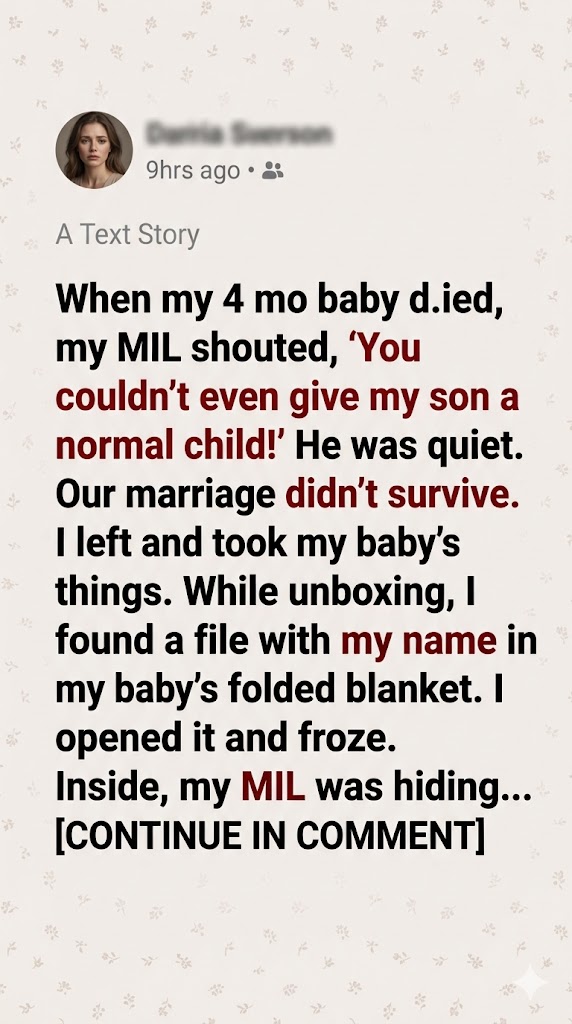
When my four-month-old baby died, my mother-in-law stood in the middle of the hospital hallway and shouted at me, her voice echoing against the walls:
“You couldn’t even give us a healthy child.”
The nurses went still. Other parents looked away. My husband didn’t.
That was the moment something inside me shattered completely.
Our son had felt like our last chance. Before him came years of heartbreak—three miscarriages, each one slowly eroding my belief in my own body. Doctors tested everything. Relatives whispered. And though my mother-in-law never said it outright, I could feel her judgment.
That I was somehow flawed.
When I finally carried a pregnancy to term, I thought it was a miracle—a final opportunity. I lived in constant fear, counting every movement, whispering promises to a baby I hadn’t even met yet.
When he was born—tiny but alive—I cried harder than I ever had before. I thought, we made it.
Four months later, I held him as his breathing faded. I memorized everything—the weight of him in my arms, the warmth slipping away, the silence that followed.
After that, everything changed.
My husband grew distant. He stopped coming home early, and when he did, he slept facing away from me. Grief pulled him away, and guilt hardened him. He never blamed me directly—but he never cleared me either.
His mother’s words were enough.
I packed my baby’s things alone. His clothes still carried his scent. I folded each one carefully, as if he might need them again. When I told my husband I was leaving, he didn’t argue. He just nodded, like he had already let go.
I moved into a small apartment across town. It was painfully quiet.
For days, I avoided everything—unopened boxes, mirrors, even my own thoughts. On the third day, I finally opened one. My baby’s blue blanket was on top—the one I used every night. My hands trembled as I picked it up.
Something slipped out and fell to the floor.
A folder.
My name was written on it.
I sat down, heart racing, and opened it. Inside was a short handwritten note:
“It wasn’t your fault. I’m sorry.”
Beneath it were medical records—genetic reports, doctor consultations I had never seen before. I read them over and over until the meaning finally sank in.
My husband carried a genetic mutation linked to a serious condition—one that could shorten a child’s life and often led to fatal complications in infancy.
It wasn’t me.
It had never been me.
For years, I had carried the blame. I believed my body had failed. All along, the truth had been hidden from me.
My husband knew.
And so did his mother.
I sat there for a long time, crying—not just from grief, but from release. Anger, relief, and betrayal all tangled together.
When I finally called her, my voice was steadier than I expected.
“I found the file.”
She didn’t deny it.
“He didn’t want you to know,” she said quietly. “He was afraid you’d leave. He convinced himself it wouldn’t happen.”
“And you let me believe it was my fault.”
There was a long pause.
“Yes,” she said. “I chose to protect my son.”
She admitted she had watched me fall apart—blaming myself, shrinking under the weight of guilt, losing pieces of who I was.
“When your baby died,” she said, her voice breaking, “I said something unforgivable. And I realized… if I stayed silent, you would destroy yourself with that guilt.”
Then she added softly, “I may have failed you. But I always knew you deserved a chance at happiness.”
“I hope you can forgive me—for not telling you sooner.”
I didn’t forgive her that day.
But something inside me shifted.
She had finally told the truth when it mattered most. In a painful, complicated way, it felt like a final act of honesty—maybe even mercy.
The truth didn’t bring my baby back. It didn’t fix my marriage.
But it freed me from a lie I had lived with for years.
Now, when I think of my son, I no longer see failure. I see a life that mattered, no matter how brief. A love that was real.
And when I think of my mother-in-law, I remember both the cruelty—and the one thing she finally gave me:
The truth.
At the worst possible moment—
but exactly when I needed it most.
