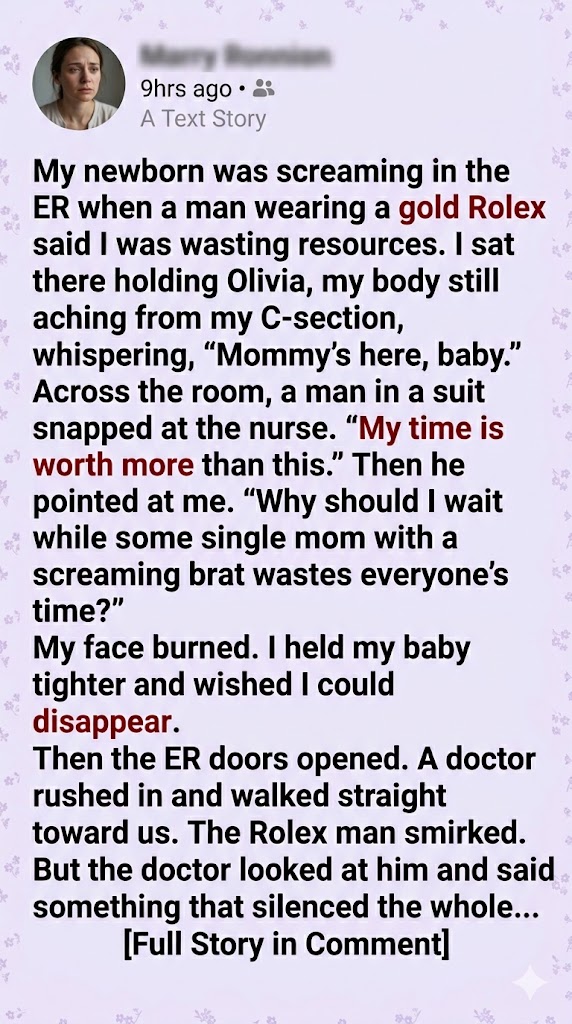
By the time I reached the emergency room, I could barely feel my own body.
My name is Martha, and three weeks earlier, I had become a mother. Not the glowing, peaceful kind of mother people show in commercials. I was the exhausted kind — the kind who wore the same sweatpants for two days, forgot meals, slept in ten-minute pieces, and cried in the bathroom so the baby would not hear.
My daughter, Olivia, was only twenty-one days old.
Tiny. Warm. Perfect.
And that night, terrifyingly sick.
Her crying had started in the afternoon. At first, I thought it was gas, then hunger, then maybe just one of those newborn storms people warned me about. But by midnight, her cries had changed. They were sharper, weaker, desperate. When I touched her forehead, heat burned against my palm.
I did not have anyone to call.
Olivia’s father disappeared the day I told him I was pregnant. My parents were gone. My friends had their own lives, their own children, their own problems. So I wrapped Olivia in a blanket, grabbed the diaper bag with shaking hands, and drove to the hospital.
The ER waiting room was bright, cold, and full of tired people.
I sat in a plastic chair with Olivia pressed against my chest, whispering the same words over and over.
“Mommy’s here. Please, baby. Mommy’s here.”
She kept crying.
I could feel people looking. Some with pity. Some with annoyance. I understood. Nobody likes listening to a baby scream at two in the morning. But what they heard as noise, I heard as fear.
Across from me sat a man in an expensive suit.
Everything about him looked polished — his shoes, his hair, the gold watch on his wrist. He kept checking the time like every minute in that waiting room personally insulted him.
Finally, he stood and snapped at the nurse behind the desk.
“How much longer are we supposed to wait?”
The nurse, whose badge said Tracy, stayed calm. “Sir, patients are seen based on urgency.”
He gave a bitter laugh and pointed directly at me.
“Urgency? You mean her? She looks like she wandered in from the street. That baby has been screaming for half an hour. Some of us have real problems.”
My face went hot.
I looked down at Olivia and kissed her damp forehead. I wanted to disappear. I wanted to defend myself. I wanted to scream that I had not slept, that my stitches still hurt, that I was scared my baby might stop crying because she was too weak to continue.
But I was too tired to fight.
The man kept going.
“This is what’s wrong with the system,” he said loudly. “People like me pay for everything, and people like her waste resources.”
The room went quiet.
A teenage boy nearby stared at the floor. An older woman shook her head but said nothing. Tracy’s jaw tightened, but she remained professional.
Something inside me finally cracked.
I lifted my eyes to the man.
“I didn’t come here for attention,” I said, my voice low. “I came because my newborn has a fever, and I’m terrified. But thank you for proving that money can buy a watch, not compassion.”
His mouth opened.
Before he could answer, the ER doors swung open.
A doctor in blue scrubs stepped into the waiting room, scanning faces quickly.
“Three-week-old with fever?” he called.
I stood so fast I almost dropped the diaper bag.
“That’s us.”
The doctor came straight toward me. “Come with me.”
The man in the suit exploded.
“Excuse me! I’ve been waiting over an hour. I said I had chest pain.”
The doctor stopped and turned.
“You walked in talking, breathing normally, and yelling at my nurse,” he said evenly. “This infant is three weeks old with a fever. In a newborn, that can become dangerous very quickly. She goes first.”
The man’s face reddened. “Do you know who I am?”
The doctor did not blink.
“No. But I know who she is. She is a patient. So is her baby. And in this hospital, your income does not decide your place in line.”
The waiting room went silent.
Then someone clapped.
One clap became two. Then five. Soon, half the room was applauding while the man stood there, humiliated and speechless.
Tracy gave me a small nod. “Go, honey.”
In the exam room, the doctor checked Olivia carefully. He asked questions, listened to her breathing, measured her temperature, and watched her with the seriousness I had been begging the world to show.
After what felt like forever, he looked at me gently.
“She’s stable,” he said. “It appears to be a viral infection, but you were right to bring her in. With babies this young, fever is never something to ignore.”
I started crying so hard I could barely breathe.
Not because everything was suddenly easy.
Because someone had finally told me I was not overreacting. I was not wasting space. I was not a burden.
I was a mother trying to keep her child alive.
Before we left, Tracy handed me a bottle of water and a small pack of crackers.
“You’re doing better than you think,” she said.
I carried Olivia out just before sunrise. The man in the Rolex was gone, but I no longer cared.
His cruelty had filled the room for a moment.
But the doctor’s truth lasted longer.
My baby mattered.
And so did I.
