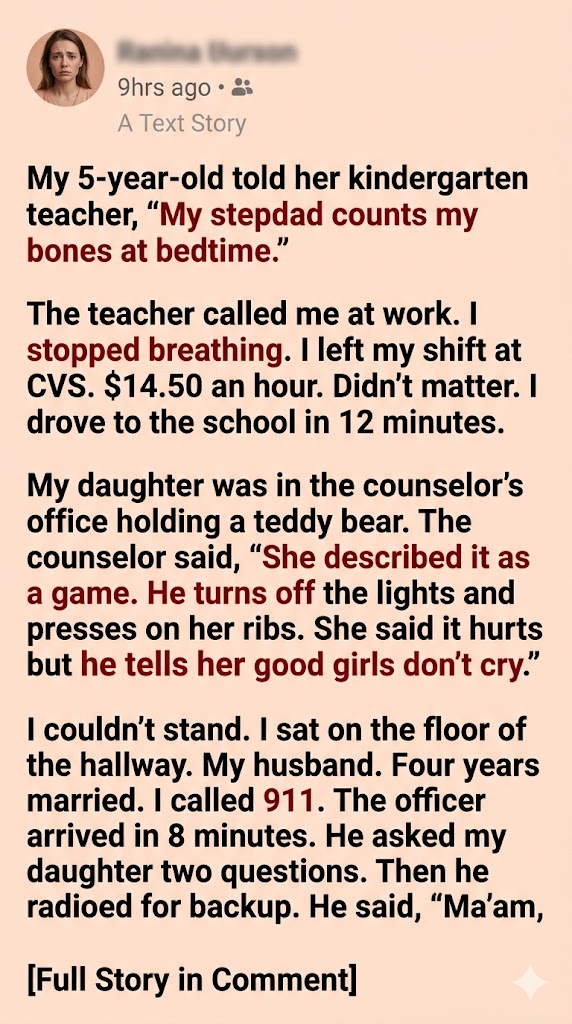
The officer lowered his voice.
Then he said:
“Ma’am, based on what your daughter described, your husband has been medically examining her.”
I blinked.
“What?”
Nothing made sense.
The counselor looked as confused as I felt.
The officer immediately clarified.
“Not necessarily abusing her. But we need to understand exactly what’s happening.”
My knees nearly gave out.
Because for ten horrifying minutes, my mind had gone to the darkest place imaginable.
Then the officer crouched beside my daughter.
“Sweetheart, can you show me where he counts your bones?”
She nodded.
And pointed to her ribs.
Then her collarbone.
Then her shoulders.
Nothing else.
The officer asked:
“Does he touch you anywhere your swimsuit covers?”
She frowned.
“No.”
“Does he ask you to keep it a secret?”
“No.”
“Why does he count your bones?”
My daughter shrugged.
“Because he worries.”
The officer exchanged a glance with the counselor.
Then asked one more question.
“What does he say when he counts them?”
My daughter answered immediately.
“He says we’re getting stronger.”
My heart stopped.
Because suddenly something clicked.
Three years earlier, my daughter had been diagnosed with a rare digestive disorder.
For nearly a year she couldn’t keep food down.
She lost weight dangerously fast.
There were weeks when every rib showed.
Weeks when doctors worried about malnutrition.
My husband had been there through all of it.
Every hospital stay.
Every specialist.
Every sleepless night.
Then I remembered something.
During recovery, he’d developed a strange habit.
At bedtime, he’d gently feel her ribs and tell her how much healthier she was getting.
How much stronger she felt.
How proud he was.
The “counting bones” game.
A game that made perfect sense to a five-year-old.
And sounded absolutely terrifying to everyone else.
The officer still did exactly what he was supposed to do.
A full investigation.
Interviews.
Medical evaluations.
Everything.
Because when a child says something alarming, adults must take it seriously.
Always.
For three days our lives were upside down.
Then the investigation concluded.
No abuse.
No inappropriate behavior.
No criminal conduct.
Just an unfortunate misunderstanding described through the eyes of a kindergartener.
When my husband learned what happened, he didn’t get angry.
He cried.
Not because he was offended.
Because he realized how easily a child can describe something in a way adults interpret differently.
A week later, the counselor invited us back.
Mostly to apologize.
But my husband stopped her.
“Don’t.”
She looked surprised.
Then he smiled.
“You did exactly what you were supposed to do.”
The officer had done his job.
The teacher had done her job.
The counselor had done her job.
And honestly?
As terrifying as those three days were, I’d rather live in a world where people investigate concerns than one where they ignore them.
That night at bedtime, my husband sat beside our daughter.
She looked worried.
“Are you mad at me?”
His face immediately softened.
“Never.”
Then she asked:
“Can we still play the bone game?”
He laughed.
Then shook his head.
“Nope.”
She frowned.
“Why?”
He smiled.
“Because from now on, we’re calling it the superhero strength check.”
My daughter grinned.
And for the first time all week, so did I.
Sometimes children tell the truth.
Sometimes they tell the truth in a way adults don’t understand.
And sometimes a terrifying misunderstanding becomes a reminder of why listening carefully—to both children and facts—matters so much. ❤️
