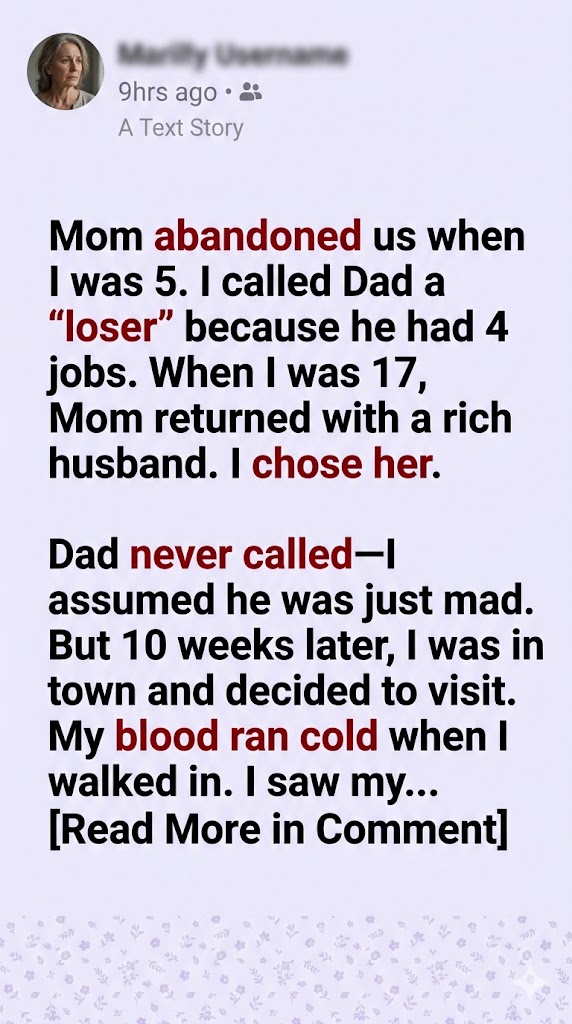
I was just five years old when my mother left us. I still remember standing at the window, hoping she would turn back. She never did. From that moment on, it was only my father and me.
My dad worked himself to the bone. He held multiple jobs, left before dawn, and came home long after I was asleep. His clothes were always worn, his hands rough, and fatigue seemed permanently carved into his face. Yet no matter how hard life became, he never let me go without food, clothes, or a packed lunch for school.
Still, we struggled constantly.
Money was tight, the fridge was often bare, and my clothes came secondhand. I watched other kids enjoy things I could only wish for, and over time, embarrassment turned into anger.
But instead of blaming the parent who left, I blamed the one who stayed.
As I grew older, that resentment deepened. By my teenage years, I said things I can never undo. I called my father a failure. I told him that if he worked so hard yet we were still poor, then he must not be good enough.
And the most painful part was that he never argued back.
He never raised his voice.
He never defended himself.
He just took it in silence. Back then, I mistook that silence for weakness. I didn’t realize it was strength.
When I was seventeen, my mother came back unexpectedly.
She arrived in a luxury car, dressed elegantly, speaking confidently about her new life, her wealthy husband, and everything she had achieved. There were no apologies and no explanations.
And still, I was drawn to her world.
After years of hardship, her life looked like everything I thought I had been missing. So when she asked me to come with her, I agreed immediately.
I packed my things and left.
My father stood quietly in the doorway of our small home. He didn’t stop me or beg me to stay. He simply hugged me and told me that if leaving was what I wanted, then I should go.
I ignored the sadness in his eyes.
Looking back, I think I already knew I was making a mistake—but pride pushed me forward anyway.
At first, life with my mother seemed perfect. The house was beautiful, the comfort unfamiliar, and the financial stress I had grown up with was gone.
But something didn’t feel right.
Everything felt conditional. Warmth came with distance, kindness felt temporary, and nothing compared to the steady sense of safety I once had with my father.
Weeks later, I returned to my hometown to see old friends and drove past my childhood house.
What I found stopped me cold.
The home looked abandoned—an overgrown yard, empty windows, and a lifeless porch. Inside, it was even worse.
The furniture was gone.
The photos were gone.
Even my father’s old chair had disappeared.
It no longer felt like a home. It felt like a life that had been erased.
A neighbor later told me the truth.
Only days after I left, my father had been in a severe car accident. The injuries were serious, and without proper insurance, he had to sell almost everything to pay for treatment and survive.
And then I heard something that broke me completely.
Even after everything.
Even after I had walked away.
He still asked about me.
He still hoped I would visit.
I rushed to the hospital immediately.
When I saw him, I barely recognized him. He looked fragile, exhausted, and worn down by everything he had endured.
And suddenly, every harsh word I had ever said came rushing back to me.
Every insult.
Every accusation.
Every moment I failed to appreciate him.
I broke down at his bedside and begged for forgiveness—for leaving, for choosing my mother, for not seeing his sacrifices sooner.
Then he opened his eyes.
And he smiled.
Not with anger.
Not with disappointment.
But with love.
He told me quietly that he always believed I would come back, because he trusted the child he had raised.
That moment changed everything.
I finally understood that real love isn’t measured by comfort or appearances—it’s measured by sacrifice, patience, and unwavering care.
That night, I called my mother and asked for help. Her answer was simple: if I chose my father, I was no longer part of her life.
And for the first time, everything became clear.
One parent loved me when it suited her.
The other loved me without conditions.
I stayed with my father through his recovery. I worked, cared for him, and stayed by his side through every difficult step.
Slowly, he healed.
And as I watched him recover, I finally understood the truth of everything he had carried alone for years—the exhaustion, the worry, the sacrifice, and the quiet strength it took to raise me.
He had given up his comfort, his health, and his dreams so I could have a chance at life.
And even after everything I put him through, he never stopped loving me.
That is what real love looks like.
And it’s a lesson I will never forget.
